

BUTTER AND CHEESE MAKING
Butter and cheesemaking on a large scale
took place at Pericoe Station managed by
John Alexander and his family - six sons,
seven daughters. John's wife was formerly
a Miss Smith, of Pambula. Sons were Ted,
who left early in the piece to go to Queensland,
Robert ("Bo") who ran the "Hayfield"
farm, Sydney, ran the "Bonnie Doon"
property, Percy, ran the "One Mile",
Eden had "Fairview", and Alf had
the "home" dairy. Daughters were;
Sarah, Annie, Mamie, Barbara, Ada, Dot and
Queenie.
Most of the old-timers from Towamba and
Pericoe have passed away but the old butter
factory in the house yard at Pericoe has
stood up to the elements these may years.
The iron brands for branding the words "Pericoe
Creamery" on butter kegs were there
with the wooden churn and the cream vats.
The circular butter pressing table bore testimony
to their use and the big separator had a
pulley on it for attachment of belts to the
wood-fired boiler engine which was anchored
to a huge block of wood.
Excerpt from "Hoof Beats & Whip
Cracks from the Past" by Wilfred Ingram
1981
The Bega Budget (NSW : 1905 - 1920)
Wed 14 Oct 1908
TOWAMBA.
Towamba, at present, presents a pleasing
appearance, everywhere being clothed in a
mantle, of lovely green. Farmers are busy
with the plough, and dairymen are beginning
to smile once again. Some of our farmers
are fighting great battles with bunny. Mr.
Alex Binnie, of Log Farm, is fighting him
for all he is worth, and has just wire-netted
about 60 acres of his cultivated land to
cope with the pest. During a visit to Mr.
Binnie's place, I was shown some fine samples
of ensilage made from green maize. These
are preserved in large jars, and have the
natural appearance of the growing maize.
The crop was sown in 1905, cut and stacked
in1906, and opened last year. Besides having
stacks of this fodder, Mr. Binnie also grows
large quantities of mangold.
The Jersey herd on this farm is looking
in prime condition, and the milk yield is
far ahead of a number of dairies here, as
the cows milked, number twice as many as
any other.
'The Southern Record and Advertiser '
6 Feb 1926
Towamba Butter Factory Closed.
At a meeting of shareholders of the Towamba
Co-operative Creamery Company, Ltd., held
at Towamba on Saturday, 23rd January, it
was definitely decided that the factory be
closed. Mr. R. Alexander, chairman of directors,
presided.
The chairman explained the result of an interview
by himself and co-directors with the directors
and manager of Pambula factory respecting
the conditions under which Towamba
and Burragate suppliers' cream could be conveyed
to and treated at the Pambula factory. As,
however, some of the Pambula directors and
manager had come prepared to give the information,
he suggested that they be invited to attend
the meeting and state what they were prepared
to do.
The course suggested by the Chairman was
adopted.
'Magnet'
May 16, 1936
PIONEER DAIRYMAN, 60 YEARS SUCCESS
(Mr. William Watson, president of the Bega
District Council of the P.P.U. and president
of Pambula Branch. Speaking at the Agricultural
Bureau Conference at Pambula.)
(Excerpt from above article)
" In the year 1883 I left the Illawarra
and came south to the Towamba district, still
on the South Coast. I arrived on November
20, and the district was a sheet of white
clover from end to end. There were no rabbits
of that time, the country had not long been
ring barked and appeared to be in a hurry
to produce large quantities of rich pasture.
I went to work on a dairy farm and it was
quite a prosperous proposition. At that period,
dairying on the highlands at Towamba was
definitely a success; the cows milked remarkable
well. On all the dairy farms there was a
good class of shorthorn, the progeny of the
Illawarra brought by those who migrated south.
The quantity of butter made in Towamba, Pericoe
and Burragate was very large. What is it
today? Rabbits and other causes are blamed
for the drop but I think quite a lot of that
country could be brought back to its former
high productive state by fertilizing and
by rabbit extermination. There are, of course,
quite a few alluvial farms rich and productive
in the Towamba Valley. In the early days
they grew maize for pig production but today
some of them are very prosperous dairies.
Does anyone stop to think of the very exalted
position the primary producers, which includes
dairy farmers, occupy? They are builders
of a nation. Their names are not written
on marble or on stone but are forever written
in the conquest of the soil."
October 28, 1882
'The Australasian'
* Bega, N.S.W., has been rendered famous
as a dairying district, not only by its natural
adaptability for that industry, but by the
prominence given to it in our late International
Exhibition through the exhibits of Mr. James
Manning. We notice in our advertisement columns
an announcement of an intended sale of dairy
farms, a subdivision of the famous Towamba
Fattening Farm, the property of Messrs. Manning
and Stiles. The areas range from 200 to nearly
600 acres.
'The Bega Gazette and Eden District or Southern
Coast Advertiser'
11 February 1885
The Eden Correspondent of the Bombala Herald
says:-" Mr. Surveyor Dyer is busy at
Eden with the permanent survey, but the start
is the most difficult part, as grades have
to be taken in various places to the nearest
deep water. A few years ago Towamba was hardly
known outside its own little surroundings,
butter could not be bought, and very few
milked more than two or three cows for their
own use-now kegs of butter roll in for the
Sydney market, and from two factories I saw
some very good cheese, some 60 in number,
bearing Perico and Perico Park brands respectively,
being shipped by the I. S. N. Co's boat Kameruka.
All the Marino wool has not yet been shipped
as some came down on Saturday. What with
work on wharf and railway, Eden will soon
not know itself, for having lain dormant
for so many years, the residents have got
into a jog trot way which it will be very
hard to break themselves of, and they will
have either to better themselves of, or go
to the wall. I am just informed that the
terminus will be close to the present wharf,
and that the station for shunting engines
&c., will be near Mr. Keon's house; the
line from thence will bear in a N.W. direction
till it joins Mr. Robinson's survey. Mr.
Dyer hopes to make the line in 38 miles to
Bega, with one ¼-mile tunnel.
Pambula Voice' October 20, 1893
TOWAMBA
* There is a luxuriant spring in the grass
here which causes dairymen to look cheerfully.
A better season could not be wished for.
Roads are not in the best of order and in
the absence of maintenance men, are not likely
to improve. A few days' rain would render
most of the roads quite impassible.
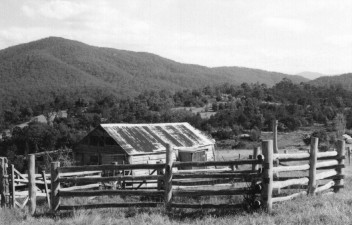 |
| Old shed and yards. 'Rockleigh' Burragate Photo K.Clery |
'The Shoalhaven Telegraph'
15 August 1894
The Towamba correspondent of the CANDELO
AND EDEN UNION writes that it is rumoured
a movement is on foot to ask the Bega electorate
to co-operate with Towamba and surrounding
districts to ask the I. S. N. Co. (or some
other steamship company) to provide cool
chambers for the transit of butter and other
produce to the metropolis, thus enabling
the farmers of that district to compete successfully
with other dairying centres.
'Pambula Voice' February 9, 1894.
PERICOE
Mr. John Alexander of Pericoe milks two hundred
and thirty cows on two dairies and has sent
to Sydney the last two weeks, thirteen and
fourteen hundred weight (cwt) of butter respectively.
Mr. Alexander has the capacity for five hundred
cows on the two dairies and he hopes by next
year to have an increase on the present herd.
Several cases of sickness are reported. Dr.
Meeke was summoned last week to attend Mrs.
Gower who was seriously ill. The infant child
of Mr. W. Watson was taken with convulsions
the other day and for a time its life was
despaired of but it has come round again
and is keeping better.
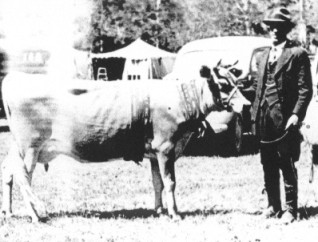 |
| LES MITCHELL WITH 'MARUA DREAMING COUNTESS' 2ND GRAND DAM OF TOWAMBA ROYAL KING. C. 1930's. Possibly Burragate Show. Photo courtesy M. Mitchell |
Aug 10, 1894
Burragate
* Another meeting was held last Friday to
try to form a Co-op Dairy....
Aug 30, 1895
Burragate
* Owing to scarcity of fodder, etc. during
the winter the Butter Factory which has been
established here is not opened yet. However,
everything is being put in readiness to start
when the spring has properly set in, and
we hope to hear her first whistle before
very long.
Jan 10, 1896
Wyndham
* Dairying in the district is at a standstill
owing to the prolonged drought - severest
for some 23 years.
'Pambula Voice' January 21, 1898
WYNDHAM
* Mr. J. T. Horne who has been managing a
dairy of Mr. Morehead's at Wog Wog for some
years is about to take his departure from
district.
'Pambula Voice' May 6, 1898
ROCKY HALL
* Rather a novel scheme has been promulgated
by one of the suppliers to the local butter
factory and that is the proposal to run a
store on co-operative principals. The project
has already met with the favourable consideration
of a number of suppliers.
'Pambula Voice' June 17, 1898
ROCKY HALL
The directors of the Rocky Hall Dairy Company
who recently decided to run a co-operative
store in connection with the factory have
received their first shipment of goods. This
new departure on the part of the company
promises to be a big success and will undoubtedly
prove a great boon to suppliers.
'Pambula Voice' July 1, 1898
BURRAGATE
* The Burragate Co-operative Dairy Co., are
endeavouring to get sufficient shares taken
up to warrant them building a central creamery
in Burragate with a refrigerating plant.
This is a step in the right direction as
Burragate is so centrally situated.
'Pambula Voice' August 25, 1899
* Burragate Dairy Co. Ltd - Tenders invited
for erection of Co.'s cheese factory at Burragate,
E. H. Scott, secretary.
'Pambula Voice' September 15, 1899
* Messrs Waterson and Moore successful tenderers
for Burragate cheese factory.
'Pambula Voice' November 17, 1899
At Burragate last week, the employees on
the "Lyndhurst" Estate met together
for the purpose of making a presentation
to Mr J. H. Martin JP, who is about to retire
from the management of "Lyndhurst"
and take up his permanent abode in Pambula.
The present, which was accompanied by good
wishes for Mr and Mrs Martin's future welfare
and happiness, consisted of a handsome watch
pendant in the form of a silver match-box
inlaid with gold, and inscribed with the
initials of the recipient. Mr Martin has
been in charge of "Lyndhurst" for
10 years and was much esteemed by the employees
of the estate, who learned of his departure
with sincere regret.
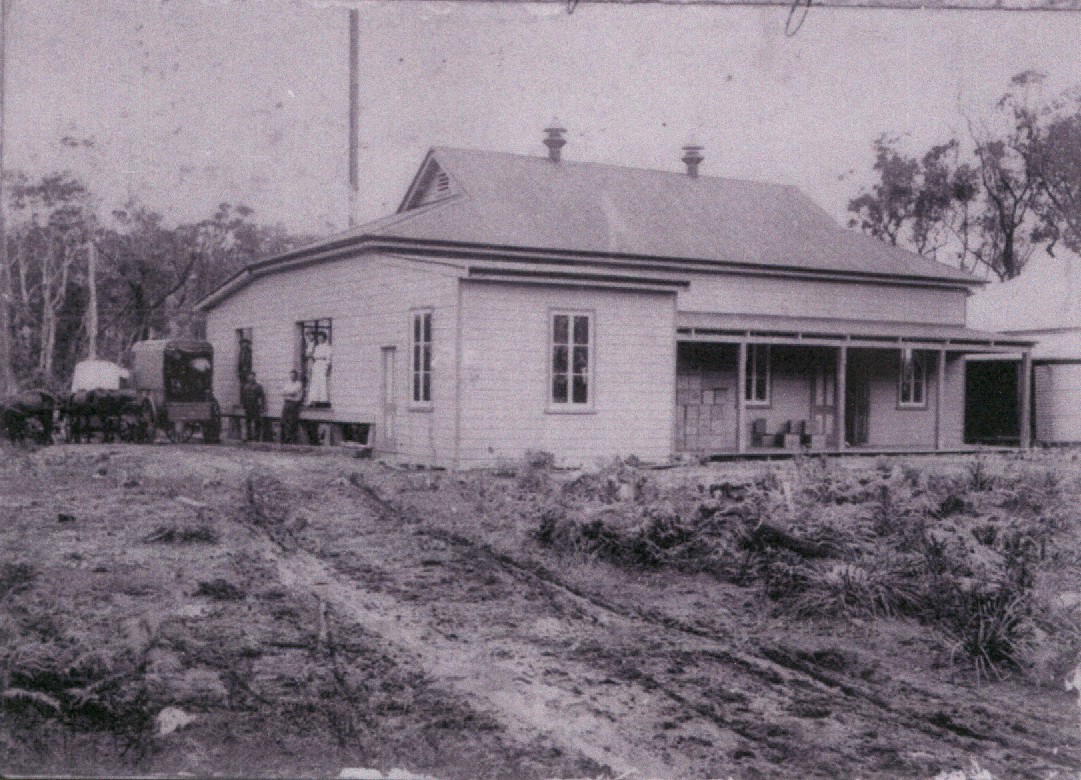 |
| Lyndhurst Butter Factory No date |
'Pambula Voice' January 12, 1900
* Inquiry into the cause of the fire at "Lyndhurst"
factory, Burragate, was to take place yesterday.
* Dry spell affecting dairying industry -
Wyndham.
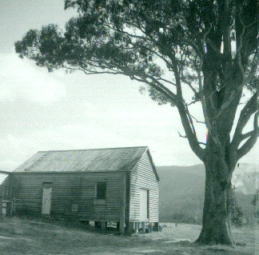 |
 |
|
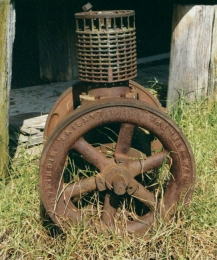
| Part of the old Burragate Butter Factory 'Lyndhurst', Burragate. Photo K.Clery |
Machinery. Burragate Butter Factory Photo K.Clery |
Mar 23, 1900
* Mr. Robinson, Inspector under the Dairies
Supervision Act, is at present engaged in
visiting all the dairies in the Pambula District.
'Pambula Voice' October 17, 1902
* The well-known 'Lyndhurst' estate, Burragate,
is to be offered for sale at Wyndham on the
25th inst. by Messrs D. Grant and Co.
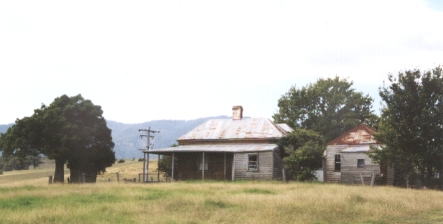 |
| 'Lyndhurst' Burragate. Photo K.Clery |
| Advertisement Important auction sale, 1787 acres splendid dairy land known as the Lyndhurst Estate, Burragate, at Wyndham. Sat. 25 Oct 1902. By order of the mortgagee. D. Grant and Co. have been favoured with instructions from the mortgagees to submit to public auction on Sat. 25th Oct. 1902 at 2 o'clock pm, at the Robbie Burns Hotel, Wyndham, Mr John Henry Martin's property adjoining the village of Burragate, known as Lyndhurst estate, comprising 546 a 1 r freehold, 1121 a 1r conditional purchase land and 120 acres conditional lease. Terms 1/4 cash; balance in four years, bearing interest at 5% payable half yearly. |
'Pambula Voice' October 31, 1902
* No offer was made at the sale at Wyndham
on Sat. for the purchase of the Lyndhurst
estate, Burragate.
'Pambula Voice' July 3, 1903
* Mr Michael Behl has disposed of his farm
at Nethercote to Mr R. A. Gordon of Mt Pleasant,
Pericoe.
'Pambula Voice' July 17, 1903
* The well-known "Lyndhurst" Estate,
Burragate, was offered for sale by auction
at Wyndham on Saturday by Messrs D. Grant
and Co., but no purchaser was found.
'Pambula Voice' August 14, 1903
* Tenders invited for the lease of the "Lyndhurst"
Estate, Burragate. JAS Bank, Pambula.
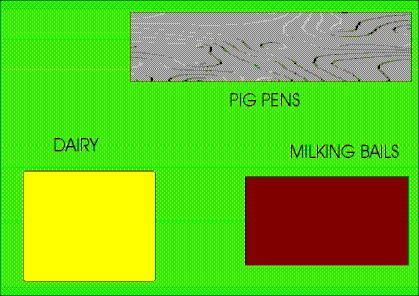
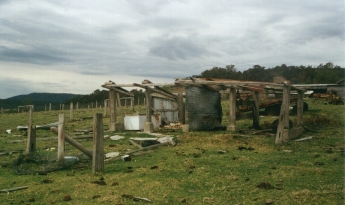
DAIRY YARD SETUP BEFORE THE INTRODUCTION OF MILKING MACHINES
 |
|
Before milking machines were used in dairies
in the Towamba district the cows were milked
by hand in the bails. The bails were in a
separate building which had sectioned off
areas with wooden rails separating each cow.
The cows stood in these sections (bails)
taking fodder in at one end while milk was
extracted at the other. The buckets of milk
were then carried over to the dairy shed
where the milk was put through the hand operated
separator and the cream put into cream cans
ready to be picked up and taken to the butter
factory. The separated milk was then fed
to the calfs and pigs. |
 |
 |
||
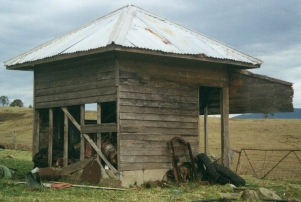
| Old dairy used in hand milking days. 'Oakleigh', Towamba. Photo K.Clery |
Remains of the milking bales in the days of hand milking. 'Oakleigh', Towamba Photo K.Clery |
||
'The Sydney Morning Herald'
March 14, 1904
PAMBULA.
* The Pambula A. H. and P. Society, after
paying prize-money and all expenses in connection
with the late show, will have a credit balance
of about £40 towards the liquidation of the
overdraft (now between £70 and £80). The
directors of the Burragate Co-oporative Dairy
Company have decided to remove the central
factory from Burragate to Towamba, with creameries
at Burragate and Pericoe, on the strength
of the support which has been promised by
dairymen in the Towamba-Pericoe district.
'Pambula Voice' September 9, 1904
* There is a marked increase in the cream
supply at the local (Pambula) factory, but
it is partly due to the arrival of a quantity
from Burragate which is being sent here pending
the completion of the new central factory
at Towamba.
'Pambula Voice' September 23, 1904
* New (butter) factory at Towamba completed.
October 7, 1904
'The Sydney Morning Herald'
* The new co-oporative dairy factory at Towamba
was formally opened on Saturday last.
February 10, 1906
'Southern Star'
* Mr. Harry Duncan, junr., is going to Lower
Towamba to manage a dairy for Mr. Binnie.
April 13, 1906
'The Sydney Morning Herald'
DAIRYING.
* During March the Pambula Co-operative Dairy
Company manufactured 24,8171b of butter,
which realised £1022 gross. The working expenses
averaged 1.17d per lb, and sinking fund .08d
per lb. Suppliers were paid at the rate of
88d per lb net.
For the same period the Towamba Central Creamery
Company manufactured 12,6491b of butter,
which realised the sum of £528 Is Id, suppliers
being paid 81/4 pence per lb net. The prospects
for a good winter are very encouraging.
November 26, 1910
'The Sydney Morning Herald'
BUTTER FACTORIES.
* For the month of October the Towamba Dairy
Company manufactured 64551b of butter, which
realised £290. The expenses and sinking funds
totalled £48. Suppliers were is paid £242
net.
 |
| View looking east of Towamba-Eden Road. Arnold's
house in foreground, Slattery's farm, 'Limerick Vale' on left, Towamba Butter Factory in centre and manager's house last on right. |
'The Farmer and Settler'
27 May 1919
TOWAMBA.
* During April the output of the Towamba
butter factory was 5277 lb of butter, the
value of which to the supplier was £406,
or at the rate of 1/6½ per lb.
May 23, 1923
'Southern Star'
* Towamba Butter Factory is to be kept going,
although the cream supply amounts only to
about 1 cwt per week.
'The Southern Record and Advertiser'
6 February 1926
Towamba Butter Factory Closed.
At a meeting of shareholders of the Towamba
Co-operative Creamery Company, Ltd., held
at Towamba on Saturday, 23rd January, it
was definitely decided that the factory be
closed. Mr. R. Alexander, chairman of directors,
presided.
The chairman explained the result of an interview
by himself and co directors with the directors
and manager of Pambula factory respecting
the conditions under which Towamba and Burragate
suppliers' cream could be conveyed to and
treated at the Pambula factory. As, however,
some of the Pambula directors and manager
had come prepared to give the information,
he suggested that they be invited to attend
the meeting and state what they were prepared
to do. The course suggested by the Chairman
was adopted. Mr. Dare, Pambula factory manager,
said that, with regard to the carting of
cream, the Rocky hall people paid 2/3 per
10-gallon can, 2/ per 8-gallon can, and 1/3
per small can; Cathcart paid 8/-, 2/-, and
1/9 respectively. The same rates as Cathcart
people would obtain at Towamba, so far as
he knew. The cost of manufacture ran out
at about 2½d, sometimes under, sometimes
over. But with their modern appliances they
had an over run of anything from 3 to 4 and
sometimes 5 per cent. Mr. Ryan asked was
it possible to get an overrun of that sort
with the Towamba factory churn. Mr Dare said
that at Pambula, before the long churn was
obtained, the overrun was 1 percent , but
since they had their modern churn their overrun
had increased to 3, to 4, and up to as high
as 5 per cent., giving in the first twelve
months a return of £1380. At Wolumla, with
the modern churn, the overrun had increased
from 1 to 4 per cent. Pambula Coy. had supplied
the greater part of the butter used on the
Monaro during the last two years. The directors
had, however, decided to become parties to
the Paterson agreement, under which 1½d per
lb. levy was made and sent to the Commissioner,
Sydney, and used to pay a 3d per lb. bounty
to the men who exported. The man with a local
trade was doing better than the exporter,
and this scheme evened things up. Under this
agreement all would get the one price, according
to the grade. The directors realised that
they would be sacrificing £10,000 worth of
local trade but that would have its compensation,
and by exporting they were helping to provide
the price for producers. The price, instead
of coming back from 141/ to 120/, was now
172/ about. 1 /6½d per lb. Every factory
was losing local trade, but was getting a
higher price through the general uplift.
The main essential was to have a modern factory
and modern appliances. Pambula directors
did not want to break down Towamba factory.
Rather they would see it built up, if that
could be done. The Government Department
advised concentration and it looked as if,
with modern transport, cream could be carried
any distance. At Panbula 95 percent of the
cream arrived in good condition. The gains
from overrun helped appreciably to pay the
cost of cartage. The Paterson scheme was
working well and looked like being a huge
success. Mr. Walter Godfrey described in
detail the transport service carried on by
him under agreement with the Pambula Dairy
Co. He said that the cartage rate from Towamba
to Pambula would be the same as from Cathcart
to Pambula. Mr H. J. Ryan suggested a uniform
rate applicable to Towamba and Burragate
alike. After further discussion and explanation,
it was resolved that, in the event of Towamba
factory being closed and suppliers sending
their cream to Pambula, Pambula directors
be asked to fix a uniform cream cartage rate
for Towamba and Burragate suppliers. Mr.
Godfrey said that if suppliers decided to
send their cream by his service to Pambula
and would give a reasonable guarantee of
back loading, he would maintain a regular
motor lorry service and make a uniform cream
cartage rate for Towamba and Burragate, of
2/9, 2/- and 1/6 for the three sizes of cans.
The charge for back loading from Eden would
be 30/- per ton. - 'Magnet.'
'Pambula Voice' September 23, 1927
Pambula Dairy Co-operative half yearly meeting.
Between sixty and seventy shareholders were
present. The Chairman stated that output
compares unfavourably with the previous half
year but when one reviews the season passed
and still passing through, it would not be
out of place to say we have done remarkably
well. Suppliers were from Rocky Hall, Towamba
and Cathcart. The quantity of butter exported
for the period under review was 1,090 boxes
which is a very small proportion and goes
to show that the quality of butter is up
to standard and suitable for both NSW, Australia
and the London market. The Board of Directors
decided that the cost of transport was too
high and consequently purchased one Thornycroft
and one A.E.C. motor lorry. They have also
purchased the goodwill of the Merimbula Supply
Co., together with their latest lorry, at
a very satisfactory figure. The question
of a new factory and finance has not been
lost sight of and with that object in view
an extraordinary general meeting will be
held to authorise the Directors to make a
levy which is the usual custom nowadays in
financing such Butter Factory problems and
as a large quantity of machinery has been
installed the question of bank overdraft
will also need attention. Mr. George Hart
said he would like to see the cost of carrying
the cream from each centre. He considered
that they would drop the long distance supplier,
such as Cathcart, Rocky Hall, Towamba and
even some at Nethercote.
'Magnet' September 20, 1930
DAIRYING
HAND VERSUS MACHINE MILKING - INTERESTING
DEBATE
Few subjects of moment to farmers escape
the attention of the New South Wales Agricultural
Bureau Conference which takes place annually
at Hawksbury Agricultural College and among
the many matters discussed at this year's
gathering was the question of hand versus
machine milking. Both methods had their advocates,
the pros and cons being presented in the
form of an organised debate. A team representing
the Singleton Sub-district Council of the
Bureau affirming that machine milking was
superior to hand milking and one representative
of the Illawarra Sub-district Council taking
the opposite view.
Mr. A. S. Pankhurst (leader of the Singleton
team) likened the opposition to milking machines
to that which opposed any other improved
method. He advanced three main points in
favour of machines:
1. They solved the labour problem on the
dairy farm in that nine men could be found
to take a job on a farm where machines were
installed to every one offering of work where
hand milking was the system - the machines
did away with the drudgery.
2. The machines were more sanitary; dust,
etc., could not be prevented from getting
into the buckets when hand milking.
3. The cows were more tolerant to machines
than to hand milkers. This, he believed,
was due to the fact that the machines more
nearly imitated the sucking action of the
calf.
Mr. R. H. Hudson (leader of the Illawarra
team) said that his chief aversion to milking
machines was because the heavy initial cost
( about £200) running expenses, and
upkeep. Moreover, machines were difficult
to sterilize and if this were not done thoroughly
they would spread contaminants, contagious
mammitis and perhaps other diseases. It was
extremely hard to get paid labour to work
machines efficiently and although, perhaps
in theory, "machine" milk was purer
than "hand" milk, in practice the
opposite was the case. Moreover, in the "off
" season when the machines had to be
hung up because it would not pay to run them,
depreciation went on just the same.
Mr. F. J. Pankhurst (Singleton) admitted
that upkeep etc., on a machine would run
to £1 per week but as an offset to
that, one man with a machine could do the
work of three hand milkers. As far as cleanliness
was concerned, bacteriological tests had
proved conclusively that machine milk was
much purer.
Mr. O. Guthrie (Illawarra) claimed that most
second grade cream in his district came from
machine milk. He had installed machines but
found that unless he attended to them personally,
there was always some trouble. He could not
entrust the ordinary farm hand with the care
of the machines and consequently, had to
get rid of them.
Mr. W. W. Waddell (Singleton) contended that
as the machines were much quicker the cows
spent more time in the pastures and less
in the yards. In New Zealand where ninety
percent of the herds were milked by machine
the quality of butter was superior to that
made in New South Wales.
Mr.Lindsay Evans (Illawarra) said that the
best pure bred herds in the State were seldom
milked by machines and that the unreliability
of the machines was against their use.
The Chief Dairy Instructor of the Department
who acted as adjudicator declared in favour
of the Singleton team.
PERICOE
'Magnet' August 8, 1931
* Mr. F. McPaul renovating his dairy. Dairying
once more popular here.
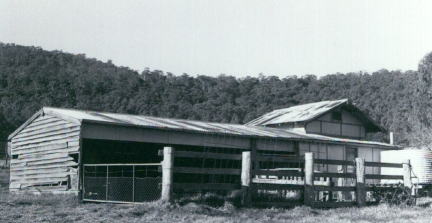 |
| Later style dairy at 'Model Farm' Towamba Photo K.Clery |
'Magnet' October 3, 1931
* Alex Law dairying at Nungatta.
KIAH
* Good rain has fallen locally in consequence
whereof crops are doing well and dairies
are flourishing. Messers R. J. Goward and
H. S. Harris are getting their herds tested
and some very good results have so far been
recorded. Test of one cow in particular has
only been equalled by that of a cow near
Pambula.
* Extension of the cream producing industry
is proceeding. Two more dairies are to be
in readiness to begin by New Year's Day.
This will make eight at Kiah River and that
number will be materially added to with the
extension of our riverside development road.
'Magnet' January 23, 1932
* Dairy men have had to make big outlays
this previous year. Paid high prices for
their herds, erecting new dairies, buying
new separators, cans, buckets, etc., Now
driest season for years and a low price for
their butter.
'Magnet' February 13, 1932
* Mr. H. Rolfe taken over the working of
Mr. A. B. Alexander's 'Hayfield' in succession
to Mr. L. Nicholson. The dairy is now in
full swing.
* Mr. McPaul recently recommenced dairying
at Pericoe.
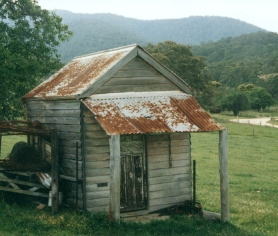 |
| Cream shed. 'Limerick Vale' Towamba. Photo K.Clery |
'Magnet' April 2, 1932
* Mr. Walker and family who have been working
Mr. F. McPaul's dairy, are about to leave,
and their place is to be taken by Mr. Edwin
Love of Lower Towamba.
* Mr. George Arnold, who has for many years
worked Mr. A. E. Alexander's dairy, will
shortly retire from this work and a Mr. A.
Tasker of Pericoe has been selected to fill
the vacancy.
'Magnet' September 1, 1934
We understand that despite a clause in the
Dairy Act which says that no structural alterations
shall be ordered where a dairy is producing
choicest cream, police in some centres at
least have been instructed that no dairy
within thirty feet of the cream room is to
be registered in future. Bimbaya P.P.U. (Primary
Producers Union) Branch has entered a strong
protest and dairy men generally contend that
commonsense, not cast iron rule, should prevail
in the administration of the Act.
'Magnet' November 17, 1934
* The district is experiencing a delightful
spring. Dairy farmers are quite jubilant
about everything except the price of butter.
'Magnet' January 19, 1935
* dairying down to once a day milking.
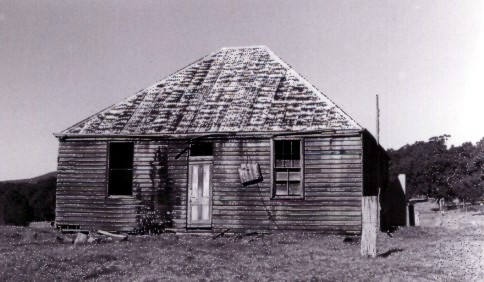 |
| Old Roberts farm house 'Parkside' Towamba Photo K. Clery |
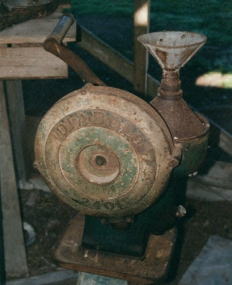 |
| Old cream separator 'Parkside', Towamba Photo K.Clery |
 |
 |
|
| Later style dairy. 'Parkside', Towamba Photo K.Clery |
Milking bales in later style dairy. Photo K.Clery |
POINTS AWARD
Mr. W. A. Green, Towamba: Suitability of fodder for dairy stock- 29
points.
Appearance of fodders- 31.
Access and economy for feeding - 18.
Protection: weather, stock, pests, fire,
etc., - 17.
Economy in production and storage costs -
22
Carrying capacity - 60 .
Surplus for market - 8.
Total points - 185.
Fodders conserved: Silage 51 tons.
Lucerne 16 tons.
Maize grain 5 tons.
Carrying capacity 16 head.
W.R. Roberts, Towamba: Suitability - 29.
Appearance - 32.
Access - 15.
Protection - 15
Economy in production - 22.
Carrying capacity - 60.
Surplus for market - 8.
Total points - 181.
Fodders conserved: Silage 92 tons.
Lucerne hay 42 tons.
Maize grain 17 tons.
Carrying capacity of property 42 head.
A.C.Clements, Towamba: Suitability - 26.
Appearance - 32.
Access - 16.
Protection - 17.
Economy in production - 23.
Carrying capacity - 60.
Surplus for market - 1.
Total points 175.
Fodders conserved: Silage 40 tons.
Red clover 35 tons.
Maize grain 3 ½ tons.
Carrying capacity of property 47 head.
J. N. Harris, Kiah: Suitability - 25.
Appearance - 29.
Access - 16.
Protection - 16.
Economy in production - 22.
Carrying capacity - 60.
Surplus for market - 4.
Total points 172.
Fodders conserved: Silage 32 tons.
Lucerne hay 7 tons.
Maize grain 9 tons.
Mangolds 20 tons.
Carrying capacity of property 25 head.
R. J. Goward, Kiah: Suitability - 18.
Appearance - 28.
Access - 16.
Protection - 17.
Economy in production - 22.
Carrying capacity - 60.
Surplus for market - 1.
Total points 162.
Fodders conserved: Silage 15 tons.
Lucerne hay 1 ½ tons.
Pasture Hay 1 ½ tons.
Maize grain 13 tons.
Carrying capacity of property 27 head.
D. Laing, Towamba: Suitability - 19.
Appearance - 33.
Access - 17.
Protection - 17.
Economy in production - 22.
Carrying capacity - 47.
Total points 155.
Fodders conserved: Lucerne hay 3 ½ ton.
Oaten hay 3 tons.
Maize grain 2 ½ tons.
Carrying capacity of property 14 head.
J. C. Roberts, Towamba: Suitability - 22.
Appearance - 31.
Access - 16.
Protection - 17.
Economy in production - 22.
Carrying capacity - 35.
Total points 143.
Fodders conserved: Silage 17 tons.
Lucerne hay 6 tons.
Maize grain 4 tons.
Carrying capacity of property 34 head.
'Magnet' September 21, 1935
At a public meeting held a few days ago local
dairy farmers decided to agitate for the
extension of the Pambula-Towamba cream lorry
service to Pericoe. At present the cream
is conveyed thrice weekly from Pericoe to
the Towamba depot - an arrangement which
shareholders regard as very unsatisfactory.
'Magnet' September 28, 1935
TENDERS
Pambula Co op Creamery and Dairy Co. LTD.
Tenders are hereby invited individually or
collectively for the company's haulage for
the period of three years as follows:
1. Cream and butter cartage on the Mount
Darragh, Cathcart, Rocky Hall, Wyndham run,
picking up all cream enroute from existing
depots and delivering to factory and delivery
of butter to rail Bombala and stores enroute.
2. Eden, Kiah, Towamba, Burragate to Honeysuckle
turn-off on Wyndham road, picking up all
cream enroute and delivering to factory and
delivery of butter to stores on the run.
Alternate tender for the picking up of Pericoe
cream at McPaul's gate, a distance of four
miles past Towamba is also asked for.
By order of the Board, the Pambula Co op
Creamery and Dairy Co. LTD.
Foss Robinson, secretary.
'Magnet' October 19, 1935
TOWAMBA
Suppliers to Pambula Butter Factory received
nice little additions to their factory cheques
in the form of a bonus 1 penny per pound
for butter manufactured for the last six
months.
'Magnet' November 30, 1935
TOWAMBA
* Cream supplies are increasing rapidly,
necessitating delivery to Pambula factory
every alternate day.
May 29, 1936
'The Southern Record and Advertiser'
SIXTY YEARS OF DAIRYING
A Paper contributed by Mr. William Watson
(Pambula), district president of the P.P.U.,
at the recent Agricultural Bureau conference
at Pambula: - - To begin, I wish to say that
I am a native of Illawarra, the cradle of
the dairying industry in Australia. Illawarra
dairy people migrated north, and south, and
everywhere were successful as a general rule;
their district was so closely settled that
even the dullest could acquire sufficient
knowledge to make them reasonably successful.
Here I wish to emphasise that to be a successful
dairy farmer you must find joy in your work.
An old saying is 'Ride your hobby, but don't
let it ride you.' Find out what you would
like to be and take off your coat and make
a dust in the world. The busier you are the
less harm you are likely to do. It makes
me smile when I hear dairymen and others
say that only within the last few years has
testing of dairy cows been carried out. They
are right as regards testing under Government
supervision, but even in the early days in
Illawarra most of the herds were tested.
We used to set the milk in dishes; each pail
or dish was numbered, and so we knew each
cow's milk. This milk was skimmed and churned
by itself, and we could soon see whether
a cow was a boarder or showing a profit.
Another way was to put the milk in separate
glasses, take the best cow's milk as a guide
and see how near the other's could come to
the winning post. Illawarra Shorthorns are
a distinct class on their own. In the early
stages of Illawarra dairying there were quite
a few different breeds, of dairy cattle,
but the wise old pioneer did not mind what
breed they were as long as they did the high
production trick. But as time went on, the
leading breeders evolved a type of Shorthorn
which has become famous nearly all over Australia
and which has been exported to other parts
of the world. That great genius, the late
J. T. Cole, of Jamberoo - later manager of
Daralara - bred Melba, one of the world's
wonder cows, which put that breed on the
map. I was personally acquainted with Mr.
Cole, one of nature's gentlemen; also with
Mr. Hugh Dudgeon, a noted breeder. The 1875
drought hit Illawarra dairymen a severe blow.
About half the dairy stock died. But it woke
the farmers from their slumbers; many went
in for intense feeding and understocking.
I say right here that overstocking has been
the cause of more stock dying than has drought.
A combination of three goods spells success:
a good farm, good dairy cows, and last, but
not least, a good manager. Nature has been
very generous to many parts of the South
Coast, and Illawarra in particular. It is
only about 7 or 8 miles from the ocean to
the dividing range, and the country is rich,
warm, and sheltered. It is an ideal strip
of country for dairying, and those who went
in for improved pastures and intense feeding
of dairy cows made their mark. In the early
days there, the milk was set in pans and
the cream skimmed and made into butter. But
- -'Advance with the times, and get ahead
of them if you can.' The cream separator
completely changed dairying from drudgery
into a gentleman's job. Factories, hand in
hand with co-operation, sprang into existence.
Mr. D. L. Dymock, of Jamberoo, a noted pioneer,
who had a big auctioneering business at Kiama
and Jamberoo, went for a trip to the main
dairying countries of Europe to examine the
systems of co-operative butter factories.
He brought the first separator to Australia.
It was exhibited at Kiama, but few had any
faith in it. The first butter factory in
Australia was built at Spring Hill, Kiama,
and the leading light in its erection was
Mr. Dymock, who now, aged 96, resides in
Queensland. He came from Scot land to Jamberoo
when he was six years of age. An incident
worth re cording: When the late Governor
Duff was banqueted at Kiama, some of the
speakers referred to the many Scotsmen domiciled
in Illawarra, and Kiama in particular. The
Governor replied that it was no surprise
to him to hear it, for whenever God sent
a good thing a Scotchman was never far away.
It was men such as D. L. Dymock, William
Stewart (a Jamberoo store keeper), and other
noted dairy farmers who started the cooperative
selling floor in Sydney known as the South
Coast Company. Out of its ashes, when it
failed, that genius Mr. Meares established
the South Coast and West Camden Co., now
the P.D.S. Co-op. Co. Before the co-operative
selling floor came into existence the dairy
farmers were the sport of speculators and
those parasites they call agents, who rose
and dropped the market to suit themselves.
They grew fat by picking the sweet patches
that rightly belonged to the farmers, who
fought fire, flood, pestilence and disease
of all kinds. Of course, it must be said
that they served their time; but they had
to make place for a new order of things.
The old pioneers of Illawarra were an industrious,
hardy lot. They went in to jungle country
and made it blossom like the rose. Many parts
were too rough to plough, and the seed had
to be hoed in. I have seen 30 or 40 acres
in one block chipped in with hoes and rye
grass and clover sown; and on such beautiful
pasture dairy cows milked at high production.
Another thing worth recording is the long
life of many Illawarra dairy farmers- some
of them 97 , and over. 'Early to bed,' etc.;
dairying is conducive to long life. Science
has done wonders for the industry and is
still trying to give us more light. Of course,
there is still a lot to be done. Improved
pastures and dairying should go hand in hand.
When I lived in the Illawarra about 52 years
ago a rust hit quite a lot of the rye grass
pasture. The hill land had to be sown about
every 7 years, more or less, according to
seasons and class of soil. The dairy farmer
should dairy off the plough or go out of
business. If he has land that will grow English
grasses and neglects to do so he is losing
hard cash. In the year 1883 I left the Illawarra
and came south to the Towamba district -
still on the South Coast. I arrived on November
20, and the district was a sheet of white
clover from end to end. There were no rabbits
at that time. The country had not long been
ringbarked, and appeared to be in a hurry
to produce large quantities of rich pasture.
I went to work on a dairy farm, and it was
quite a prosperous proposition. At that period
dairying on the high lands at Towamba was
definitely a success; the cows milked remarkably
well. On all the dairy farms there was a
good class of Shorthorn - the progeny of
the Illawarra breed brought by those who
migrated south. The quantity of butter made
in Towamba, Pericoe and Burragate was very
large. What is it to-day? Rabbits and other
causes are blamed for the drop, but I think
quite a lot of that country could be brought
back to its former high productive state
by fertilising and by rabbit extermination.
There are, of course, quite a few alluvial
farms, rich and productive, in the Towamba
valley. In the early days they grew maize
for pig production, but to-day some of them
are very prosperous dairies. Does anyone
stop to think of the very exalted position
the primary producers (which includes the
dairy farmers) occupy? They are builders
of a nation. Their names are not written
on marble or on stone, but are for ever written
in the con quest of the soil. In 1910 I moved
from Towamba to the Pambula district. There
is some very rich high land in this district
- rich chocolate soil that will grow crops
in abundance, especially oats. Indeed, I
have seen on the hills crops of oats equal
to the very best on the alluvial flats. Here
is a case where pasture improvement and abundant
oats did the financial trick: Seventy acres
were sown down with cocksfoot, rye grass,
clover, rib grass and prairie, and about
half an acre of oats per cow. Under these
conditions, instead of less than £300 for
one year, over £900 was made on the same
farm - only by improved pasture and oats.
I say 'Tickle the soil and it will laugh
into an abundant harvest.' One acre of laid-down
pasture on suitable soil is, in my opinion,
equal to 3 or 4 acres of natural grasses.
Everyone has his own ideas about the quantity
of seed to sow per acre. But if you want
to draw money out of the bank you must first
put it there - and the same applies to sowing
pastures. I sow 1 bushel of cocksfoot, 1
of rye grass, some rib grass or lamb's tongue,
some white clover, a little red clover and
prairie grass, per acre. No bald patches
for me. I paid 30/- per bushel for cocksfoot
a few weeks ago; during the war I paid as
high as £2/5/-, and would pay it again if
necessary. Some high-class Jerseys are bred
in the Pambula district - equal in quality
to the high standard of that breed in much
larger districts. The Pambula flats are ideal
for dairying. If rugging or stabling in winter
was adopted it would pay the owners. I have
been a dairyman all my life, and I know the
trials and tribulations of the game from
A to Z. I also know that God has sent many
good things and the devil has romped in and
managed them. More attention should be given
to the length of dairy cows' teats than has
been given in the past. Two and a half to
three inches is, to my mind, the right length.
As to treatment of cows, I was never well
enough off to allow anyone to dog or flog
a cow, and I never did it myself. She should
be treated as a lady. I would sooner touch
my hat to a good dairy cow than to some of
the cows who own them and re fuse them a
square deal. As to the bull, it must be remembered
that he is half the herd, and I would pay
every attention to the selection of a dairy
sire. I cannot close this very imperfect
paper without paying a high tribute to the
part played by Kameruka Estate for over half
a century to the dairy industry at this end
of N.S.W. I am sure that if figures were
available they would astonish most of us.
Its Jerseys such as Lucius and Twylish have
given us some of the greatest money producing
dairy stock in the world.
The 'Magnet Voice' March 24, 1960
BOX RANGE CHEESE FACTORY
"One of the few private cheese factories,
and perhaps the smallest in NSW, is the Box
Range Cheese Factory, situated a few miles
from Pambula on the road to Bombala. It is
a two-man venture conducted by brothers W.A
(Wal) and J.A. (Jack) Smith. Milk for the
cheese making, comes from the herd of A.I.S.
on the property at Six Mile. Cheese has been
made at Box Range since 1913 (previously
butter was manufactured) then in 1930 new
premises for cheese making operation were
erected.
Box Range cheese is in wide demand throughout
the Far South Coast and Tablelands, and even
Sale in Victoria. It is a full cream cheese
of mild flavour and maturity. Prizes have
been won at the Royal Easter Show with 6
X 1sts, between 1952 and 1957 and over 50
awards at local shows since 1958.
Cheese maker is Jack who has won continuous
grading competitions conducted in association
with the Dairy Factory Managers & Secretaries
Institute. Work on the property is divided
between the two brothers. Jack attending
to the cheese manufacture and Wal the farm
operations.
The Box Range property consists of 700 acres,
of which 600 is netted and free from rabbits
and has been in the hands of the Smith Family
for over 70 years, The soil is rich basalt,
but unlike most of the Pambula district suffers
from irregular rainfall. Average size of
the milking herd is 70, they are AIS (with
occasional Jersey) mostly by Dudgeon or Lemon
Grove Bulls and the butter fat average is
usually in excess of 4%. Since the milk for
cheese making is not standardized (that is
reduced to the same butterfat content for
all batches), it can vary in the fat content:
nevertheless this is generally above that
to be found in cheese from larger factories.
Jack has been making cheese for 37 years
and spends most of his day in the factory
with the average quantity of cheese made
in a day being 145 lbs. This is put up in
loafs of 13 to 15 lbs. plus a few 2 lbs.
“Picnics”. Total annual production is about
35,000 lbs. Cheeses are stored for maturing
in a separate building, which is insulated
by charcoal. Demand for the cheese is so
great that perhaps a reasonable criticism
is that it is not sufficiently matured for
some tastes.
Transport to district stores nowadays presents
no problems as it is taken north, south and
west by carriers, quite different from earlier
days when most of the cheese was shipped
to Sydney.
Living in semi-retirement on the farm is
their uncle Mr. George Smith though getting
well on in years, still takes an active interest
in the welfare of the property."
Above is an article about the Box Range
Cheese Factory which was reprinted from the
Country Life Newspaper 12/2/60.
In the early 1970’s Box Range Farm was a
collection of properties, owned by C.G. Parramore,
they were Leamount (Ruggs), Six Mile Creek
(Six Mile), Box Range Farm (Range Farm),
and Schriek’s Gully & Moores. By the
end of the 1970’s, two more properties were
purchased they were Cusacks and Hazelgrove,
although Cusacks was sold to J. Lynch in
1980’s.
The first owners recorded on early maps were
Jno CONNELLY, Jas. HICKEY, Edward CLARKE,
Michael SCHRIEK, W. BOW, Clement J. W. STILES,
Jas GAHAN, Jas CLARKE, W. T. BURTON, R. HAZELGROVE,
Anastasia May KEON, S. SOLOMON Ltd. Eden,
Michael SMITH, Andrew SMITH, Terence SMITH,
William J. SMITH, Mary W. COLE, Mary J. CUSACK,
Michael CUSACK, J. CUSACK, J.J. SILVERS.
As time went by, other family members took
over the ownership of the land and many other
people worked there as well, some of their
names were J. KEON, Tyson DONNELLY, Fred
SMITH, John A SMITH, Walter A. SMITH, George
A. SMITH, Frank, THOMAS and Amelia CUSACK,
John LONGHURST, Henry and Peter HYDE, Francis
SMITH, Lucy SMITH, Albert E. RUGG.
Article courtesy of Elizabeth McIntyre present
part owner of 'Box Range'.
 |
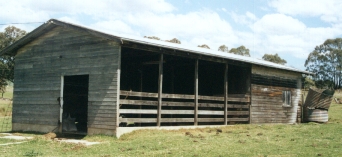
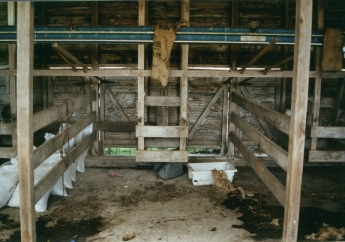
| Box Range Cheese Factory (2nd) Built in 1930 |
'Magnet' February 24, 2005
Rocky Hall
(Summerised)
The old Rocky Hall Butter Factory, on Mr.
Fred Whitby's property at Rocky Hall, used
for many years as a hay shed, succumbed to
wild weather and was reduced to a collapsed
pile of timber beneath a roof, in the last
high winds to hit the Towamba river flats
on which the building stood.
The butter factory stood as a landmark to
people travelling through Rocky Hall for
years: even visitors passing though on their
way to and from the Monaro via the South
East National Park would comment on the building
and stop to take photographs.
It was constructed by the Rocky Hall Dairy
Company in 1896 and operated for 30 years.
Cream from the dairy farms of Rocky Hall
then went to the Pambula factory until that,
too, closed.
Mr. Whitby said it was one of the oldest
dairy co-operatives in NSW; older than the
Bega Dairy Co-operative.
Mr. Whitby still has ledgers from the factory
in his care, along with many old photographs
that date from a time when Rocky Hall was
a thriving village. The ledgers date from
1896 and record deliveries and payments to
the dairy farmers who supplied cream to the
factory.
Names that are synonymous with Rocky Hall,
Wyndham, Burragate and their outlying regions
include Whitby, Grant, Kerr, Robertson, Rixon,
Sherwin, Ryan, Underhill, Collins, Knightly,
Travers and the Elphick brothers.
Regular Cathcart suppliers included Crotty,
Stewart, Mawson, O'Reilly, Griffiths and
Baker.
However, in 1918 the factory that most Cathcart
suppliers sent their butter to must have
closed temporarily, because there was a sudden
influx of suppliers from the Monaro. They
included Gerathy, Vernon, Murphy, McMahon,
Madden, Stove, Solomon, Kimber, Ingram, Gaunson,
Overend and many more names that are well
known throughout the region.
During the month of November, when the numbers
of suppliers was swelled by the Cathcart
influx, two amounts of butter produced are
recorded; 15,903 and 32,425 lbs of butter.
While the factory was not among the region's
biggest, it was among the best.
Mr. Whitby ways butter produced at Rocky
Hall was sent to London and took prizes there.
A letter slipped into the pages of one 1918
ledger from Foley Bros, Australian Merchants
based in Sydney, states: "We have the
pleasure to hand you herewith account sales
for 80 boxes of butter which we had stored
on your account and have forwarded cheque
for the profit -£43/14/- to your bank as usual and
we trust this will meet with your approval.
You see that for the butter we sold in Melbourne
we secure 150/- and 160/- per cent and we
feel convinced that no other factory in your
district has done better than you have with
their government butter. Trusting to have larger consignments from
you and thanking you in anticipation, etc.,"
However, times were changing. A big drought
in 1923 and the Whitby family, backbone of
the Rocky Hall dairy industry, stopped supplying
the factory.
"The factory was under severe stress
from then on," Mr. Whitby said. "By
1924 the motor lorry transport had progressed
and farmers could send their cream to Pambula."
A paragraph from the Bombala Times in 1924
states that the Rocky Hall Dairy Company
building, plant and machinery were for sale.
The building continued to provide cover for
large quantities of hay, invaluable to the
farmers in times of drought. It stood as
a link to the times when Rocky Hall boasted
a general store, pub, post office and church
as well as the school, hall and butter factory.
Now that link with the past is gone, and
only the school (now a pre-school and community
centre) and hall remain to indicate the village
that Rocky Hall once was.
The Rocky Hall community is indebted to Mr.
Whitby, whose knowledge of the area is extensive,
for keeping the history of a bygone time
alive.
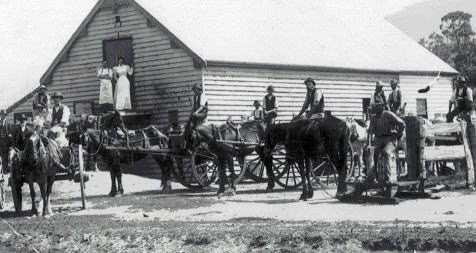 |
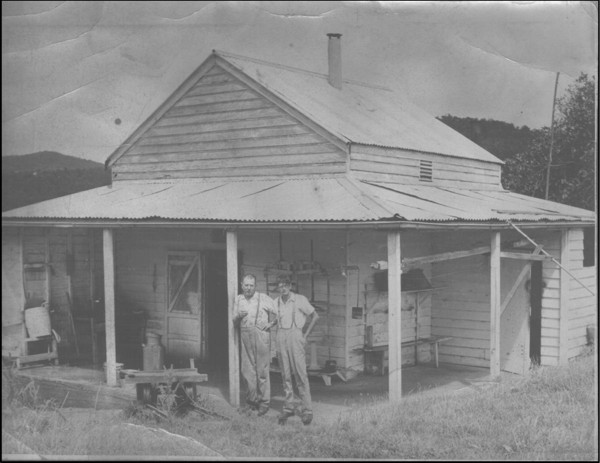
| Rocky Hall butter factory on delivery day. No date |
