

Were there too many people with bullock teams?
Was there competition?
HAROLD. Not really in my day. The bloke who
lived there, I worked for him, see. But when
Lou wanted me to go and draw the bark in,
well I drew first what was close there, drew
it out with a slide and Jack Beasley came
along there one day and said, 'Is this where
you got to?' and I had ten bullocks yoked
and there was five different owners to them.
Some belonged to Alexander's from Pericoe,
some was my own, some belonged to the bloke
that owned 'Two Creeks', Austy Sawers, some
belonged to Bill Hyde and one belonged to
my brother.
So your team belonged to different people.
HAROLD. To a lot of different people.
How old were you when you started doing that?
Was it after you were married?
HAROLD. No. I was sixteen when I was drawing
it out of there for Lou King. I started working
for Sawers when I was fourteen, stripping
bark and driving bullocks.
Was that the main industry out there?
HAROLD. In those days you trapped rabbits
in the winter time and stripped wattle bark
in the summer time and a few fellers cut
sleepers. But it wasn't that many cutting
sleepers until after the '39 fire. There
were a lot of sleeper cutters on Indigo Mountain,
(Pericoe) they come through from Victoria
and some of them come from out here, Bendoc
way. I know there were eleven or thirteen
trucks carting sleepers from out there into
Eden.
The bullocks...were they just ones that people
reared themselves?
HAROLD. Well, Alexander's......see they were
reared down on the dairy. He had share farmers
doing the dairying. Dairy families. That's
why they all had a big mob of kids so they'd
have plenty of milkers. No milking machines.
If I wanted some bullocks and I seen some
of Alexander's was any good well I just took
them and yoked them. 'Cause, working bullocks,
you got more money for them than ones that
weren't broken in. You could sell a team
of bullocks to some feller who wanted a team.
Did you ever bother to use horses in a team?
HAROLD. I never did. But different people
used horses, yes. Jim Beasley's horse team
is there (pointing to a photograph).
Was that for a different reason or just that
the person preferred.....
HAROLD. No. Some people were horse people
and some were bullock people. You see, Dad
had a bullock team and so I learned to drive
bullocks. Well Jack Beasley's father, he
was George Beasley and he had a horse team.
After George died, Jack took the team over
and he drew on the Eden Road there. Him and
Jim Beasley.
So did you used to shoe the horses and bullocks
youselves, or did someone else do it?
HAROLD. Well, Jack said he used to get Scanes
(spelling) to do his. Frank Scanes. There
was a blacksmith's shop somewhere there in
Towamba.
*** Excerpt from Harold Farrell's interview
in 'The Forgotten Corner Interviews'.
These articles cover a wide range of interesting
features and locations on the Far South Coast
generally south of Eden and inland to Bombala.
They describe the district as it was then,
(some place names are spelt differently)
and today we are left to wonder at the changes.

(Accepted as) The arrival of the Governor-General,
Baron Northcote, 1907
Possibly Rocky Hall or Wyndham.
The Twofold Bay Magnet and South Coast and
Southern Monaro Advertiser
Mon 27 Jul 1908
Early Monaro GEOLOGICAL RECORD,
Compiled in 1852.
(BY REV. W.B. CLARKE)
The circumstances that alluded to result
altogether from the natural, and but slightly
improved, geological features of the country,
to the consideration of which the proceeding
seeming digression from the immediate object
of this Report, is not unsuitable introduction.
The eastern border of the Main Coast Rangers
which separate the maritime counties from
the basins of the Snowy River and the Murrimbidgee,
and which have a generally persistent character
from the head of the Derra or Shoalhaven
River to thelr final obscuration south of
the boundary line of the two Colonies, is
marked by a series of depressions overlooked,
nevertheless, by high peaks, where the ridge
dividing the waters is extremely narrow,
and towards the coast most abrupt. It is
at these points of depression that the Passes
are found between the uplaid country and
the coast and so narrow is the ridge at these
points, that it may be stepped across in
from six to nine paces.
The original discoverers of these passes
have given various significant, but still
not the most pleasing, names to them. As
in the case of the deep ravine at the head
of the Brogo to the southward of Robinson's
Hole, this term is applied to the similar
localities at the base of the escarpments
bordering the line of decent. With some trouble
I obtained the Aboriginal names, but, as
identifying the localities, I will enumerate
them in their order from the south, by both
the Aboriginal and the Colonial designations,
hoping, nevertheless, that the former will,
upon maps of the country,
eventually replace the latter, of which there
are, already, too many of like signification
in other parts of the Colony:-
1. Bondi or Bundian Pass, between Calkin
and the head of the Jenoa.
2. Wog Wog Pass, between Killerooma and Yarramgun.
3. The Devil's Hole, head of Maharatta Creek,
otherwise Butrimboco.
4. Hell Hole, otherwise Wambamgarragan.
5. 5.5. Coal Hole, otherwise Combloblumblo.
6. Great and Little Purgatory, otherwise
Tummamah.
The designations of some of these localities
have been assigned by the bullock drivers
and stockmen, who took that expressive mode
of defining the fearful nature of the original
state of the descents, their depths and gloominess
and certainly, it is satisfactory to even
those who may not be as mythological or poetical
as a bullockdriver, to be informed that,
after escaping the perils and inconveniences
of such a " facilis descengus Averni,"
and the risks of Purgatory, the explorer
is enabled to arrive at length upon, the
shores of Eden, which, if nothing more than
Australian, is certainly a Paradise compared
with the region through ' which it is approached."
The Pass of Bundian is bordered by the defiles
collecting the head waters of the Jenoa,
of which the northern is guarded by the heights
of Coonbulico, Wallagarra, Nangutta, and
Ekalun, and the southern by the spur of Diliganea,
which precipitates the steam collected to
the southward of the pass, over a wall of
granite 67 feet high, and which forms the
cataract of Windindingeree. These waters
unite a little above the station of Bundian
(Bondi), being in vertical descent below
the Pass 1173 feet, and falling at the rate
of 234 feet per mile; and after reinforcement
from the Nangutta Ranges, just upon the boundary
line, the collected supplies are known as
the Jenoa which passes away to the south
east and meets the salt water at Malagoota,
after falling about 50 feet per mile. The
distance from the Pass to the discharge of
the water into the Ninety Mile Beach is but
41 miles; the Jenoa, therefore, takes the
most direct line of descent, being bounded
by ranges, the joints of which indicate its
course. The fall of Maharatta Creek, on the
other side of the pass is not more than 16
feet per mile of direct distance; so distinct
are the features of the table land and sea-board.
The south-east direction is so persistent,
in the main channels of all the waters in
the county of Auckland, such as the Jenoa,
the Towamba, the Bemboka and Brogo, which
are parallel to the range separating that
country from Dampier, that viewed in relation
to the courses of the main streams and ranges
in the county of Wallace and Wellesley, and
to the possibility of indicating the apparent
continuation of the same lines of fissure
on the western side of that region, or of
parallels there to. In the deep and precipitous
ravines watered by the Jingalaba, Amboyne,
Catamurra, Toonginbooka, Ingeegoodbee, Moyengul,
Tongaro, Burrungubbuck, and the Upper Gungarlin,
and by various transverse portions of the
Snowy River to which these are affluents,
as well as by the Buckenderra and Wulwya
Creeks which also belong to the same system,
(all of these being also parallel to the
great line of trappean eruption which separates
the Snowy River system from that of the Murrumbidgee,)
there can be no doubt, that the drainage
of the county of Auckland and the peculiar
disposition of its headlands are due to the
same powerful agency which has left such
evident traces of its violence in other parts
of Maneero, directing the rivers in lines
of fissure, fracturing and dislocating the
schistose rocks and opening a channel for
that series of igneous eruptions by which
those rocks have been transmuted and overflowed.
June 1870
'The Sydney Morning Herald'
THE BORDER LAND: FROM GENOA TO EDEN.
In a former paper I described the country
between Eden and Mallacutta Inlet (or the
estuary of the Genoa River), as it appeared
on my journey through it, on the 10th and
11th of December last, by Cochrane's Flat,
and Robert Allen's, Merrimingo, and Genoa
Station - a route that lies coastwise between
the sea, on the one side, and Mount Imlay,
and a southward line drawn thence, on the
other.
I shall now give a short account of the district
through which I rode on my homeward journey
to Eden from Genoa Station (to which I returned
on leaving the surveyor's camp at the Inlet).
And as my road lay a good way inland - between
Mount Imlay and the Monaro Mountains - I
write of a different (western) tract of country
from that (the eastern seaboard) previously
described; and I think it will be shown that
the Ovens Spectator had as little ground
for branding the one as the other - that
each is within the bounds of civilization,
and the home of hardy, prosperous settlers,
and not a terra incognita - however few the
number of the present inhabitants, and wild
the aspect of the land.
My first stage was to Stephenson's, at Wongarbel,
- a distance of ten miles. The Genoa River
was to my left, and ran close by (at starting);
but it was soon lost sight of until I neared
Stephenson's, and caught a glimpse, now and
again, of the rocky flats and gravelly, beds,
to which I alluded in the earlier paper as
well adapted to salmon. At first, also, the
line of country over which I passed was very
hilly, rough, and stony - no dray road, now,
but only bridle paths; - and about midway
I found myself on a loft ridge from which
the eye ranged over a vast extent of forest
and mountain; but the soil and character
of the country gradually improved to undulating
grassy land. Two or three miles from Stephenson's
there is a large, valuable flat, on which
a herd of cattle was feeding (he keeps a
small dairy); and in amongst these there
were four emus stalking about, as if unconscious
of the others' presence; but they would not
allow my horse to come near them; as he descended
the hill that overlooks the flat, they strode
away, easily but swiftly, and were lost amid
the timber that skirts it. The mountains
stand about Stephenson's house, and, to most
men, it would be a lonesome spot; but he
had fixed his abode, and had healthful work
to attend to; his children were around him,
and plenty for them. What more need any man
desire? But there was something in addition
that is rarely met with in the "Bush".
His garden was well stocked with vegetables,
quince and apple trees; rarer still, with
the gooseberry, raspberry, and currant, the
rose, and other common, but not the less
beautiful, flowers - an example worthy of
imitation by other settlers in far more favoured
districts; many of whom, though possessed
of much larger means, and better facilities
for surrounding their homes with suitable
gardens, and securing to their families the
comforts, enjoyments, and refinements which
fruit, vegetables and flowers, raised and
tended by their own hands, are sure to afford,
affect to despise such influences, and to
prefer the slough of the stockyard, or blackness
of the sheep-pen, to the beauties, elegancies,
and advantages which a garden can yield.
A further stretch of twelve miles brought
me to Nangutha, the homestead of Mr. Weatherhead.
From Stephenson's the road was very rough
and steep, and the country poor and wild;
but it grew better towards Yombla flat, a
long, narrow, and winding strip covered with
rich grass and clover; and thence to Nangutha
it is open and grassy, but hilly. On Yombla
flat were many well-bred and handsomely-marked
cattle, the fattest and best I had seen since
leaving Eden. Some of these were reserved
for the Tasmanian market; for it is one of
the peculiarities of Tasmania that it does
not produce sufficient cattle for consumption
by its own people, and has to import from
New South Wales. Beyond the Flat was a range
of mountains on the right; on the left a
range of mountains; and Mr. Weatherhead's
cottage (embosomed in roses and vines) was
almost surrounded by a third, - all lofty,
sweeping, and magnificent, a very Land of
Mountains; and well did one of the inmates
of that peaceful home exclaim, "We can
never be solitary here, Sir, with mountains
like these around us." The duties of
a dairy station, on a very considerable scale,
add to the enjoyments as well as to the usefulness
of their lives, and preserve their intercourse
with the Bay. A bullock dray can travel from
Eden to Nangutha, though with difficulty;
for the main road is about "as bad as
bad can be;" and I believe a light waggonette
did, on one occasion, accomplish the journey
- but the experiment has never been repeated.
That night I spent at Mr. Weatherhead's,
- the shadows of the mountains about me,
the perfume of flowers pervading my little
room, and the wild cry of the curlew piercing
the somber air; while the moon and stars
looked down in silent majesty upon the poor
dwellers of earth, their hopes, cares, and
sorrows.
The next morning I started for Towamba. The
first six miles of the bridle-way were over
fairly grassed hills and hill sides; the
next twelve along poor ridges, for the most
part - with stray fern-trees peering out
from sheltered nooks - but improving as one
approaches the Free Selection of John Alexander,
and thence, for the remaining six miles,
I passed through the well-grassed and beautifully-undulating
station of Towamba, the property of Sir William
Manning. Here again, throughout the greater
part of this day's journey, mountains were
visible - sometimes on one side of the path,
sometimes on the other, sometimes on both
- now close at hand, then far distant.
The comfortable and hospitable homestead
of Towamba is on the right bank of the river
of the same name, but which (it will be remembered)
becomes the "Kiah", before it falls
into the sea, lower down at Twofold Bay.
This, too, is a cattle station; and, together
with the still more beautiful and valuable
station of Canoona (situated in the Bega
District, and belonging, principally, to
the same proprietor), supplies the greater
portion of the cattle that are annually exported
for sale (from the Bay) to Tasmania. There
are very few sheep to be found in any part
of the border country south or south-west
of Eden - not 200, I should say. It was at
"Stephenson's", I think that my
horse shied on seeing some "pets",
the strangest objects he had met with for
days past.
From Towamba to Eden is seventeen miles the
river (which has to be crossed by the homestead)
is here of a good width, and flows over a
shingly bed. It is very shallow, except during
a "fresh", or flood. There are
some small farms on the right, and a "store"
on the left; but when these signs of progress
recede, a rough, ridgy and worthless country
succeeds, with mountains on either hand,
once more - old Imlay now rising amongst
the rest; for I had almost completed, by
this time, my circuit about him, and with
it the tour of the Borderland - now rugged
and wild, thinly peopled, and thickly timbered,
mountainous, bleak, and lone; but capable
of much improvement, very interesting, and
the future home of a hardy race.
I cannot conclude without referring to the
disgraceful condition of various portions
of what professes to be a highway between
Eden and Towamba, and to the shameful waste
of public money upon them. In places, hill
sides have been cut down, and the line of
road been carried and formed at much expense
along difficult passes; but, for want of
proper drainage, in the first instance (which
might easily have been provided), and of
timely looking to afterwards either by the
Government or local Trust (if there be one),
the first heavy rains that came were allowed
to run riot upon them - down or across as
the case may be - every succeeding shower
followed suit; immense ruts were thus hollowed
out, and the route rendered almost impassable
- its last state worse than the beginning,
but hundreds of pounds sunk in the mud meanwhile.
Will the time ever come when the whole Colony
shall be divided into districts, the proprietors
in those districts be obliged to make and
keep in repair their own roads, and be allowed
towards that object a share of the proceeds
of the public lands sold within them - a
moderate tax upon private lands supplying
the deficiency? Our roads would be then properly
formed, and properly attended to, when formed;
and there would be a speedy end of the jobbery
and neglect that now characterise the expenditure
upon roads (in spite of all the efforts of
the able and accomplished Engineer who has
charge of them). There would also be an end
of the Parliamentary "log-rolling",
or clubbing for roads and other works, by
which the honest government of this country
is becoming an impossibility.
A jetting promontory and glimpse of the sea
beyond were discerned some time before I
reached the head of the Nelligan - here a
narrow stony-bedded river. thence it is but
a short distance to the salt Creek, to the
hill-side that overhangs the Quarantine grounds,
and to the township of Eden the neglected
- but ever beautiful - Eden! deserted by
many a lover, but still woed by the fresh
winds and sparkling waters of the Bay that
circles her with its arms, and is itself
a peerless Haven.
A. M'F.
14 July 1871
'The Sydney Morning Herald'
THE-BORDER LAND: FROM EDEN TO GENOA.
On the morning of the 10th December, '69,
I started from Eden (Twofold Bay), on a visit
to the Victorian Surveyors, who were commissioned
to define the "Boundary line" between
the two Colonies - from Capo Howe (which
is our most southern limit) to Forest Hill
(a spur of the Australian Alps), and who
were encamped near to Mallacutta Inlet, which
is also the estuary of the Genoa - a beautiful
river that falls into the sea south of Cape
Howe and of Gabo Island.
Eden is in the territory of New South Wales,
about thirty-five miles north of Cape Howe,
in a direct line, and, if not the most lovely
seaport, certainly the most lovely site for
a seaport, which it possesses; and Mallacutta
Inlet is within the territory of Victoria,
about eight miles south of the same Cape,
by a direct line; but the road usually traversed
between the two places is far from direct,
and is about sixty miles in length. The route
by which I intended to return was still less
direct, and more inland. I had thus a considerable
sweep of Border land before me - a circuit
of nearly 140 miles that is seldom visited
by the traveller, and has been the subject
of much misconception and exaggeration. In
a "description" of that and other
portions of the Border country which appeared
in the Ovens Spectator of November last,
and "went the rounds of the Papers",
it is stated: -
"Along a great portion of the boundary
between Victoria and New South Wales, extending
from Forest Hill to Cape Howe, there has
never trod a European foot, as it is generally
rugged and densely scrubby; but here and
there miners and stockmen have pushed through,
from one Colony to the other. For years past
there has been a kind of neutral ground at
these points, where claims are jumped with
impunity, and thieves, cattle lifters, and
loafers lead wandering lives, and carry on
their depredations without fear of the law.
….. Beyond Twofold Bay, the country is terra
incognito; nothing being known of it, except
that it is cut up by rapid rivers, and precipitous
ranges, and that it is extremely scrubby."
Now the fact is there is considerable and
pretty constant intercourse over the Border
lands of the two Colonies, from the point
at which the "dividing line" cuts
the Snowy River in its course into Gipps
Land (not very far from Forest Hill) to where
it intersects the head of the Genoa (a belt
some sixty miles in length), especially in
the neighbourhood of the Delegate and Bendoc
mines and across the Borders from the place
at which the "line" cuts the Genoa
to Cape Howe (a distance of about forty miles),
there is some communication it times; while
as regards the district that is immediately
the subject of this Paper, there is a fair
dray road from Twofold Bay to Mallacutta
Inlet - a route (as we have seen) extending
through this "terra incognito"
- and several homesteads by the way - a good
deal of the country very open - and none
of the four intervening rivers at all impassable
under ordinary circumstances. But it was
the same Newspaper that ignored Mr. Allan,
the chief of the Survey party, and conferred
its leadership upon a subordinate officer.
Such are the materials that history is made
of!
I was on horseback, and accompanied by one
who knew the route; the morning warm and
sunny - a summer morning in that delightful
clime - and our horses eager for the road.
In a few minutes after, leaving Eden we reached
"Nixons Bower", passed its shades,
and came out upon a tract of well timbered
but otherwise valueless land, with patches
of grass here and there; glimpses of Mount
Imlay in front, towering to a height of 2900
feet; the Inner Bay on the left glistening
in the early sun, and the surf breaking on
the Quarantine ground; little birds twittering
over-head, and the "coachman sounding
his whistle and twanging his "lash".
The Salt Creek was soon crossed, and a track
to the left brought us close to the entrance
of the Nelligen, a sandy-bedded, bright-watered,
short-coursed, and big-mouthed river, which
we forded with some difficulty - the stream
up to our saddle girths, but running leisurely
into the Bay. Then, the beach at Boyd Town,
and our horses dashed into a quick canter
along the yellow sand, which the ebbing tide
left bare - a canter that soon sprang into
a gallop. Away, the hardy steeds! Stride
for stride, and head and head; the foam flakes
flying around us, and the wind whistling
by! O, how the blood circles, and the brain
is cleared, by such a gallop. On then! while
we may; and still onward, on.
To our right, but partly concealed by the
spreading bush and encroaching sand mounds,
were the half-finished church, the long,
pretentious dwelling-house, the tiny cottages,
and tall store, built by Mr. Benjamin Boyd,
shortly before his departure for the "Islands",
from which he never returned - and all which
buildings, with the exception of the dwelling
house (now owned and occupied by another),
have been deserted for years past, and are
fast crumbling to decay.
Beyond the store, the Bay winds to "East
Boyd", and "Boyd's Tower"
- monuments equally striking, and equally
mournful, of a bold conception marred by
destiny. But our road lay to the right of
the store, among "native" cherry
trees, blue bells, and fringed violets, and
by the banks of the Towamba or "Kiagh"
- another but larger, longer, and very winding
river, that falls into the Bay (a couple
of miles above the "Town" ), and
which we had to cross three times before
reaching "Wheelan's", or "Cochrane's
Flat", and twice afterwards - skirting
at times the rude ill-cultivated farms that
are occasionally to be met with along the
river's banks, but in many of which blackened
stumps appeared to be more carefully preserved
than anything else, and the "cockatoo
fences" neither ornamental nor useful
- and keeping midway between the sea and
grand old Imlay, but losing sight of each,
ere long.
In the neighbourhood of East Boyd there are
indications of copper - also below Mount
Imlay, and gold has been found near the latter.
(Clarke's Researches in the Southern Gold
Fields.) But neither has been discovered
in payable quantities.
At high tide the Kiagh is navigable by a
boat for five or six miles from the Bay,
and the sail along it's winding, wooded banks,
is a very pretty one. Its estuary and lower
part are favourite haunts of the pelican
and swan, but they are "disturbed"
too often to be easily approached. The upper
part is well supplied with duck, and its
neighbouring woods with pigeons and parrots.
Kangaroos are numerous in the same vicinity,
and a sportsman, or lover of Nature, might
pass a pleasant week in it.
Ridges of timbered sandstone, or ranges of
scrub, but none of them "precipitous",
and rough wet flats succeeded, for several
miles - the latter covered with "blady
grass", rushes, or other coarse herbage;
and the former with low bushes, gum trees,
and "wattles".
Here and there the big trunk of a felled
tree lay across the path - felled for the
sake of the honey which had been accumulating
in it, until the quick eye of a bushman detected
the busy makers, buzzing around the cleft
in which their treasure was concealed - and
then it was doomed. A flock of cockatoos
screamed on our left, and a "native
dog" skulked in the distance. It was
during this part of our journey that the
sky suddenly darkened, and a cold wind came
up from the south, then the mutterings of
thunder were heard on the right - thunder
low and distant at first; but louder and
nearer, nearer and louder it grew, until
the heavens seemed to be torn asunder by
each crashing peal while the rain fell in
sheets, mixed with cutting merciless hail,
and both horses and men quailed under the
lightning's flash. Numbed and dripping we
reached "Robert Allen's" (twenty
miles from Eden), about 11 o'clock, and were
glad to stretch and warm ourselves before
the log fire, to which we were kindly welcomed;
while our horses plucked the sedge and rank
grass that surrounded the hut or station.
But if ee were welcome, a visitor who immediately
preceded us had a very different reception,
and not undeservedly. An immense iguana had
come out of the bush, attacked a hen upon
her nest, drove her from it, and devoured
the eggs upon which she was "sitting",
but was observed by the dogs as it wriggled
away, was caught, worried, and killed for
its pains. I was told of a contest, not long
before, between an iguana and an eaglehawk,
in which, after a long struggle, the hawk
pecked out the eyes of the other, and proved
victorious.
The iguana makes war upon the eggs of all
native birds, which it can reach either by
crawling or climbing. A friend of mine, when
travelling in New England, came upon two
enormous ones, half buried in the carcass
of a dead horse; and "they rose at him",
as if about to tear him as well - as they
probably would, had they given them a chance.
But, as a general rule, the creature makes
off, up a tree, into a hollow log, or under
the scrub, whenever it is approached; and
so much the better - for it has a very snappish
mouth, and very "ugly" teeth, even
to look at.
There was not from the banks of the "Kiagh"
to the hut at which we were now resting -
nor, indeed, to the banks of the Genoa -
twenty-five miles farther on - was there
a single patch of cultivation visible - all
was waste bush and scrub; nor did we see
one sheep; but some small mobs of ill-bred
cattle were met with; and we heard of a Manaro
squatter who had lately taken up a run in
"Allen's" neighbourhood as a breeding
station; but I do not think that this part
will be much of a cattle district, for years
at lease.
In a couple of hours we resumed our journey.
the storm had subsided, the thunder rolled
away, and the sun shone bright in the azure
sky. Under foot was a good "bush road,"
that led through a scrubby and "coast-like"
country, with a range of hills on the left,
until we came to the river Womboyne, which
is a rapid, prettily wooded, but narrow stream.
Free selection upon its undulating and inviting
banks has begun, and will extend. I should
have liked to have followed its course to
the sea at Green Cape, but time did not permit.
The "dividing line" will intersect
it somewhere about the point at which it
is crossed in the route to the Genoa. We
were, therefore, in Victorian territory when
that point was passed; but I cannot say that
I therefore observed any improvement in the
appearance of the country, strange as the
fact may appear to Victorians.
There is a deserted hut, with a fenced paddock
around it, a little way beyond his river;
and thence to the Genoa the character of
the land may be best described as fairly
timbered and peculiarly adapted to the haunt
of the kangaroo; though we saw none, the
time being unfavourable. (It is in the early
morning, or late in the evening, that the
kangaroo is generally met with in the bush.)
Reaches of black mud, and marsh, and a long
narrow flat, on which a herd of promising
cattle was browsing, brought us within sight
of the Genoa Peak (that rose to the left
- square, stony and massive), and of other
jagged mountains which lay five or six miles
away. In three quarters of an hour afterwards,
the lowing of cattle, the barking of dogs,
and the voices of men apprising us that we
were approaching the river Genoa, at "James
Allen's" of Merrimingo, which (as I
have said) is some twenty-five miles further
south than "Robert Allen's".
The river Genoa takes its rise in the heights
that border the Pass of Bundian or Bondi,
on the borders of Manaro proper; one of the
head streams rushes over a wall of granite
67 feet high, and forms the cataract of Windindingerree;
its various streams unite a little above
the Bondi station and are reinforced from
the Nangutta ranges, upon the boundary line
- from which the collected supplies are known
as the Genoa. The river "falls"
at a rapid rate, and runs in an almost direct
line through the greater part of its course;
and, flowing at no great distance from the
homesteads of Nangutta and Wangarbel (of
which I shall have something to say in another
Paper), passes in its way to the sea between
Marrimingo and Genoa Station (the property
of the "Alexanders"). It is hemmed
in by defiles and ranges, and bounds from
level to level in its upper course; but in
the lower it is a clear, bright river, with
banks and islands thickly timbered, and expanding
in places into lakes - broad sheets of water
- between Merrimingo and Mallacutta Inlet,
which (it will be remembered) falls into
the Pacific. The Genoa is well stocked with
fish - perch and bream, schnapper, guard
fish, &c. At the time of my visit three
or four hands were employed in taking and
preserving them for sale in Manaro; and I
know of few rivers better adapted for the
habitat of the salmon, especially in the
upper part of it, where there is a succession
of "falls" and gravelly beds. Nor
is there, perhaps, any other river in Australia
which is so much frequented by wild swans
and pelicans as the Genoa. I have been assured
that from two to three hundred of these birds
may be often seen upon it, at the same "reach",
and time. I saw upwards of fifty on one spot
upon the morning of the 11th December 1869.
Meanwhile we crossed it, the evening before,
close by the Merrimingo stock yard, which
was filled with fat cattle and calves. The
river was there about thirty yards in width,
about two feet in depth, and running leisurely,
but at times its current is both fast and
deep, and the Genoa is not exempt from floods.
We took up our quarters for the night at
Mrs. "Alexander's", on the southern
side, where we were hospitably entertained
and "slept the sleep that knew not breaking",
until a late hour on the following morning.
So much for a ride of forty-five miles on
an Australian summer's day, through the Australian
bush - a pure and healthful enjoyment within
the reach of thousands who seldom or ever
avail themselves of it.
My late companion left me here; and I had
leisure in the morning to survey my quarters,
which I found to be a good sized-cottage,
having four or five apartments, with big
fireplaces and deep ingles in two of them,
a little garden in front, well stocked with
roses and sunflowers, peas and cabbages,
weeds and briars, paddocks to the left, in
which an old "racer" was neighing,
a tiny flat to the right, dotted with stumps,
among which the station horses, cows and
bullocks, geese and pigs were grazing in
harmony; a field of corn beyond, and a hillside
behind - with a very airy stable on it, in
which I was shown two other "racers"
therein training - a very Borderer's home,
with all its adjuncts, and the ruling passion
of our Australian youth strongly developed.
After breakfast I was again in the saddle.
From Genoa station to Mallacutta camp the
distance is about fifteen miles, and the
road lay (for the most part) through a poor
scrubby country, along the sides of hills,
or up hill and down dale. But there is one
large grazing flat, not far from the homestead
and a smaller patch, about two miles nearer
the Inlet, covered with dense ferns and rank
herbage, from which a few fern trees reared
their tall stems and graceful boughs. There
was some big timber by the wayside; three
or four small but ugly creeks to be crossed
(after I left the main road, and took to
a bridle path, as a "near cut"),
and a couple of marshes. As I rode along,
a pair of kangaroos peered at me through
the scrub, batches of cattle scampered into
the bush, and the bright river was occasionally
seen, winding to the Inlet like a cord of
silver.
The mention of cattle reminds me to state
that the sooner the "dividing line"
is determined and clearly marked out, so
much the better for both Colonies. At present,
the payment of rent for Crown lands to either
Government, is an obligation as much "honoured
in the breach as in the observance",
by stock-owners and run-holders of the Border
land.
Not by all of them by any means, but by some;
and when either Government applies to them,
the ready answer is, that "the run is
within the territory of the other",
and thus both are defrauded. Nor can crime
be punished, justice be administered, or
settlement promoted, so long as the boundary
remains unascertained - fortunately the question
has now been almost settled through the skill,
energy, and zeal of Mr. Allan and his party.
It was noon when I reached the sandy track
that lends to ' Delvlin's horse paddock -
large, well grassed, and dotted with noble
Apple trees - that borders the right bank
of the estuary and soon afterwards I was
in "the camp" - the camp of a Victorian
officer, and courteous gentleman, whose labours
are lightened, and whose tent is graced by
the presence of a devoted and true -hearted
partner. I need scarcely say, therefore,
that the visit was, to me at least, a very
pleasant and very happy one. The minutes
sped into hours and the hours into days,
as we strolled along the beach, over the
furze above it, or on the shores of the neighbouring
Inlet; gazed at the dark Cape beyond, or
the white breakers that foamed between it
and Gabo's rocks, talked about absent friends,
and "dividing lines"; threw lines
of a different kind, and caught no fish for
our pains; or sat by the tent door, listening
to the beat of the sea or watching the play
of the moonbeams around the great trunk,
and gnarled branches, of the giant Apple
tree, that rose above us solemn and weird,
and told of Ages past.
A. M'F.
'Australian Town & Country' December
9, 1871
A TOUR TO THE SOUTH
A TRIP FROM EDEN TO NANGUTTA .
by Our Special Correspondent.
The Border Land, on the Southern coast of
New South Wales, is as little known in some
parts as the country about the sources of
the Nile.
Considering the rugged character of the district
and to the ordinary traveller the almost
insurmountable difficulties of access, this
can scarcely be wondered at. Passes, defiles,
rocks, gullies, hilly and scrubby ground,
present themselves in succession to the gaze
of the stranger, and unless one has a guide
it is utterly impossible to proceed with
certainty. Yet far back in some of these
wilds, bold and enterprising spirits 'over
thirty years ago' found their way, and made
homes for themselves and reared large families.
To the residence and station of one of these
pioneers, I resolved while on a visit to
Eden recently, to take a trip and see the
surrounding country. Good horses having been
procured, the sun had scarcely begun to light
up the top of huge Mount Imlay, which rose
3000 feet right before us, when we were in
the saddle, and were proceeding under the
shades of Rixon's Bower, a short distance
from Eden. The first seventeen miles is easily
described, along stony and pebbly ground,
across gullies, and up watercourses; then
over hills, along sidlings, relieved by an
occasional oasis, in the form of a patch
of rich pasture on an alluvial deposit, and
all the time endeavouring to make a circuit
of Mount Imlay. Soon after we came to the
Towamba, or Kiah River, a fine broad stream,
which flows into Twofold Bay. There are a
few farms here, a store and post-office,
and a good public school, the latter under
the able management of Mr. Beer. On the right
bank of the Towamba River, is the homestead
of the Towamba Station, the property of C.T.
Stiles and Co.
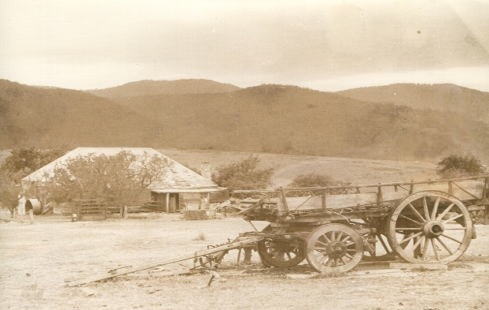
Towamba Homestead and bullock wagon.
No date
The station has been cut up considerably by
free selectors, who have taken most of the
choice spots on the river banks, and the
population has so much increased that there
is a second erected on the station, a few
miles higher up, at a place called Burragate,
or Pussy Cat.
Being 'on pleasure bent', I diverged a little
from the comfortable home station at Towamba,
and visited Burragate. The school here is
a half-time one, under the charge of Mr.
G. D. Riley. It is constructed of sawn timber
and shingled, and is a very neat little building.
C. T. Stiles Esq., is the only member of
the local board, and to him is mainly due
the credit of erecting this school. There
were sixteen children in attendance, including
all on the roll. This is the only school
that I have ever visited where the number
in attendance was the same as the number
on the roll. Though only opened a short time,
the children were examined in grammar (including
reading, parsing, and analysis) arithmetic
and geography. They showed considerable proficiency
in these branches; and taking into consideration
the fact that they only get half-time instruction,
they must be either remarkably intelligent,
or the method of instruction must be very
good, perhaps both. Besides their good writing,
I must not forget to mention that other necessary
parts of parental care, school discipline
and the children 's welfare, had not been
neglected. They were all neatly dressed,
and wore boots, and all had clean faces and
clean hands.
Under these favourable circumstances, I am
tempted to give the names of a few of the
scholars whose proficiency was worthy of
mention. viz.: - O. Sherwin, W. Robinson,
A. Binnie, Alice Sherwin, Sarah Robinson,
and Elizabeth Hide.

JINGERA ROCK, BURRAGATE.
Photo K. Clery
A few miles from the school there is a grand
sight, worth a day's ride. It is a great
wall of rock, three miles east of Burragate,
and a mile from the Wyndham-road to the Monaro.
It forms part of the Jingery mountains, of
which Mount Imlay is the highest point. This
almost perpendicular wall of rock is calculated
to be 1300 feet high, and 900 feet wide.
About half way up there is a ledge; and from
the highest part there is a waterfall or
cascade, which falls on this ledge, where
there are four or five perfectly circular
wells, filled to the brim with water. The
depth of these wells must be very great,
for we tried to bottom them with saplings
twenty feet long, and did not succeed. There
are pipes in the stone, leading from this
ledge over to the next, at an equally great
depth below, where there is a second well
or couldron-shaped indenture in the rock.
At one end there is an outlet by which the
water escapes down the rocky precipice.
We returned to Towamba from here, passing
several free selections on the road. From
the station we had a long ride of twenty-four
miles, through a country which was as changeable
as the climate - summer in the morning and
winter in the evening. Between ranges, along
cattle tracks, through sterile country, and
then wild passes, followed by well-grassed
and undulating pastoral land, and at last
arrived at an opening where the welcome sounds
of human voices struck our ears. This is
Nangutta station the property of Mr. Alexander
Weatherhead - as bluff, yet genial, and hospitable
an old gentleman as there is in the colony.
Even before we had introduced ourselves,
our horses were taken charge of, and we were
welcomed to a comfortable and well-built
house, surrounded by flowers and emblossomed
in climbers. Such was the spot where Mr.
Weatherhead has made his home. The years
of toil attendant on the opening of this
part of the country must have been very great,
but the worthy owner is well repaid.
Nangutta is altogether 32,000 acres in extent,
and is now a cattle station. The country
is principally mountainous, and, therefore,
only suitable for pastoral purposes. I was
glad to notice the excellent breed of cattle
on the station, which is in strange contrast
to the mongrel breeds of some parts of the
coast, with the exception of those at Towamba,
which are mostly very fine. The view from
Nangutta House is grand in the extreme. Lofty
mountains clad in verdure, east west, north,
and south, and winding valleys in the centre
of which is a fine stream of water ever flowing,
and yielding an abundant supply for the station.
All these good things are calculated to make
the life of the worthy proprietor and his
family a happy one. The business of the station
and personal attention to their herds relieve
the solitude which might otherwise prevail
among this pioneer family. Mr. Weatherhead
has reared a goodly number of tall, strapping
sons, and fine well-grown daughters; and
they, one and all, inherit the same kindly
feelings which characterise the father. They
are just such people, in fact, as a gifted
writer in a recent number of the Town and
Country Journal described in the following
beautiful lines: -
Strong and active, tough and tireless,
open-hearted kindly souled,
such as poets love to picture in the far
off age of gold;
Such people as bring back to our minds the
time: -
When our fancy fondly lingered in that past
our soul reveres,
When man's life was nursed by nature into
patriarchal years:
When the field, the forge, the study, claimed
no life-exhausting toil,
And the sons of men lived simply - from the
kindly-natured soil.
The Bega Gazette and Eden District or Southern
Coast Advertiser
Wednesday 22 November 1882
DOWN TO TOWAMBA
The approaching sale of the Towamba Estate
has induced many of the residents of this
district to visit the place which has been
brought so prominently before the notice
of the public at large by placards, lithographs,
and advertisements in the press all over
the colony for the past month or two. The
writer was fortunate in obtaining a seat
on Friday last with a party who were journeying
down to see the country; and the whole trip
there and back was most enjoyable, giving
great satisfaction to all the parties to
the arrangement. A very fine team large roomy
vehicle with a well known whip in charge,
plenty of tobacco, plenty of racy conversation,
and plenty of fine weather, nothing more
was desired or asked for. The journey to
Eden was without incident, further than that
several other Bega teams joined in about
Panbula, and made a good show into the Port,
which was reached about five o'clock. Mr.
Hopkins' hotel was quite full when the whole
brigade was apportioned billets. After tea,
as is usual in Eden, the conversation turned
on the prospects of the Port; everybody seemed
to be quite satisfied that the day is coming
when Eden will be a tremendous place of business,
the Port of all the southern portion of the
colony, with a large transit trade, with
large ships direct from home, and cargoes
going straight to London, with a large intercolonial
steam trade, and beautiful steamers coming
and going to all the chief ports of the Australian
group. No one, however, seemed to see how
it all was to be brought about exactly, and
after two hours' discussion of the subject
we turned in a little after 10 o'clock, arranging
beforehand for a very early breakfast in
the morning, and corresponding early start.
Six o'clock on
Saturday morning saw us started for Towamba,
distant eighteen miles. Getting immediately
into a splendid timber country, the road
for the greater portion of the way goes up
and down the hills, just in the old track
originally formed by the blacks. Some very
fair cuttings have been made, but the road
has not been shaped by any professional man,
simply improved by the small yearly sum allowed
by the government; but it is patent to anyone
travelling along, that all the hills and
hard portions of the road can be avoided,
in fact a recent trial survey gives a very
fair level road, much shorter than the present
one, that can be made at a comparatively
small cost. Two or three miles from the homestead
a very fine view of the estate is obtained,
and as the road comes down on to the Towamba
River signs of civilisation present themselves-
patches of grain, ploughed flat lands on
the river bank, small grass paddocks and
orchards, yards, outbuildings and houses;
and after crossing the river, Towamba house
is reached at 10 o'clock-three hours from
Eden. We indulged in a second breakfast while
the horses were being run in and yarded,
as there was no likelihood of getting anything
to eat before the re turn in the evening.
The whole party, escorted by Mr. C. T. Stiles,
set out at 11 o'clock to view the country-a
very much larger job than most of them anticipated.
Speaking for myself, it was the biggest lot
of the kind that had presented itself for
the past five years. Nine or ten thousand
acres of country, no matter how level it
may be, covers more ground than any outsider
would have the slightest idea of, and the
majority of the party were grateful when
our guide and director turned on to Block
26, and made tracks for the homestead about
7 in the evening.
It would be out of place here to write critically
of the country. All that can be said of it
is this, that it went considerably beyond
the expectations of the most sanguine. Beautiful
undulating country, lightly timbered, with
creeks of water abounding all over the estate,
grasses of all descriptions plentiful in
the different paddocks, and some of the grandest
bullocks in the southern district in them.
One fellow, (a great big fellow) was quite
pleased to see so many strangers visiting
the place, and as we drew near gave a little
bit of a roar, then a jump or two, and a
twirl of his tail, and a small charge at
one of the crowd; then stood still until
we passed; and then another little roar,
and a dance, and another charge, quite pleased
to show off before so many strangers, until
we left the paddock and got into block number
eighteen. Eight o'clock saw the whole of
the party seated about the verandah after
tea, smoking and yarning, discussing the
day's proceedings and the journey of the
morrow, whilst the maid inside was using
her best endeavours to provide sleeping accommodation
for the rather large party who had invaded
this usually quiet household. After so many
hours' riding, none of the travellers stayed
up late, and before 10 o'clock the whole
house was quiet. Before five the next morning
everybody was astir, breakfast was ready
half-an-hour after, and at six o'clock the
cavalcade started, with the Messrs. Stiles
attending. The new town ship, which is being
surveyed on the opposite side of the river
to the house, was visited, and the old Monaro
road, used by Boyd in the early days of the
colony followed to Honeysuckle, passing,
on the way, Blocks nine, ten, and twelve,
together with the lands and residences of
Messrs. Binnie and Keys. This land is thickly
covered with wattle, now in full bloom, a
grateful relief to the uniform colour of
the foliage. An hour's spell and turning
out of the horses at Mr. Prosser's at Honeysuckle
was very acceptable to man and beast, for
the heat was very great; then a quiet drive
along the Big Jack Road into Panbula, (or
"Pampula," as one of the old members
of the party insisted on terming it) in time
for dinner. Bega was reached a little after
six o'clock, and one of the most enjoyable
trips that has been made for some time back
in the district came to an end.
It would be ungrateful to pass over without
comment the very courteous attention the
whole party received at the hands of Mr.
Stiles, from the time of meeting him half-way
on the road between Eden and Towamba, until
he bade the company good bye on the north
side of Block twelve. The whole of his establishment
was placed at the disposal of the visitors
with a freeness which disposed of restraint,
and it will be a very long time before the
writer forgets to speak with pleasure of
the trip down to Towamba.
YOUNG D .
'The Bega Standard and Candelo, Merimbula,
Pambula, Eden, Wolumla, and General Advertiser'
25 Nov 1882
Impressions of Eden and Towamba.
By an Old Resident.
Towamba subdivision; Eden subdivision; or
Palestine estate subdivison; Eden -
everything now in Eden; everyone seems to
have Eden on the brain; and speaks as
though the fact of a railway survey from
Bombala via Candelo and Wolumla would
cause a great city to spring up in a night,
like a mushroom, at the port of Eden.
Hearing, so much of this wonderful locality,
I began to feel out of place in company,
if 1 could not rhyme off by heart the number
of each block of the Towamba estate, so I
turned my steps southward, and I soon found
myself at Hopkins' hotel, Eden. The sensation
at the time was anything but pleasant; a
strong south wind was blowing, and a sea
rolling in with awful force; I could with
difficulty keep from parting company with
my hat. Nothing could be seen that night,
but I was out at day-break next morning;
the sea was grand, I never saw it heave and
surge with such majestic force. All at once
a snug little steamer came round the Lookout,
and in a few minutes was alongside the wharf
expecting passengers for Melbourne, but being
informed that the Begaites thought no vessel
would, be at sea in such weather, was off
to sea in a few minutes, and lost to sight
beyond the breakers off the South Head. I
was made the butt of a good many jokes about
our Tathra and Merimbula ports. I felt very
small on the subject, and thought the less
said the better. I was always a firm believer
in a railway from Eden to the table land
of Monaro, and more so now than ever. Any
ship, in any weather, by day or night, without,
a pilot, can enter the port and ride at safe
anchorage. What a universal benefit it would
be to the travelling public of Bega and Monaro
districts if they could travel
by sea in first -class steamers, that could
span the distance from Eden to Sydney in
fourteen hours in any weather. Had we the
railway from Monaro to Eden, a passenger
could have his dinner up the mountain, be
in Sydney in time for breakfast next morning,
do his business in
Sydney, and be at home for dinner next day.
Besides, many of our industrious farmers,
having holdings under 320 acres, could make
a comfortable living for their families,
as they could, by having railway communication,
compete with the Victorians and our own northern
and western farmers in the Sydney markets,
with hay, chaff, potatoes, onions, and the
like,
Eden has for years been supplied with forage
from Tasmania cheaper than the land carriage
would come to from Bombala, and many of the
small holders having agricultural areas have
to sell out to the large land-holder, because
he has not sufficient land to run a flock
of sheep or to keep a diary; and he is forced
by necessity to be the unwilling dummy of
the large land-holder, consequently if our
railway is not put through at once our small
holdings will have passed into the large
land-holder, who will become a land-lord,
and we will have the land in the hands of
a lot of tenant farmers, and the history
of discontented Ireland will be repeating
itself in New South Wales. You may ask me
how would a railway prevent this? I answer
by placing less favored farmers in this district
on equal footing with other farmers in railway
districts. The freight on one ton of hay
from Sydney to Tathra is 20s per steamer,
and by
rail it is only the same for the same distance.
Had we rail to Eden, our steamboat companies
would be as well paid at 10s loaded at Eden
direct, as they are now fooling about for
3 days at every little inlet for 20s. No
intelligent person can shut his eyes to the
fact that this district has arrived at that
stage of maturity, when a railway is an absolute
necessity; nor can any Government expect
to hold office who may try, to shirk the
responsibility.
Some argue that Sydney merchants would oppose
this line, because it would be competitive
to the Sydney line, as Eden would soon become
a formidable rival to Sydney; and if a line
from Cooma and Bombala, and another from
Cobargo, through Bega to Eden, were completed
no doubt but Eden would become greater in
10 years than Sydney was for the first fifty,
as Sydney only grew slowly as the population
increased. We have now an established
ocean trade of vessels of the first magnitude
passing within sight of Eden, and an extensive
territory capable of producing almost any
commercial product, together with a wealthy
population, and we want only a few miles
of railroad to allow trades and commerce
to flow in their natural channel, and cause
Eden to become what from her geographical
position, her salubrious climate, her easy
ingress and egress, entitle her to become
- a great sea port town. This, instead of
provoking the jealousy of Sydney should and
would be Sydney's pride.
Some people are of opinion that Sydney members
wish to keep Eden in the back ground. Nothing
can be more absurd. Who, I ask, but the merchants
of Sydney are to supply the material which
will be required to build the great City
of Eden?
Eden's prosperity must be Sydney's gain!
and the opening of a great shipping port
at Eden must soon attract a considerable
trade from the northern portion of Victoria.
Our Government have made a great mistake
in surveying the township, nearly all the
original town must be bought back for harbour,
fortifications, recreation grounds, and government
sites for public purposes, and the sooner
a step is taken in that direction the better,
before speculation sets in. What would now
only cost a few thousands, will soon run
into millions.
The town proper should have been at least
a mile from its present centre. Unfortunately
for Eden much of the property is held only
by jumped titles, which must retard the progress
of the town, and those who have titles will
neither sell nor build.
To get a house at Eden at present is an
utter impossibility.
I have left myself little space to speak
of Towamba, but I have been there for the
first time in my life, and I am thoroughly
ashamed of myself to have allowed 10,000
acres of such magnificent country to fall
into the hands of one firm.
I say to every person in search of good
dairying country, see Towamba before the
day of sale, and judge for yourself. When
you do see it perhaps you will say as I did,
I never expected to see such land at Towamba.
'The Bega Gazette and Eden District or Southern
Coast Advertiser'
Wednesday 29 November 1882
The Towamba sale came off yesterday most
successfully, and brought together the largest
number of buyers ever seen in Bega. The average
was over £4 per acre. A few lots were passed
in, but purchasers are treating for them
privately. The late hour at which the sale
was over precludes the possibility of an
extended report till Saturday.
'Australian Town and Country Journal'
26 May 1883
Southern Pencillings.
BY "THE RAVEN."
TWOFOLD BAY AND THE EDEN DISTRICT.
THE road from Panbula to Eden, a distance
of 12 miles, is not interesting with the
exception of Greig's Flat, three miles from
Panbula, where there are several small maize
farms and a few orchards; the country passed
en route, which is principally forest, shows
few, if any, signs of settlement. A mile
beyond Greig's Flat one has to ford the Salt
Water Creek, after which an almost unbroken
and monotonous stretch of uncleared forest
land continues until the town ship of Eden
is reached.
From a distance Eden gives one the idea of
a town of no slight pretensions, the natural
beauties of its locality and its numerous
buildings, many of them large brick and stone
edifices, combining to make a favourable
first impression upon the stranger. Upon
a closer inspection, however, if is found,
alas, that many; I might even say the majority,
of the aforesaid buildings are untenanted
and rapidly falling into decay. (This, to
a great extent, is explained by the fact
of Eden having sprung into prominence, if
not existence, during the great; rush to
Kiandra in 1860, to which goldfield it was
considered the best starting point.) At this
time town allotments brought fabulous prices;
the town boasted as many as 13 public-houses
(now reduced to two), whilst thousands of
people were living in tents. The rush, unfortunately,
failed, and Eden suffered in consequence.
From this fall it has never recovered, and
is not likely to until the influence of the
much-talked of railway is brought to bear.
Eden is 202 miles south of Sydney, and is
situated on the north shore of Twofold Bay,
so called from the fact of its being divided
into two bays, by what is known as the Middle
Head or Look-out Point. Of these two, however,
only the South Bay is used for shipping purposes,
and, as is well known, it forms one of the
best harbours on the coast, possessing a
first-class en trance and an immense extent
of deep water.
The Tasmanian S.N. Co.'s steamers are supposed
to call in weekly on their way to and from
Tasmania, but, through press of trade in
Hobart, have lately been very irregular.
The I.S.N. Co.'s steamers make bi-weekly
trips here. There are two places of worship
in Eden, of the Presbyterian and Roman Catholic
denominations respectively, a public school
with an attendance of about 60 children,
a court-house, and one or two stores, the
principal of which is kept by Mr. S. Solomon.
One of the early residents of the Eden district
was a Mr. Ben Boyd, who, by-the-bye, disappeared
mysteriously and has never been heard of
since; he owned a large tract of country,
immediately to the north-west of the South
Bay, and, in the hope of getting the road
to Monaro to pass that way, he built a town
there, opposite to where Eden now stands,
called after himself Boydtown. He put up
there a splendid hotel, stores, and a row
of houses, which he christened "Jerusalem,"
for the use of the workmen employed in a
large boiling-down establishment, which be
carried on in the locality.
In order to keep back as much as possible
the development of the then young town of
Eden he bought allotments there, upon which
no one was allowed to build. In spite of
these precautions, however, Boydtown, with
the exception of the hotel, which is now
used as the private residence of Mr. Flavelle,
the present owner of the property, is to-day
in ruins and a town of the past. On the south
head is the tower of a lighthouse, built
at a great cost by Mr. Boyd; the stone for
this was all procured from Pyrmont, but the
lighthouse was never completed in consequence
of some misunderstanding with the Government.
Curalo Lake, at the back of the beach of
the north bay, is a pretty sheet of water
about a mile long, by half a mile wide, and
is generally liberally besprinkled with swans.
The district of Eden is bounded on the east
by the Pacific, on the north by the Bega
district, on the west by Monaro, and on the
south by Victoria. The country, as a rule,
is of rugged and brush-covered description,
its geological formation being sandstone
and granite. It is mainly devoted to stock-farming
and fattening, large numbers of cattle being
sent to Tasmania.
Sheep do not thrive here, and are besides
subject to foot-rot. Dairying (butter and
cheese) is now very much on the increase
here, more especially in the neighbourhoods
of Towamba, Wyndham, Burragate and Rocky
Hall, where numerous small farms are to be
met with. Maize and potatoes are cultivated
to some extent, the former being largely
used for feeding pigs, a great number of
which are reared in the district. Many of
these are turned into bacon, but I believe
I am not far from the mark in saying that
the majority are sent alive to Melbourne,
in steamers that call in purposely for them;
their bed, during the voyage, is usually
on the top of the coals, a supply of maize
being taken for feed. Hops have been tried
on a small scale and succeed well, as do
also English fruits.
The principal runs in the district are Towamba,
held by Mr. C. T. Styles and Sir Wm. Manning;
Wog-wog, by Messrs. Ramsay and Morehead;
Nungatta, by Mr. Alex. Weatherhead; and Bondi,
by the Bank of N. S. Wales. All of these
are cattle stations, and each is over 35,000
acres in extent. A large amount of country
on each has been secured by auction and conditional
pur chase, but with the exception of that
on Towamba the land is generally of a somewhat
inferior description. The total extent of
land secured in the Eden district is 75,000
acres. Its population is only 1550.
There are large quantities of fine serviceable
timber in the district, the principal descriptions
being woolly-butt and ironbark. Captain Nichol
son, late of the schooner Ellen, has a sawmill
at work, and another large one is in course
of erection near Boydtown. Wattle is plentiful
in the district, the collecting the bark
of which gives a lucrative employment to
many.
The two principal streams running into Twofold
Bay are the Nullica and Towamba, or Kiah,
rivers. The waters of the neighbourhood abound
in oysters, in which a good trade is done
with Sydney and Hobart, three individuals
holding licenses.
One important industry of Twofold Bay is
the exciting and lucrative (if lucky) employment
of whaling, of which, unfortunately, I was
too early to witness anything. The season
commences about 1st June and finishes at
the end of October, between these months
being the period during which the "killers"
take up their residence in the locality.
Before proceeding further, how ever, it would
be perhaps as well to give some idea what
a "killer" is, and in what way
it can influence the whaling season. A killer
is a fish, which sometimes attains a length
of 30ft, has a round head, with formidable
teeth, a large dorsal fin, or, more correctly
speaking, spike, often 6ft in height, and
a tail like a whale. These fish are the best
friends the whaler has, as they not only
chase the whale, like a pack of dogs, into
shallow water, leaving it an easy prey to
him, but when one of these monsters is attached
to a boat by means of a harpoon and rope,
they materially retard its progress through
the water. Upon a whale being despatched,
this rapacious pack of hungry denizens of
the ocean, take it to the bottom, where they
generally keep it for 24 hours, and on the
occasion of the capture of the first whale
of the season, take care to leave remarkably
little of it for their co-hunters on the
surface of the water.
There are two descriptions of whales got
here the "right" or black whale
and the "humpback" the former will
yield 10 tons or more of oil, worth some
£30 a ton; the latter, which is by far the
more common species here, will give from
five to seven tons of oil of the same value.
The bone of the right whale is more valuable
than that of the humpback. For some reason,
best known to themselves, the killers do
not make a habit of tearing the right whale,
but of simply eating out the tongue.
There is now only one whaling party at Eden,
who have their "try" works (extracting
the oil from the blubber) at the mouth of
the Towamba river. There were formerly three
or four, amongst whom there was great competition,
the excitement at the approach of a whale
being, I am told, something tremendous. Private
signals to acquaint the members of the respective
parties of the auspicious event were used,
and a general rush to the boats took place.
The most common weapon directed against the
life of the whale here is the bomb, which
is fired out of a small brass gun, and which
explodes after a few seconds, sudden death
being generally the result. A hand lance
5ft or 6ft long with a small line attached
is also used; this is plunged into the body
of the victim several times, being withdrawn
by means of the line. The harpoons used are
usually attached to a line from 60 to 109
fathoms long.
I cannot close this letter without expressing
not only surprise, but regret, that one of
the finest harbours in the southern hemisphere,
as Twofold Bay certainly is, should to-day
be almost unknown and, I might say, entirely
unrecognised by the powers that be. Various
reasons are ascribed for this. Would-be prophets,
however, foretell a grand future for it,
and even go so far as to say that, if federation
becomes an accomplished fact. Eden stands
a good chance of be coming the capital port.
June 28, 1884
'The Bega Standard and Candelo, Merimbula,
Pambula, Eden, Wolumla, and General Advertiser'
Notes of a Journey from Bega to Genoa via.
Towamba.
My object in writing a plain and unvarnished
account of my trip to the above places, is,
that having been interrogated by numerous
intending selectors, I can in form a great
many who are anxious to know, what sort of
country it is - its capabilities for settlement,
and if it is worth selecting. On these points
I will give my opinion through the columns
of your journal, as the STANDARD is, I can
safely say without flattery, the only paper
from Bega that finds its way into these remote
and long-neglected parts, and the residents
seem to be in blissful ignorance of the existence
of another print in your rising and flourishing
town. So much for the "preamble.'"-
I left home on the 25th ultimo, being Sunday,
the day after Queen's Birthday, and at dinner
time found myself at that snug little township
of Candelo, whence the revelries of the previous
day and night had not quite departed, and,
were I to judge from the few gushing spirits
notice able, the fastness of the rising generation
is quite in keeping with, if not a shade
in advance of, the progress of the town.
However, I was well attended to at dinner
by mine host Cochrane, whom I have known
for years, and I can say he is as jolly now,
and can laugh as loud, as the first day I
saw him. No better man could be wished for
to 'boss' a country hotel than this same
Jem Cochrane. The country round the 'Vale'
looks well, grass short, but sweet and green.
The road to my destination goes through paddocks,
Mr. J Collins jnr., Ryan's Swamp, lying on
the left, where I noticed the milking cows
were being fed with green stuff. On the right
is Mr. T. McAuley's property, on which the
hills look grand. Mr. McAuley has a nice
and comfortable homestead, and is the owner
of some 2000 and odd acres, all divided into
paddocks, rung, and other wise generally
improved. All this beautiful property, which
will be a mine of wealth to the owner in
a few years, has been obtained by honesty
and hard work. At Bateman's Creek, at the
back of Mr. Bower's farm, the first cutting
on the Myrtle Creek road commences, and continues
for some distance. Two creeks close to each
other are very dangerous spots, and it is
impossible to take any kind of vehicular
conveyance over them. The cutting continues
through Cook's paddock, but there is no sign
of a culvert at any of the creeks, which,
I think, is a mistake, as the road is practically
useless and impassable for wheel traffic
without them. The cutting stops in a very
rough part of the road, and if the traveller
keeps on he will find that it is necessary
to retrace his steps some distance to make
the old road. Without further mishap I arrived
at Mr. Prosser's accommodation house, Honeysuckle.
The house itself is externally a rather unpretentious
one, but inside the traveller will find cleanliness,
comfort, hospitality and moderate charges,
which more than atone for any defects in
the outside appearance. Mr. Hickey has a
general store here, and Captain Nicholson's
sawmill is in full work close at hand, and
I am informed he is doing well. The 'skipper'
was away in Sydney for medical treatment
at the time of my visit. Next morning found
me in the saddle bound for Towamba, distant
from here about fifteen miles. For the first
seven miles the country is poor and uninviting,
but when that distance has been traversed
there is a marked change in the soil, and
you come to some good paddocks. Then past
Burragate, leaving Binnie's to the left,
you come to the pick of Towamba.
McPaul's farm is on the Perico Creek, and
here a flourish ing dairy is carried on.
It is a pity that the land offered by Mr.
C. T. Stiles at auction, last year, was not
sold, for I consider it equal in every respect
to the Bega country for dairying and grazing
purposes, being something like the best of
Numbugga and Meringlo. On a portion of the
10,000 acres Mr. Stiles still holds I saw
some Bibbenluke cows that, I was informed,
had been sent down 'as poor as crows' about
nine weeks previously, and plenty of them
are now good ' beef.' The grass is plentiful,
and as green as a wheat-field. Mr. Purnell,
one of the dairy fanners, told me that he
made three large kegs of butter per week
from 45 cows last summer. Had that sale gone
off there was a great future in store for
Towamba. I may state that the land that is
now being taken up by selectors is very inferior
indeed, in fact, like every other place,
the eyes have been picked out of Towamba.
Settlement is going steadily ahead, and there
are a few very energetic men who do the best
they can for the locality, and they deserve
great praise for the way in which they urge
on the claims of the place. The roads are
in a very bad state, and growls are the order
of the day. From Perico, Mr. J. Alexander's,
to Nangutta, Mr. Weatherhead's, is eighteen
miles, and there is only a very indistinct
bush track connecting the two. Until a dozen
miles are passed the country is barren in
the extreme, and would not feed a bandicoot;
but six miles this side of Nangutta it is
a great deal better. I was hospitably entertained
at the latter place for the night. Mr. Weatherhead
has about seven or eight thousand acres se
cured on his run; and there are some good
spots there yet, but a fair amount of capital
is required to work them.
From Nangutta to Genoa is 24 miles, and the
road is good, cuttings having been made and
culverts put in by a bark firm from Melbourne.
Wangerabell, Mr. W. Stevenson's, is 12 miles
from Nangntta, and in Victoria. There is
some fair country here, and numbers of selectors
are on the run. The country is mostly timbered
with box, with gritty ridges interspersed
by flats. Mr. Stevenson has a great aversion
to selectors whom be looks upon as his natural
enemies. On the same day, 29th May, I got
to Genoa and stayed at the residence of Mr.
Robert Alexander for two nights. On the Genoa
the flats are suitable for growing anything,
but at present are all lying waste and idle
; hundreds of acres, as good as your best
Bega flats, growing nothing but rushes and
tussocks ten feet high. Mr. Alexander has
eighty acres of flat, forty of which could
be ploughed at once. Boats come up the river
to these flats, land supplies and take away
produce from the banks; the river abounds
with fish. Mr. W. Allen has a nice residence
and some very good land on the left bank
of the Genoa River, on which maize is grown
to a considerable extent. To any energetic
men a fortune awaits them here; I do not
consider the hills so good as reported, but
when the timber is killed it may prove fair
grazing land. Mr. Alexander will be most
happy to show any intending selector, and
he owns the run. He would like to see a large
number settle down there, when the place
would be bound to go ahead. There are not
many of those good spots open for selection,
but they could be rented very cheap. Mr.
Harrison, of Twofold Bay, owns Howe Hill
Station, and his steam craft will trade regularly
up the river with timber, etc; I am also
informed Mr. Dorrel, the wattle bark merchant,
intends starting an extensive saw mill ;
but what Genoa most requires is a number
of practical agricultural farmers, as there
is certainly a mine of wealth in these fine
flats if only properly managed. Next day
I proceeded from Genoa to Nellybarba, where
Mr. McCloy, a Wollongong man, has selected.
The country is patchy and bad throughout
from there to Timbillica; Mr. Robert Alexander
owns the latter place, and keeps the post
office. From there to Doyle's on the Kiah
River, which is only a continuation of the
Towamba River; by following up tho river
for about eight miles you could to Mr. Mitchell's
at Towamba, which I reached after dark, having
ridden that day, through very rough country,
about fifty miles. From Genoa to the Bay
(Eden) is forty-five miles by the road, which,
I am told, is a fair one. Mr. Mitchell was
most kind, as indeed are all the settlers.
His place is in capital order, and shows
that a large amount of industry has been
bestowed on it. He has any amount of push
in him, and grows corn and fattens pigs.
Next day found me homeward bound for Bega,
which I reached about sundown. WANDERER.
'The Sydney Mail and New South Wales Advertiser'
Sat 16 May 1885
EARTHQUAKE SHOCKS IN THE SOUTH
BEGA, Wednesday.
An earth tremor was distinctly felt here
a few minutes before 10 o'clock this morning,
lasting over 40 seconds. Some persons say
that a slight shock occurred last night,
between
11 and 12 o'clock.
ALBURY, Wednesday.
A slight shock of earthquake occurred here
about 10 o'clock this morning.
BOMBALA, Wednesday.
A very severe shock of earthquake was felt
here about 10 o'clock this morning. The tremor
lasted for several seconds, literally shaking
the houses. It is spoken of as being the
most severe shock that has been felt for
a long time in this district.
MELBOURNE, Wednesday.
A shock of earthquake was experienced this
morning about half past 9 o'clock, travelling
from south to north, and lasting about one
minute. Some alarm was caused by the shock
at Sandridge, where its effects on the shipping
were most marked.
HOBART, Wednesday.
A smart shock ot earthquake, this morning
about 9.40 was felt here and all over the
colony. The shock is reported as having been
very severe at Launceston, and in the northern
parts of the colony. At one place the children
ran out of the school, and numbers of persons
left their houses,
but no serious damage is reported. The shock
is the most severe that has been felt in
the colony.
'Australian Town and Country Journal'
3 January 1891
New Year's Day.
PAST AND PRESENT.
OUR COUNTRY AS IT WAS, AND AS IT IS.
THE AUSTRALIAN METROPOLIS.
GLANCED AT FROM 1790 TO 1891.
New Year's Day, 1791, and the first day of
1891 are separated only by a hundred years
of time, but how far are they apart when
the interval is measured by the changes that
have taken place. Pictures of New South Wales
as it was and as it is, that accompany this
article remind us what our advanced civilization
makes us easily forget, the rapidity of our
growth. An appropriate accompaniment to the
series of illustrations, which so forcibly
depicts our progress is the portraits and
biographies of some of our very old residents.
They are people who have grown up with the
nation, who have helped to found it, and
who can remember our Pilgrim Fathers. Last
week we gave two of these people-Mrs. Martin
and Mrs. Mobbs. The last mentioned of the
two died only a few weeks ago, leaving behind
her a host of descendants, numbering some
hundred good Australians. This week our portraits
include Mrs. Medhurst, doubtless the oldest
living native of Sydney, now in her 91st
year. The first day of the year has always
in the history of Australia marked the beginning
of twelve months of rapid progress, of a
vigorous growth of all those institutions
which go towards making a happy and prosperous
nation. Australians do not mourn over the
death of the old year-the dawning of the
new one is too bright with hope for that.
"Time to the nation as to the individual
is nothing absolute; its duration depends
on the rate of thought and feeling."
This was said by a historian of intellectual
progress in Europe, and it may be said with
equal truth of Australia.
But if the duration of time to this nation
be measured by its march on the road to nationality,
then the truism that "time is nothing
absolute" can be fittingly taken to
be the moral of Australian history.
Without going so far back as the last century,
there are plenty of strong contrasts to be
obtained. …It has the appearance of a very
indifferent bush township of the present
day, and the picture is an accurate one,
for it was taken from an old and valuable
book, published at a time when the people
could judge its truthfulness. On New Year's
Day, 1800, Australia could boast of live
stock: 39 horses, 72 mares, 188 bulls and
oxen, 512 cows, 3189 hogs, 4721 sheep, and
2588 goats. Of land in cultivation: 6465
acres of wheat, 2302 of maize, 82 of barley,
and 8 of oats. There were 9356 inhabitants
in the settlement, out of which 6000 sup
ported themselves. Says a writer of the period:
"The Rocks, a part of the town of Sydney,
is the general promenade for the dashing
belles of the settlement; and the European
women, it is observed, spare no expense in
ornamenting their persons. The shops, where
most of their decorations are purchased,
are set out with much taste; and articles
of female ornament and apparel are greedily
purchased."
........It must not be supposed that Sydney
was without public buildings at this time;
but these were chiefly granaries, gaols,
and barracks. The town of Parramatta was
also a long way ahead of what it had been
a few years before, for, in addition to granaries,
barracks, new Government House, and a "neat
thatched hut for the gardener," "a
handsome church was erected 100ft in length,
with a room, 20ft long, raised on stone pillars
for a vestry or council room." …..It
will be seen that the "handsome"
church, which was completed in 1802, and
called "the new church," was in
a severely simple style of architecture.
It was built of red brick. The church was
long known as old St. John's, and its foundation
was laid as far back as April 5, 1797. It
was first used for divine service on April
10, 1803. The late Mrs. Mobbs of Parramatta,
whose portrait was given last week, was married
in it by the Rev. Samuel Marsden. ….The first
part of the structure was begun in 1797.
This was the old clock tower. The tower fell
down in 1806, and was rebuilt of stone the
same year. The church was opened in 1809
by the Rev. W. Cowper, who arrived in Australia
in that year. This gentle man was father
of the present Dean Cowper. The church was
completed in 1803, and George III. presented
it with a handsome altar service. The building
remained unaltered until 1848, when the existing
structure was begun at the rear of the old
church….. the Female School of Industry situated
at that time (1834) near where the Public
Library now stands. …..St. James's Church,
the oldest church now standing in Sydney.
The Rev. Samuel Marsden preached the opening
sermon in it on July 6, 1822. …..of St. James's
Church (the School of Industry) are compared
with Sydney in 1800, and those with Darling
Harbor in 1790, are placed in comparison
with King street on New Year's Eve, 1891,
and Darling Harbor with a view of Sydney,
then the rapidity of our growth may be to
some extent realised.
......When the year 1834 opened Governor
Bourke was considering new regulations regarding
the assignment of convicts, which led to
no little excitement and dissension among
the population. Before the end of the year
the first step had been taken towards the
construction of Circular Quay. As a preliminary
towards the beginning of this work it was
suggested in the Legislative Council that
a salary of £800 per annum should be guaranteed
for five years for the payment of a competent
civil engineer, the salary being granted
as a means of inducing a competent person
of that profession to come and settle in
the colony, where hitherto no civil engineer
had taken up his abode. The whole charge
for the year was estimated at £132,790, and
the ways and means at £147,344. Out of this
revenue £120,000 was derived from the consumption
of ardent spirits. They drank freely in those
days, although they did not do much to celebrate
the holiday. The advertisements in the papers
of the time do not offer harbor excursions,
and reduced or any other railway rates to
pleasure resorts were not dreamt of. The
only steamer advertised was the Tamar, running
to Newcastle. Darling Harbor was, of course,
greatly improved upon what our picture shows
it to have been in 1790; but its waters must
have been very different to what they are
now, or this little item of news from a paper
of the day would not have appeared: "Lieutenant
Finch, of the 17th Regiment, was fined 5s
for bathing in the waters of Darling Harbor."
There were several bushranging exploits reported
on the Parramatta-road in the January of
that year, and there was a curious advertisement
in the LONDON TIMES. It set forth that any
lieutenants in the Royal navy under 45 years
of age, with large families, could obtain
a free passage to Sydney, New South Wales,
on application to C. T., R.N., Post Office,
Hythe, Kent. Who was C. T., R.N. Was he a
kind of General Booth, with a scheme for
the relief of half-pay naval officers by
sending them to Australia; or was this a
"plant," and C. T., R.N., a rogue?
Sydney in 1848 can be remembered by a good
many of its citizens in 1891, yet many are
the alterations and momentous the events
which have come about since then. Taken from
drawings made in that year, we give two illustrations
of Twofold Bay. Boyd Town is on the south
shore of Twofold Bay, and Eden on the north
shore.
 |
 |
The latter township is the important one
nowadays, but it was Boyd Town in 1848 that
was the chief place. A particular interest
attaches to this port, as it was off Twofold
Bay that Captain Cook lay to on the night
of Friday, April 20, 1770, after having first
made the land of New South Wales in the neighborhood
of Cape Howe, sighting the Ram Head. The
town of Boyd was divided by the river Kiah
or Towamba, and the two portions were called
East Boyd and Boyd Town. Both towns were
named after their founder, Mr. B. Boyd. During
the year 1848 a lighthouse was erected on
the south head of East Boyd, and was then
considered the finest structure of its kind
in Australia. At that time the whaling industry,
since completely died out, was flourishing
at Twofold Bay; and Boyd Town was a busy
little township in consequence. Our illustrations
include a picture of whaling in Twofold Bay.
Sydney in 1848, although grown to a city,
was a long way behind what it is now, not
half a century later. Its population was
38,358, and out of 7109 houses in the city
1820 were of wood. At that time J. F. Josephson
held the office of Mayor, and he was the
sixth mayor since the incorporation of the
city in 1842 under the old act. It was 20
years before the foundation-stone of the
present handsome town hall was laid. The
newspapers, when the year opened were beginning
to look forward to steam communication with
England, which had not then become an established
fact. But the chief topics occupying the
public mind at the time were the proposed
constitution in view of Port Phillip becoming
a separate colony, and before the year ended
the transportation question and the contemplated
railway were subjects creating much excitement.
Twenty years later, in 1868, the estimated
population of Sydney: was about 70,000, and
including the suburbs, not more than 110,000.
In another 10 years, 1878, the city population
was estimated at 76,000, and including the
suburbs, 135,000. But when the census of
1881 was taken it was found that the city
proper numbered 99,670 persons, and the total
population, including the suburbs, 220,427.
When the census of 1891 is taken it will
probably be found that the estimated population,
357,690, is considerably below the number.
A glance at Sydney as it is to-day and as
it was, reminds us what good use has been
made of the years that have come and gone.
The birth of each new year is full of cheerful
promise in this new country, and is a fitting
season for holiday making. With such delightful
spots for outdoor enjoyment as are found
round Sydney, its people ought indeed to
take pleasure in their holiday. What more
tempting scene than that on page 31, the
park at Watson's Bay; or, not to go out of
Sydney proper, the Botanical Gardens. Well
may Australians make merry on New Year's
Day ; and justly may they feel pride in the
progress of their land, of which it may truly
be said: Think'st thou existence dost depend
on time? It doth, but actions are our epochs.
'Australian Town and Country Journal'
23 April 1892
The weather had now recovered its sunny temper,
and the drive was most exhilarating as we
fol- lowed centerally the course of the Coolumbooka
Rivulet, ascending gradually towards the
coast range. The village of Cathcart was
passed 10 miles out, and a couple of miles
further on our route diverged from the main
road which descends the famous Tantawanglo
Mountain to Candelo and Bega, while our destination
was Eden, via Pambula. Turning therefore
to the right we crossed some level country
for about three miles, and then ascending
a low gap we came suddenly upon a great gulf,
into which we had to drop some 2000ft. The
old road is very steep, but a new one with
tolerably uniform grades makes the descent
in about four miles. This new road had been
blocked up by landslips after the recent
heavy rains; but learning that it had been
sufficiently cleared, and sending our escort
ahead to give timely warning, we ventured
upon it. It is a good piece of engineering
work, but in its then state required steady
nerves and a good brake to get down with
safety. First a steep downward plunge, and
then we curved away to the left, doubling
back sharply at the heads of gullies, wheeling
round projecting spurs, where the road would
apparently end in space, ever downwards,
a wall of rock on one hand and an unfenced
precipice on the other. Here and there were
the roadmen busily engaged in clearing away
the huge boulders that had rolled down and,
still left scarcely space to squeeze past,
or making up embankments where the new soil
had been carried away by the mountain torrents.
No time to stop for any scenery, scarcely
could even a glance be spared from the dangers
of the road. But in half, an hour we were
safely at the bottom of "Big Jack,"
where the road crosses the clear, sparkling
stream which develops into the Towamba River,
and where the road party had established
their camp. Having come some 19 miles, we
determined to camp ourselves for lunch and
take some views, as it is a pretty spot.
Many of the trees and bushes were wreathed
with masses of white clematis. We exposed
three plates, all of which, turned out well,
and it was difficult to select the one for
reproduction. On resuming, our journey, we
ascended the opposite slope with the object
of getting above the rocky gorge of the stream,
and soon emerged in the valley, where the
picturesque village of Rocky Hall is situated.
Several good views could be obtained here,
but as only one more plate was available
for the day's work, they were passed by.
We could not resist, however, the crossing
of the Rocky Hall Creek, and decided that
we must have that whatever we lost during
the rest of the afternoon. Following the
Towamba River for some distance through more
open country, we crossed it by a bridge,
and then turned away to the left over hills,
following Madagah Creek, to Wyndham, where
we stayed the night. Having arrived, we went
for our usual stroll and climbed a mountain
close at hand, whence we got a good panorama
of the surrounding country, which is very
wild and broken. We could look back on the
course we had come, and before us was the
rocky wall in which the new silver mines
are situated.
The next morning we proceeded on our way
towards Pambula, crossing the tributaries
of the Towamba River and then the watershed
between that and the Pambula rivulet, which
we followed down. While at Wyndham we heard
a good deal about the Whipstick silver mines,
and after going about three miles we saw
signs of the rush, pegs, and tents, and even
wooden buildings being erected on each side
of the road, in dense forest, for we had
now entered the great coastal forest. Every
turn in the road gave a fresh picture, till
at last we stopped and photographed one "bit,"
the head of Whipstick Creek, looking in each
direction. One of them is reproduced, and
is a fair illustration of the forest country,
through many a mile of which we afterwards
travelled. Till now the morning had been
cloudless, but soon after a sudden storm
rolled up and put a stop to photography for
the rest of the day, to our great regret,
for we passed through some beautiful scenery.
We had to content ourselves with admiring
the wonderful variety of foliage and flowers,
for this is the home of the wattle and other
flowering undergrowth; and as we got lower
we came on to sandstone country with bright-flowered
epacris, and many other flowers to be found,
in the neighborhood of Sydney, all glittering
with the - to them - welcome shower bath.
A pause in the rain enabled us to inspect
one of the quartz-crushing mills belonging
to the Pambula gold mines. But another shower
corning on we were glad to take shelter,
for lunch, at the "Roan Horse,"
on the opposite side of the valley to Pambula,
where we were welcomed by the host as an
old acquaintance from the west.
'Pambula Voice' October 27, 1893
TOWAMBA DISTRICT,
ITS RESOURCES AND CAPABILITIES
From our special reporter
Probably the great majority of our readers
have never visited Towamba and are not aware
of the vast extent of good grazing and agricultural
lands in that locality. None but those who
have paid a personal visit to the place can
form a correct idea of what the district
is. Our reporter recently had the pleasure
of a hurried trip through 'the valley of
the Towamba' and was agreeably surprised
at the general character of the country and
undoubted richness of the soil.
Right from Rocky Hall to Twofold Bay, rich
flats and well grassed hills abound along
the river's course in many places extending
several miles back from the stream. Towamba
is one of the very old settlements of the
Colony. Many years ago it comprised an enormous
sheep station owned by a Mr. Walker and was
then known by the name of 'Pussy Cat'. The
station afterwards became the property of
Sir William Manning and Mr. Stiles and was
changed into a cattle run. The last named
gentlemen still hold a large area of land
in the locality though much of the original
holding has been subdivided and sold to settlers.
When settlement began to extend the Government
had a township surveyed and laid out which
is still known on the government maps and
other documents as the village of Sturt.
It is situated about fifteen miles from where
the river empties into Twofold Bay on the
southern side of the water course; but as
yet the only building erected on the village
site is the public school. Settlers made
their homes below or above the Government
site as well as on the opposite side of the
stream; a store, post office and hotel have
also been established there and the name
of Towamba has been retained by the residents
but as the good land extends far and wide
- east and west and south - settlement has
extended with it , hence we find the village
of Burragate about nine miles to the west
of Towamba, while Pericoe and Wog Wog, Timbillica,
Bondi, Nangutta and other places all claim
existence to the south, southwest and south
east.
The district is at present utilized almost
entirely by a dairying population who have
managed to overcome the great obstacles which
beset every district in the early stages
of its history-vis., want of roads for access
and egress, density of timber and scrub,
the distance from which supplies have to
be obtained and a thousand and one other
inconveniences with which early pioneers
are so familiar and which only the very sturdy
and stout hearted usually survive.
The present generation of dairy men and settlers
handicapped as they are on every hand and
beset with troubles which are quite big enough
- know comparatively little except by tradition
of what their forefathers have gone through
however, they are comfortable and contented-
as much so as most people. One of the great
characteristics of the residents of the Towamba
district is their hospitality towards each
other as well as towards visitors.
Roughly estimated there are upwards of fifty
families engaged in dairying pursuits in
the vicinity of Towamba, Burragate, Wog Wog
and Pericoe. The country is abundantly watered
by the rivers and creeks which abound in
the locality and also by springs, indeed
from every hillside the water oozes out in
may places and serves in lew of irrigation.
The dairies vary in size and from 50 to 200
cows are kept on different holdings in proportion
to the size of the runs. The land is hilly
and soil in most places is black and grading
down to a light sandy loam, in parts very
stony but not thickly timbered. Wattles thrive
excellently and almost every settler has
his patch of trimmed wattles in various stages
of growth. Natural grasses alone are to be
found, no English grasses have yet been introduced
nor are they required.
The common Chinese gardener does not appear
to have yet found a rest for the sole of
his foot in the neighbourhood and consequently
the people have their own vegetable gardens.
Many go in for a little cultivation such
as potatoes, maize, lucerne and other grasses
and peas, which later are used for winter
fodder. The different holdings range in area
from several hundred to several thousand
acres and of course are worked according
to the enterprise and capacity of the holders.
A portion of the larger runs has been utilized
for fattening stock for the markets but the
price recently is so unremunerative that
to use a common phrase ' the game is not
worth the candle' and in consequence the
dairying facilities are being extended and
the herd of milkers increased.
Nearly every resident has his own piggery
adjoining the dairy and in most instances
the pigs are just fattened and sent to market
while a few make their pigs into bacon. The
people kill their own meat and are independent
in many ways with regard to food supplies.
Though the bulk of the dairy men do not stick
to the old style 'setting' and 'skimming'
the milk many of them are convinced that
they are far behind the times and are promising
themselves that as soon as possible they
will introduce the more perfect and less
laborious system available by means of modern
machinery appliances. A few of the more enterprising
class have already secured separators for
their dairies and have proved the great advantage
to be derived from them.
'Pambula Voice' November 3, 1893.
THE TOWAMBA DISTRICT,
ITS RESOURCES AND CAPABILITIES Cont.
by our special reporter
We have no doubt that an important future
is in store for this portion of our district.
Its resources are permanent and capable of
extensive development in many directions.
The village of Towamba is situated 18 miles
south west and about 30 miles from Pambula
either via Eden or Wyndham by road though
in a direct line it is scarcely 20 miles.
Eden is the port for the district and a wagon
runs regularly between the port and the settlement
bringing stores for the people and taking
away their produce.
Residents of Towamba have one advantage over
many of the coast districts, it has regular
communication with the market. The splendid
harbour of Twofold Bay being accessible in
every kind of weather. Some of the dairy
men have their own conveyances for running
their butter and cheese to market. A little
inconvenience is caused in times of flood
when the river becomes very swift and dangerous
but as a rule it goes down quickly. In addition
to its vast and almost unlimited dairy capabilities
gold has been found in payable quantities
in various parts of the Towamba district
and a large area of land is held by the government
as a gold field reserve.
During the present year a police barracks
has been established at Towamba and though
the institution has been classed by many
as a 'white elephant' we find that there
are ample reasons to justify the actions
of the authorities in making such a provision.
In outlying districts like where the population
is so scattered, evil disposed persons can
do an immense amount of mischief and carry
on with impunity the pursuit of nefarious
practices which are at once checked if not
entirely abolished by the presence of one
of Her Majesty's representatives. A large
percentage of the business which is dealt
with by the Bench at the nearest court of
petty sessions comes from this neighbourhood
and it is not improbable that ere long a
court house will also be brought into existence
at Towamba.
Some of the roads in the locality are in
fair order but others are simply impassable
and it is a standing disgrace to our government
that in these days of progress settlers are
allowed to labour under such disadvantages
as are here experienced by many for want
of a few pounds judiciously spent on the
roads. The disgrace is emphasised by the
fact that in some of these places where a
considerable amount of traffic is necessary
the treasury coffers benefit to the extend
of hundreds of pounds annually from the surrounding
holdings while not a single penny is spent
in return to assist the settlers. One government
road in the vicinity cannot be traversed
at all - that from Burragate to Pericoe-
and one of the residents kindly allows the
use of a track through his private lands
for traffic otherwise it would be necessary
to go twice the distance. If some of our
parliamentary representatives were sentenced
to a few months compulsory residence in a
district like Towamba and had to travel these
so called roads frequently during that time
they would doubtless try to do a little more
for the worthy pioneers who are the backbone
and sinew of the country.
One of the most important parts of the district
is that known as Burragate. It is from 8
to 10 miles west of Towamba and not far from
Wyndham. Here several well known Pambula
identities have made a home. The remains
of an old wool shed are to be seen on the
Burragate Reserve which was in use over 50
years ago when that locality was a sheep
run under the name of 'Pussy Cat'.
One of the first properties of interest when
entering the district from the direction
of Pambula is a nice little holding owned
by Mr. W. J. Tweedie, our well known townsman.
He has about 400 acres of splendid dairying
land and has recently been effecting considerable
improvements on the property in the line
of clearing and building. A new dairy has
just been erected and is now getting into
full swing under the management of Mr. Charles
Peisley also well known about Pambula. The
property is a good one and Mr. Tweedie deserves
credit for the manner in which he is utilizing
it to the best advantage.
Mr. George Keys is the next enterprising
selector and his valuable holding of about
1000 acres joins the one above mentioned.
Hitherto, Mr keys went in chiefly for breeding
sheep but he has recently turned his attention
to dairying with satisfactory results, the
latter proving the more profitable business
of the two. A discovery of gold was made
on this property some time ago and kept a
number of men at work for several months.
Another dairy of some 500 acres leased by
Mr. H. Grant from Mr. J. Robinson Snr., adjoins
that of Mr. Keys while Messers D. and J.
Binnie are also large property holders at
Burragate. Mr. D. Binnie has one of the best
dairy herds in the colony and he shows good
judgement in this respect by going in almost
exclusively for Jersey cattle which are proving
themselves the best for dairy purposes. Mr.
Binnie has recently purchased a new separator
and is procuring steam appliances to facilitate
dairy work. Mr Albert Binnie has a compact
little dairy farm at Burragate from which,
by careful manipulation, he has succeeded
in producing 300 lbs of butter in one week
from the milk of 37 cows. This shows what
can be done on a small area and should encourage
those who are not fortunate enough to possess
large holdings.
A portion of the Burragate reserve was recently
offered for sale by the Crown Lands agent
at Eden in small lots suitable for building
purposes and most of the blocks were eagerly
secured by district residents who know the
value of the land and who see that the place
has a future before it. At present the 'village'
consists only of one house, that of Mr. Samuel
Shipway. Being centrally situated Mr. Shipway
has started business on a small scale and
also manages the local post or receiving
office which was recently granted on the
petition of the residents. A provisional
school is likely to be opened in the vicinity
shortly as there are some 26 children of
school age within a reasonable distance of
the place. 'Lyndhurst' the home and property
of the popular Mr. John Martin. Jnr, J.P.
is situated at Burragate. A description of
Mr. Martin's place will probably appear in
our next issue.
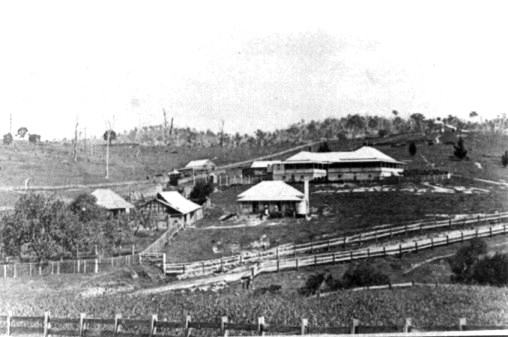
Dunblane with Janco Homestead in foreground.
Photo courtesy J. Caldwell. No date
Janco is another important part of the district.
It is owned almost entirely by the brothers
Binnie and includes a very large area of
good dairy land which is fully utilised.
The old homestead is situated on Janco Creek
and is still occupied by Mrs. Binnie, relict
of one of the oldest and most successful
pioneers of the district. Several of the
sons reside on different parts of the estate
and all are engaged in the common pursuit
of dairying. the brothers Binnie and includes
a very large area of good dairy land which
is fully utilised. The old homestead is situated
on Janco Creek and is still occupied by Mrs.
Binnie, relict of one of the oldest and most
successful pioneers of the district. Several
of the sons reside on different parts of
the estate and all are engaged in the common
pursuit of dairying.
Pericoe also occupies a foremost position
in the district's environments. Settlers
in this neighbourhood include Mr. John Alexander
(whose property we propose again alluding
to) Mr. James A. Love, Mr. William Ryan,
Mr. A.C. Stubbs, Mr. F. Ramsey, Mr. W. Watson,
Mr. T. P. Shelley, Mr. A .Bennett, Mr. Johnson,
Mr. Doyle, Mr. Robert Gordon (son of Mr.
Simon Gordon. J.P. of Lochiel) and others.
Mr. Love, though deprived of one of his arms,
successfully manages an area of about 2000
acres.
In and around Towamba and down the river
to what is known as the Kiah, a large number
of settlers reside amongst whom may be mentioned,
Messers Edmund Mitchell, E. T. Mitchell,
J. T. Mitchell, R. H. Haselgrove, W. H. Harris,
John Ryan, Alexander Binnie, William Clements,
S. Chamberlain, W. J. Beasley, Robert Binnie,
R. Higgins, John Prendergast, C. J. Roberts,
H. Kraanstuyver, W. and John Robinson Jnr.,
G. Young, Andrew Binnie, G. Robinson and
others, few of whose places our reporter
was able to visit. The district is certainly
a rich one and its resources and capabilities
afford a strong argument in favour of the
proposed railway route from Bombala to Twofold
Bay via Bondi and Towamba. Before concluding
we must again refer to the wide spread hospitality
of the people residing in this growing district
which is made none the less genuine because
it is so general. We shall look forward with
pleasure to another opportunity of visiting
Towamba and its surroundings.
(Owing to the unavoidable brevity of our
reporter's visit, possibly some of the information
is not as full and complete as could be wished.
We shall be glad to correct any mis statements
that may have been made through lack of particulars.)
 |
 |
||
| Granny Binnie. 'Janco', Burragate No date. |
'Janco' Homestead. Burragate. No date. | ||
'Pambula Voice' November 10, 1893
'LYNDHURST' AND PERICOE
Genial owner of 'Lyndhurst' is almost a native
of Pambula being the son of that much respected
townsman Mr. John Martin. Mr. Martin Jnr.,
was formerly a prominent businessman in our
town. Preferring a quiet country life he
decided some four years ago to remove to
Burragate which was just being thrown open
to selection about that time. He was aware
of the inconveniences and hardships which
all beginners have to endure but did not
allow these things to discourage him, being
fortunate enough to secure a good block of
land, Mr. Martin built himself a comfortable
home and settled down to work in earnest.
His place is about two and a half miles from
Pambula and some ten miles from Wyndham and
the Burragate or Towamba River flows through
the property. 'Lyndhurst' comprises nearly
four thousand acres of land and is admirably
adapted for dairying pursuits. Some two hundred
milch cows are kept on the estate and Mr.
Martin has recently started a second dairy
on the opposite side of the river. The owner's
residence is pleasantly situated on a slight
elevation a few hundred yards from the dairy.
It is snugly and comfortably built and is
surrounded on three sides by a beautiful
flower garden containing an innumerable variety
of rare and lovely flowers and shrubs. Mrs.
Martin, who is a daughter of the late Mr.
C. H. Baddeley of Pambula, is at home among
the flowers and takes great interest in beautifying
the place. A nice vegetable garden is situated
a short distance from the house and contains
some excellent samples of vegetables. This
department, as well as all the farming operations
on the estate, is in charge of Mr. J. Richards,
a man of considerable experience in such
matters and under whose supervision, the
best results can always be relied on.
Several acres have been planted out with
fruit trees and will doubtless form a splendid
orchard in a few years time. A paddock of
lucerne near the river is thriving wonderfully
and two acres of peas, sown as an experiment
promise a good yield.
The 'Lyndhurst' factory brand of butter has
won a name for itself in the market. The
dairy is built with a view to general comfort
and each bale has a gate in front of it through
which the cow passes as soon as she is milked
thus making room for the next one. Mr. Martin
informs us that he believes girls are the
best workers on a dairy being of a kind disposition
and not fond of idling. A short distance
from the yards is the pig paddock while the
factory is close at hand standing on the
upper side of the hill. A permanent supply
of water is obtained for the factory from
a well about one hundred and thirty yards
distant by means of one of Gould's double
action force pumps which is capable of supplying
six hundred gallons per hour and can be worked
by a boy. Among Mr. Martin's dairy herd we
noticed a handsome Ayrshire cow which was
imported from New Zealand and has been at
'Lyndhurst' for some three years. She has
yielded as much as 60lbs of milk per day.
There was also another Ayrshire cow which
was purchased for eighty guineas when a calf
and was bred by Mr. Cadell of Oran Park.
At present Mr. Martin is going in for Jersey
stock and has a splendid young bull of that
breed recently purchased from W. Wren esq.,
manager of the far famed 'Kameruka' Estate
near Candelo. The utmost cleanliness is to
be observed in every part of the establishment.
The factory contains a de Laval separator
capable of treating one hundred and fifty
gallons of milk per hour and all the necessary
machinery and appliances for work in such
a large establishment including a churn turned
by steam and a hand butter worker. A vertical
boiler is used and is erected some short
distance from the engine and plant. A saw
bench stands in an adjacent shed where a
circular saw is worked from the factory and
cuts up all the wood for the engine as well
as for household use. Steam pipes and taps
are laid on where ever necessary, everything
being handy and convenient. The whole of
Mr. Martin's plant was purchased by Messers
Waugh and Josephson of Sussex Street, Sydney
and has given the owner entire satisfaction.
The soil on the estate is a rich black loam.
A quantity of poultry, a few horses chiefly
for home use and a small flock of sheep are
kept. The comfort of the employees is well
looked after.
'Lyndhurst' is a very valuable property and
reflects great credit on the owner considering
the comparatively short time he has resided
upon it. Both Mr. & Mrs. Martin are deservedly
popular for their widespread kindness and
hospitality.
At Pericoe, or that portion of it owned by
Mr. John Alexander, is about eight miles
from Burragate and the same distance from
Towamba in a southerly direction. The property
is hilly but the hills are not so high or
steep as in other parts of the district while
the timber is more plentiful. Mr. Alexander
is of that genial class of gentleman with
whom one feels at home almost at first sight.
He is the son of one of the pioneers of the
district, his father in company of another,
having been the first to discover the good
lands for settlement away to the south and
west, some sixty years ago. Mr. Alexander's
property extends over an area of about six
thousand acres and is utilised as a dairy
and also for breeding and fattening purposes.
The plant of the factory is the most complete
and extensive one to be found throughout
the whole district and eclipses many of the
large factories around Bega and elsewhere.
A six horsepower horizontal boiler and engine
works the one hundred and fifty gallon separator
but a three hundred gallon separator is just
being introduced. The dairy herd consists
of over two hundred cows. All the most modern
appliances and conveniences are used in connection
with Mr. Alexander's factory consequently
the product, butter, is always of the best
quality. A large number of pigs are reared
on the place and shipped regularly to market
from Eden. An extensive crop of wattles was
growing on portion of the run but recently
they seem to have taken a kind of blight
and are dying off rapidly meaning a loss
to the owner of several hundred pounds. About
forty acres of land are under cultivation
this year yielding an excellent crop of peas
which grow to great advantage and make a
splendid food both for pigs and cattle. A
nice vegetable garden is laid out on the
banks of the Pericoe Creek where a plentiful
supply of good vegetables is always obtainable.
Mr. & Mrs. Alexander have lived at Pericoe
for about thirty years and have a large family
most of whom remain at home and assist in
carrying on the dairy and other work. A private
tutor is engaged for the benefit of the younger
children and judging from samples of their
work which were shown our reporter they are
making good progress and have all the facilities
obtainable at a public school. One of the
most interesting and useful contrivances
on Mr. Alexander's estate is the water supply
which is simply perfect. An hydraulic ram
is placed in the creek stream about four
hundred yards from the house and brings a
permanent supply of water right to the doors.
The ram is worked by the action of the water
running into it. It is capable of driving
water up an incline at a grade of one foot
in five. Several tanks are kept at the house
and are always full and running over. While
pipes are fixed in the kitchen, the bathroom,
garden, dairy and wherever necessary, at
any of which you only have to turn the tap
to let the water run, the whole thing is
simplicity itself and it is a wonder that
these rams are not more frequently seen being
such a great convenience especially on a
large dairy where a quantity of water is
always necessary. At Mr. Alexander's place,
as elsewhere, hospitality is one of the great
characteristics and our reporter will not
soon forget his visit to the Towamba district.
'Pambula Voice' February 22, 1900
Mr Oliver, Commissioner for the Federal Capital
site, came to Eden last week and after inspecting
the harbour he started on a second visit
to Bombala, via Towamba and Bondi, accompanied
by the Secretary of the Eden Progress Association.
(Mr Phillips).
April 1, 1903
'Australian Town and Country Journal'
Southern New South Wales.
(BY "ST. MAGNUS.")
The country which I wish to describe is that
lying between Eden and the Victorian, border,
and southward to Cape Howe. It is a country
but little known to the average inhabitant
of New South Wales. It has many advantages
over the sun-dried and waterless interior,
and some disadvantages compared with many
other coastal or tableland regions. Nevertheless,
it is a delectable country to live in, and
possesses natural ad vantages all its own.
It possesses a fairly large area of good
land, an abundance of wood and water, rich
mineral resources, chiefly gold and silver,
is generally elevated tableland, and a magnificent
and salubrious climate. In Twofold Bay it
possesses a fine port, which, if the various
governments of this country had acted on,
its interests at large ought now to have
been an entrepot for Monaro and the whole
southern district. Had Twofold Bay been made
the terminus of a great southern railway
forty years ago, Eden might now have been
a large town, with its ship ping and docks,
and all the appurtenances of civilisation,
where thousands of people might have made
a living. It is a capacious and safe harbour,
and the cattle, wool, and hides of Monaro,
and wheat of a portion of Riverina, and minerals
and timber of the mountains, might have been
shipped here to all parts of the world. In
like manner it might have been the seat of
a large import trade for transport to the
interior. But the governments with which
Australia has been blessed have seen nothing
of this - nothing but their own selfish aims,
which ultimately must be defeated.
A large town and a large trade would not
have been the only result of a wise and farseeing
policy, but the country would have been occupied
and cultivated, and its manifold resources
developed, and there would have been life
and happiness. Instead of such a picture
we have nothing, or next to nothing, and
yet our so-called states men will deliver
long harangues about what they have done.
They have done nothing but mismanage and
blunder, and they must go down to the grave
unhonoured and unregretted, not to be mentioned
but with a sneer of derision. The country
has great possibilities. It abounds in timber,
which may be reckoned as one of its readiest
and most easily reached resources, which,
under happier auspices might have been cut
and sent to Broken Hill and elsewhere. Instead,
the timber is obtained from America, while
our own is ruthlessly destroyed or left standing,
and still the doctrine of our politicians
is protection. The country also abounds in
rivers and creeks, whose waters might be
saved and applied to irrigate the land; but
the waters are allowed to run into the sea,
although we have been propounding far-fetched
schemes of irrigation for the past 20 years.
But these schemes have not been planned for
places where the water exists, and where
it might be easily saved and placed upon
the adjacent land. Many of the irrigation
schemes put forward have been proposed for
places where water does not exist, and where,
if it did exist, it would have to be run
hundreds of miles through canals to the land
it was intended to irrigate.
Through the Towamba Valley, 20 miles from
Eden, there runs a beautiful river, and the
water could be saved by weirs or reservoirs,
and run upon the valley lands, which consist
of deep, rich, loamy soil, and immense crops
of maize, sorghum, and lucerne could be grown,
and rich and remunerative harvests might
be garnered. The Kiah River runs through
a valley which yields rich maize crops, which,
in fair or good seasons, average about 60
bushels per acre; but in dry seasons the
land requires irrigation. The water might
be saved and raised from the river by any
of the means known to irrigationists. These
valleys, as well as others in the country,
will grow excellent fruit, potatoes, and
pumpkins. The land is equ ally valuable for
dairying or horse breeding. For cattle-rearing
the country has been used years and years
ago, and for this purpose it is well adapted.
As the rich lands are surrounded by extensive
ranges, wide extents of less valuable pasturage
is available.
The country is remarkable for the number
of peaks which form pictures in the landscape,
such as Mount Imlay (2900ft high), Mount
Wolumla (2220ft high), Mount Poole, Mount
Mungalla, and a number of others. The mountains
and ranges are densely wooded, affording
food and shelter to numbers of wild animals.
The kangaroo was once very plentiful, and
wallabies, hares, etc., still are to be found,
but the kangaroo has been pretty well hunted
to death. The choicest portion of the country
has been long occupied, but there are still
areas of land, mostly swamp country, which,
if cleared and drained, would be considered
fair soil in the more settled districts,
but here is scarcely looked at. Since the
outbreak of the Yambulla diggings, the country
is becoming better known. Numbers of strangers
are visiting tho district, and each one carries
away information of some kind, either good,
bad, or indifferent, and spreads the reports
abroad. Towamba and Yambulla are the furthest
southern towns on the New South Wales side
of the border, and they are merely hamlets,
though they promise to grow larger. Yambulla
will probably be a permanent field, and the
gold is scattered over a considerable area,
and doubtless it will spread south to the
ocean, and west into Victoria. At present
the centre of the gold field is about 15
miles west of Green Cape. North ward to Burragate,
Pambula, and Wolumla, the formation is all
of the same character, and is well known
to be mineral bearing, but some of the fields
are very elusive and patchy. The good land
all yields splendid crops of farm produce,
and the creeks flow in ordinary seasons.
There is a scattering of population on all
the good land, though in my opinion there
is much more land that would yield crops
if cleared and cultivated. This country,
as well as all the coastal tablelands, will
one day form the chief centre of irrigation,
for here water is most abundant, most easily
conserved, and most easily and profitably
applied to the soil. The land will employ
thousands of men, and yield sustenance to
men of small means, who form the bulk of
the population in every country. Most undoubtedly,
the section of the country to which I refer
will prosper some day, but the time has not
yet come. I have said little of the town
of Eden, for though well situated, its resources
are lying dormant, and it has but few inhabitants.
It was larger 40 years ago than to-day; it
has had a long Rip Van Winkle sleep, and
is still slumbering peacefully.
December 16, 1905
'The Advertiser'
THE FEDERAL CAPITAL SITE.
AN IMPORTANT REPORT
The Minister of Home Affairs circulated to-day
a report, dated October 26, by Mr. C. R.
Scrivener, a district surveyor, giving technical
descriptions of areas of different sizes
in the neighborhood of Dalgety, together
with a recommendation as to the area which,
in his opinion, is desirable as the Commonwealth
territory. Mr. Scrivener regards an area
of 630 square miles, embracing such a length
of the Snowy River and its tributaries as
will give a good water supply, as the irreducible
minimum for a city site, but, he says, he
would not hesitate to suggest as the most
desirable area 1,550 square miles embracing
the whole catchment area of the Snowy River.
All the boundaries of these areas are fully
described. The general description of the
means of access to the sea from Dalgety is
as follows:-"Commencing at Dalgety and
following the course of the Blackburn Creek,
the Matong Creek, the Delegate and Bombala
Rivers, and the Maharatta Creek, then Crossing
the main coast range near Bondi, and following
generally the course of Wog Wog Creek, and
the Towamba River to the shore line of Twofold
Bay. Thence by that shore line northerly
to Eden.
'The Sydney Morning Herald'
13 Mar 1907
GOVERNOR-GENERAL IN DANGER.
Coach Accident.
Descending Big Jack Mountain.
His Excellency the Governor-General and party
had a narrow escape from a serious
accident at midday on Monday, when descending
Big Jack Mountain, en route from Bombala,
via Wyndham, to Eden (says the " Sydney
Morning Herald " of 12th March). His
Excellency's carriage, drawn by four horses
driven by Mr. Nicholson, of Cooma, was travelling
down the mountain at a good pace, when just
as they were approaching the worst turn of
the mountain the shoe brake of the carriage
broke. The horses swerved, and increased
their pace, and an accident seemed inevitable.
As the horses swept towards the sharp corner,
with projecting rocks on one side, and a
precipice on the other, shouts from his Excellency's
private secretary (Mr. Sharpe) warned the
police escort, who were, fortunately, quite
close in advance. Then Mr. A. Chapman, the
Postmaster-General, who was sitting alongside
his Excellency, leaped from the carriage
as the wheel struck the rock, and the carriage
turned almost over. Mr. Chapman's weight
on the high side of the vehicle fortunately
prevented a complete capsize over the precipice,
which would have been attended with serious
results. The vehicle rose sufficiently high
to throw the driver from his seat, and the
horses sped on dragging him along the ground,
still holding the
reins, for about thirty yards, with Mr. Sharpe
making strong efforts to secure the reins.
The police, when they heard the shouts, instantly
jumped off their horses. Senior-constable
M'Innes rushed to the off leader's head,
and held it. Constable Ellis also promptly
came to the rescue. Mr. Chapman got hold
of the near side horses, and in a moment
they were stopped, and a frightful accident
was averted. His Excellency behaved with
great coolness, and was ready to spring out
when the horses wore checked.
He was heartily congratulated on a narrow
escape, and in turn expressed his thanks
to
the others. Repairs were soon executed, and
the party were on the way again little the
worse for the accident, a broken Spoke or
two, a damaged hood, and other trifling injuries
being the extent of the damage.
'The Sydney Mail and New South Wales Advertiser'
Wed 24 Apr 1907
NATIVE NAMES IN THE SOUTH-EASTERN DISTRICT.
According to the researches of the Department
of Crown Lands, the meanings of place-
names in the Monaro and Twofold Bay districts
are as follow: -
'Monaro,' a breast, so-
called on account of the cone-shaped pinnacles
on the plains in the district;
'Murri'
(Murray), make haste - there is much evidence
that the river, in its upper reaches, was called by the aborigines 'Murri,' prior to
receiving its official name from Captain
Sturt, who called it after Sir George Murray,
Secretary of State for the Colonies in 1828-30;
Hamilton Hume, the discoverer of the Upper
Murray, bestowed his own name on the stream
in 1824;
'Kiah,' a beautiful place;
'Cooma,' a swamp or lake;
'Numeralla,' valley of plenty;
'Murrumbidgee,' a large water, plenty of
water;
'Jindabyne,' a valley or gorge;
'Myalla' (corrupted from 'Pyalla'), a big
talk, something equivalent to a 'conference
of Premiers';
'Bunyan,' the nesting-place, or rendezvous
of pigeons;
'Bimnul,' an aboriginal cemetery, a place
of burial;
'Cobra,' a large mountain;
'Jingerah,' a very large mountain, one difficult
of ascent;
'Towamba,' or 'Terrambera,' a place where
much lightning had been seen;
'Bombala,' meeting of rivers;
'Bibbenluke,' the meeting of waters;
'Bega,' a large camping-ground;
'Tathra.' a wild cat.
March 21, 1908
'The Bega Budget'
The Eden Show.
The annual Eden Show was held on Tuesday
and Wednesday, beautiful weather prevailing
both days. The ground is prettily situated
about a mile from the town, and the general
appointments are quite as good as one could
expect in connection with so young a society.
It was the writer's first visit to an Eden
Show, and the general opinion was that the
display was not quite equal to some previous
years. Certainly, there were a very great
number of classes against which the legend
'no entry' had to be written. The most notable
amongst these was 'cheese.' It makes funny
reading to say that a South Coast show was
held without an exhibit of this commodity
being on view. But although Eden is the 'south-coastest'
of the South Coast, the farmers do not go
in for the manufacture of cheese, and producers
at a distance evidently did not think it
worthwhile sending along exhibits. Of course,
popular interest was centred principally
in the ring events, but the Budget considers
that in point of commercial and national
importance, a jumping, trotting, or lady
driving contest is not 'in it' with prime
butter, maize, cattle, pigs, vegetable, or
fruit exhibits. All these latter represent
national progress, wealth, and stability,
while in too many cases the ring is the place
where the pothunter or per son who follows
'the game' is mostly in evidence. These remarks
apply to every show in the State, and while
this paper appreciates the attractiveness
of the ring events, it refuses to place them
on a pedestal far above those sections which
stand for national progress and greatness.
In cattle the en tries were only medium,
and the animals, as a rule, did not represent
that peerless class of animal (especially
in the Jersey and Shorthorn sections) for
which the South Coast is famed A couple of
fine Guernsey bulls were shown and attracted
considerable attention. So far, this breed
has not grown in much favor with dairy men,
but then the Jersey, to which this breed
is closely allied 'hung fire' for a long
time. In pigs, the display, though not large,
was of the finest quality, every animal being
a champion, and infinitely superior to anything
appearing at the other coastal shows. This
section was quite a feature of the show,
representing as it does, one of the industries
that has not received that close and general
attention it deserves. The present price
of pigs, bacon, and hams, show the great
possibilities in pig raising. Mr. J. T. Mitchell
of Lower Towamba, stood almost alone in this
section, and his Berk shire, and Tamworth-Berkshire
crosses were perfect animals. Farm Produce
was another section which showed the splendid
capabilities of the country in and around
Eden.
The display was splendid, and one would be
pretty safe in saying that better samples
of maize could not be got together in any
other locality in the Commonwealth. Mr. J.
T. Mitchell carried off first prize, while
Mr. Kelly was second with an exhibit which
only an ex pert could separate from the one
carrying the blue card. Of course, there
were those who had better samples at home,
but the Budget has no time for the man who
is too weary to bring his exhibit under the
critical eye of the judge. Potatoes, pumpkins,
and other staple products were well represented,
and sustained the good reputation of the
Eden and contiguous districts. A collection
of vegetables shown by Mr. Longhurst was
much admired, and showed what can be done
by intense and intelligent cultivation. The
entries in poultry were very small, no less
than 19 classes being entirely neglected,
while in the few remaining classes competition
was not keen. Fruit and Flowers made a fair
display, but the Bud get thinks the exhibits,
as a rule, were not quite up to the capabilities
of the districts represented. Household Items
was a section that induced keen competition,
thanks to the industry and enter prise of
the ladies. The exhibits were well got up,
and, in many in stances, the judge must have
had some difficulty in placing the winner.
The Needlework section was well filled up
and attracted considerable attention. The
exhibits were of a very high order of merit,
and it is doubtful if any South Coast show
had such a fine display. Fine Arts did not
encourage much competition, although some
of the exhibits were very meritorious. In
Writing, the young people made a good show,
and the copy books were a credit to the schools
of the surrounding districts. In the Industrial
section, Mr. S. H. Pearce carried off the
blue for single buggy and sulky with exhibits
which would have taken a lot of beating anywhere.
The Twofold Bay Magnet : and South Coast and
Southern Monaro Advertiser
Mon 3 Jul 1911
Country Notes.
(From our Correspondents.)
TOWAMBA.
Mr E. Love, carrier between Pericoe and
Eden for some years, has decided to discontinue
following that occupation and has disposed
of his team of six horses to Mr A. Parker,
of this village.
A stack of oaten sheaves was destroyed by
fire here yesterday. Some excitement prevailed
during the blaze, efforts being made to save
a portion of the stack, but without much
avail.
Children who were playing close by are responsible
for the ruin, it having, transpired that
one of the number had a wax match, which
resulted in a loss estimated at £30 to the
owner, Mr W. Beasley.
We have been without a blacksmith for at
least a week, and the public who are affected
by the
absence of the recognised "smithy"
are considering the desirability of dispatching
a search party in the direction of Kiah.
A new turbine steam tester is now installed
at the local butter factory, it being a vast
improvement on the one previously used.
Foley's moving picture show is billed for
Saturday night. A fair house is expected.
Mrs Ben Beasley, who was indisposed for
some few days is about again. This lady has
more than her share of sickness.
Towamba will be represented at both festivities
at Wyndham on the 5th proximo. Rabbit Canning
Factory opening and the R.C. Ball.
The Pericoe dance, in the minds of many,
will be a function worth patronising.
'The Bombala Times '
Fri 12 Apr 1912
The Towamba Storm.
Mr. C. W. E. Bedford, Imlay Shire -engineer,
visited the storm swept area at Towamba this
week, and found that the reports of damage
done were not exaggerated. At Towamba bridge,
the heavy engine placed in the bed of the
river for repair work, was swept down about
100 yards by the rush of water. The rain
fell in torrents and swept down hillsides
and over roads in waves. At Pericoe a bullock
was swept out of the yard and down the river
for miles,
where it lodged and hung dead in a tree eight
feet from the ground, and another owner reports
the drowning of 20 poddies. The centre of
the storm hovered over a strip six by three
miles, and it is estimated 11 inches fell
in an hour. Mr. P. Alexander, when it commenced
to rain,
started for home, and had crossed the culvert
from the store and gone about 50 yards, when
he decided to return. It was raining at a
terrific rate. When he got back to the culvert,
he found even in that short space it was
covered, and in crossing he narrowly escaped
being washed away, the end of the buggy being
turned round by the swirl of water. The damage
to
roads is estimated at within the vicinity
of £1,ooo.
'The Twofold Bay Magnet : and South Coast
and Southern Monaro Advertiser'
Mon 20 Jan 1913
TOWAMBA.
Quite a stir and much enthusiasm has been
aroused by the finding of a good show up
the creek known as Ferny Creek in this locality.
A syndicate was formed on Monday 1ast which
has agreed to pay Messrs G.H. Hite and K.
Quigg to further develop the show and find
the main reef within a month. It is to be
hoped that success will crown their efforts,
as it will require something like a gold
rush to awaken this village.
Mr R. Bobinson, father of our factory manager,
is on a visit to his relatives here.
Mrs H. Bollmann has gone to spend a holiday
in Sydney.
Mr J. Hartneady has disposed of the racing
filly Eulalie at a good price.
Since the closing down of the Yambulla mines
quite a number of families have removed from
there to reside in our midst, while a few
have passed on to Wyndham, where Mr E. W.
Finch has employed them on a molybdenite
show.
Mr Tom Evans was married to Miss W. Lewis
at Yambulla on 19th ult, and they have made
their home here, where Mr Evans carries on
his business as blacksmith. Congratulations
to the young couple !
Constable Colmer, our popular senior, is
spending a well-earned holiday at Armidale,
together with his niece and daughter. During
his absence Constable Germer is in charge.
A rifle match was held on New Year's Day,
and the winner proved to be Captain McCarthy.
A ball at night was well patronised, consider
ing that a number of local sports were away
attending Bega races.
The Romany Bioscope Co. is to open here on
Saturday night, and will, as a diversion
from the usual monotonous routine of country
life be highly appreciated.
National Advocate
Fri 1 Aug 1913
VACCINATION ORDER CAUSES
STRIKE.
BEGA
A strike occurred at the Maizena works at
Merimbula, through the manager, Mr. Percival
Love, insisting that all the employees should
be vaccinated. However, when it became known
that the manager would grant sick pay to
those who were incapacitated, the men submitted,
and there the trouble ended.
'The Twofold Bay Magnet and South Coast and
Southern Monaro Advertiser'
Mon 3 Nov 1913
TOWAMBA.
Sad Drowning Fatality.
A sad drowning fatality occurred here on
Saturday, 25th instant, which has cast a
gloom over the place. Several children were
in bathing at the spot locally known as The
Willows at Robert's Crossing, when little
Mavis, the nine-year-old daughter of our
respected residents, Mr and Mrs W. Beasley, while wading in shallow
water, appeared to have slipped over a bank
of quicksand into a deep hole. Assistance
was called by screams from her companions,
and soon many willing hands appeared. After
others had failed to locate the body, which
bad been about three-quarters of an hour
under water, Mr Alf. Robinson succeeded in
bringing it to the surface at about the exact
spot where it was seen to have disappeared
and immediately under the sand bank. Resuscitation
methods were resorted, to, but without avail.
A Coroner's
inquiry was held on Monday, and a verdict
of accidental drowning was returned. The
funeral took place in the afternoon, and,
despite the incessant rain, a great number
followed the remains to the grave.
Mr Solomon, in the absence of Rev. Upjohn,
read the burial service.
The chief mourners were- father and mother,
nine brothers; and one 'sister, Mrs Beasley,
sen. (grandmother), six uncles, five aunts,
and numerous cousins. Many beautiful wreaths
and crosses were sent.
Fri 10 Jul 1914
'The Bombala Times'
* Mr. J. Summerrell and family are leaving
Cathcart in a few days for Towamba, where
Mr. Summerrell intends to enter into the
blacksmithing business.
August 30, 1918
'The Bombala Times'
A Sketch of Settlement in East Gippsland.
By Wanderer, for the 'Bombala Times.'
Eastern Gippsland will never become a prosperous
agricultural district. The areas of suitable
land are too small and too isolated. If we
except the Cann Valley, Genoa, and Wangrabelle,
there is comparatively little else that could
be successfully cultivated. In the first
place that locality was mainly banned to
the settler under some Endowment Act; this,
coupled with the policy of the Lands Department,
seemed rather to aim at stifling settlement
than fostering it. There are many spots where
from twenty to, say, forty acres of fine
alluvial soil could be utilised; but where
the whole might have sustained one settler
the Department granted up to one-half of
the good land and forced the settler to accept
the balance of his holding on the sides of
rugged useless hills. Yet there is, I believe,
a good deal of fairly good land unexploited
on the lower portions of the Thuara River.
As regards the above exceptions the chief
products are corn, cattle, and pigs. Dairying
is carried on to a limited extent. The climatic
and soil conditions, existent and possible,
are ideal for that industry; still the accursed
stranglehold of want of transport facilities
has erected an almost impassable barrier.
Even the corn that is grown -its quantity
and quality per acre is equal to that of
Orbost- has to be carried out on four legs,
i.e., fat pigs. It does not pay on any other
basis. One enterprising settler at Cann River
had a tobacco plantation, which returned
a profit of nearly £90 per acre. Right up
this river settlement extends until, not
far from the New South Wales border, the
last outpost is seen - the last fort where
a stout heart battled bravely against the
rough boulders of adverse fortune flung in
his path by a negligent government. The same
state of affairs exists in the Genoa Valley,
except that water carriage is possible during
some seasons. Many years ago a route for
a railway line was surveyed somewhere up
the Cann Valley - just where it ends only
the surveyors and wood-nymphs know. It was
said to be a good grade on which the cost
of building a line would be comparatively
little. That must have been twenty odd years
ago. The route still remains, but the railway
has not eventuated. About 1907 the Government
authorised the expenditure of £15,000 towards
exhuming the old road that ran from Marlow
towards the sunrise. After a vast amount
of work a good grade was found and the road,
or most of it, made. The route was not so
picturesque as the old pack horse track,
but, my certes, it was like a bowling-green.
This new work began at Dead Horse Creek,
which was more mellifluous than its name
seemed to infer; it passed south of Club
Terrace and reached Cann River Hotel after
joining the old Marlow road. From thence
it wended easterly over the Drummer Mountains
and various watercourses until it fizzled
out a few miles short of Genoa. Now it has
been completed to that settlement, where
a fine high bridge spans the river. This
stream was always the bugbear to motorists,
not a few of whom left their cars soaking
in the water for a few hours. The road has
been pro longed to Gypsy Point wharf, and
a branch is being cleared so that cars might
travel direct to the silver lights of the
Mallacoota Lakes. About the same time the
western end was completed to Orbost, thus
linking up with the railway. From Cann River
Hotel a branch of this road runs northerly
up the valley. It extends as far a Chandler's
Creek, a distance of five miles from the
New South Wales border. So far as made it
is a gem of a road so far as not made it
is a devil of a track. On the New South Wales
side a fine road has been constructed from
the plateau to Egan's, Rockton, thence, easterly
towards Towamba. A road continues from Egan's
to the border, about nine miles. That nine
miles ranges from a fair to a superlatively
rotten track; from the border to Chandler's
Creek - well, it is infinitely worse. After
that the going is splendid. So it will be
seen that only fourteen miles of bad road
preclude all possibility of vehicular traffic
between two sections of country that are
more or less dependent on one another for
particular products. The Victorian Government
has promised to run the road to the border
if the Mother State will complete its nine
miles. The matter has been the subject of
innumerable inspections by officials as well
as of discussions at conferences; yet the
road remains as bad as ever. The expenses
for travelling, etc., already incurred would
have done a considerable portion of the road.
It is a great pity that this confine of past
insularity cannot be swept away. It is a
barrier to progress. The only practicable
route is via Orbost and Bonang. It is impossible
to estimate the timber resources of this
mountainous region; and to study the giants
for even a short time is to risk a ' skyscraper
' neck. Millions of pounds' worth of timber
could be procured without detriment to the
forests. The quality and quantity are both
beyond ordinary timber values. Yet to get
it out would cost a mint of money. Why? Because
a short sighted government declines to provide
transport facilities. There is sufficient
timber of a suitable kind to build all Australia's
ships so urgently required; sufficient palings
could be procured to fence the ' Cabbage
State '; while the possible supply of shingles
would cause the inconvenience, consequent
on the short age of roofing iron, to hide
its corrugated head. Blackwood, lightwood,
honeysuckle, casuarinas, hickory, acacias
and wild cherry abound. These timbers are
unsurpassable for cabinet work, having a
fine grain that takes a splendid polish.
There is not only the economic view of the
question, but also the subsidiary one of
the tourist aspect, which will be dealt with
in next article.
The Southern Record and Advertiser
Sat 11 Sep 1920
Imlay Shire Council.
The date suggested for the
conference of Bega, Mumbulla and Imlay Councils
re the question of amalgamation, viz.
27th instant, was approved of.
September 24, 1920
'The Bombala Times'
Bombala as a Mineral District
(Written for the "Bombala Times"
by the late Charles Harper.)
Any observant person travelling from Pambula
up the Big Jack road to Cathcart must, be
surprised at the valley of the Mataganah
River the principal head of the Towamba River,
discharging into Twofold Bay near the foot
of the Big Jack mountain, by an almost perpendicular
wall, 2,000 feet above the bottom of the
valley to the tableland. It must be evident
that the small and confined watershed as
at present existing, could never have excavated
such a deep valley by erosion by water; but
on closer examination it is found to be the
termination of an immense basaltic lava flow,
extending over 60 miles, towards Cooma through
Cathcart, Archer's Flat, High Lake, part
of Burnima, nearly the whole of the Bibbenluke
original run, widening out northerly to past
Nimmitabel, Beard's Lakes, Mt. Cooper, northerly
across the McLaughlin River to Boco, and
westerly including Duke's Springs and joining
lakes, the Dog Kennel, Bobundra, and on to
Cooma; and is of various widths between the
sedimentary and granitic rocks it is bounded
by. There is evidence that prior to the outburst,
of volcanic activity, the greater part of
the northern and eastern part of the county
of Wellesley was drained by the Mataganah
or Towamba River to Twofold Bay on the coast,
and by the closing of this outlet our present
drainage system was forced by a very roundabout
way along the lines of the least resistance,
cutting a channel for itself to the Snowy
River, as an outlet to the ocean. It must
be conceived that the surface configuration
and physical features existing to-day are
nothing like they were when the subterranean
fires ceased erupting. The probabilities
are that the surface was hundreds of feet
higher than it is, to-day, and that the planing
off by denudation, during aeons of time,
carried away all the lighter materials, leaving
the heavier materials behind ; which accounts
for the extraordinary and enormous amount
of loose stones now spread over the surface
of this area. Modern science teaches us that
in the earlier stages of our planet's existence,
the moon was so much nearer the earth than
it is how. At the present day our meteorologists
measure the rainfall by points- that is,
the hundredth part of an inch. If they existed
in the earlier stages their unit' of measurement
would probably be feet, or even yards, instead
of points. And it further teaches us that
the denuding and transporting power was infinitely
greater than now. A river of to day, with
a flow of six feet in depth, would develop
a vast power of erosion and transportation,
but if the river rose to a depth of twelve
feet its power of transportation would be
increased sixty-seven times, and so on in
proportion, ad infinitum. We can easily imagine
what the river systems were like in the days
of yards of rainfall, and it must be remembered
that those days of abnormal rainfall and
high tides, did not cease suddenly, but by
slow gradations, during untold ages of time.
There are several high conical hills in this
area, which are by some people considered
points of eruption, such as Mt. Cooper, Bungee
Peak, and the Haystack mounds existing, but
they are not. They acquire their shape by
denudation, by atmospheric influence planing
off the softer materials, covering the harder
matter of their interior, thus assuming,
the shape of cones. The main points of eruption
now existing, dotted about this basaltic
area, are the small lakes, which are the
bottoms of the old craters, the surrounding
material washed into the original cavity,
or denuded and carried away, which I think
proves their great antiquity of dormancy,
and it is only a question of time when they
will cease to be apparent. It is very probable
that some of my readers may ask, "What
has all this to do with the district's mineral
resources?" It has a very important
bearing on that subject, especially upon
its gold-bearing probabilities. Let us suppose
that by some miraculous power to instantly
remove all traces of the volcanic outbursts,
and open to our vision as it appeared before
the great Titanic disturbance took place,
we would find a very different configuration
of the whole area; different drain age system,
and physical features. We would see rivers
flowing in quite different directions to
what they are now, one of much greater magnitude,
which had remained undisturbed for aeons
of time prior to the basaltic outburst, and
conveying the material to their main channels.
These waterways, during the period of abnormal
rain would develop immense disintegrating
power upon the sands and gravel brought down
from the higher levels, under such conditions
that any metal-bearing heavy rocks and gravels
would be reduced to fine sand; the gold would
remain, as its specific gravity would resist
removal excepting it was rolled in a ball
of clay, when it might be carried for miles
before the clay dissolved.
20 March, 1923
'The Sydney Morning Herald'
TOURING THE SOUTH.
EDEN TO BOMBALA. PARLIAMENTARY TRIP.
(FROM OUR SPECIAL CORROSPONDENT)
BOMBALA
The party spent Sunday at Eden. During the
morning, while the majority of the party
rested, a few of the younger and more enthusiastic
members made an excursion to Boydtown, on
the southern shores of Twofold Bay. When
Boydtown was established by Benjamin Boyd
In 1843 it was imagined by him that it would
eventually become one of the largest cities
in Australia. Boyd's dream has not yet been
realised. The only buildings so far reared
are those built by himself. With the establishment
of the Twofold Bay Development League Boyd's
dream is again obsessing j the minds of those
who believe In this far South Coast district,
and who look forward to the time when Twofold
Bay will become the flourishing tort for
which nature had so, admirably adapted it.
Twofold Bay has an area of six and one-eighth
square miles, nearly half of which has a
depth of upwards of 24ft. By the construction
of breakwaters the whole of this area could
be converted into an extremely safe harbour.
It is not necessary, however, that a single
penny should be spent upon it in order that
it may be utilised, for as it now stands
the arm of the bay In the vicinity of East
Boydtown affords complete protection to shipping
from all weather. As a proof of this it is
stated that 13 vessels, including some of
considerable tonnage, have sheltered in this
spot at one time in comparatively calm water
while outside raged a howling southerly gale.
On Sunday afternoon all members of the party
were the guests of Mr. Logan, the president
of the Twofold Bay Development League, at
afternoon tea. In order to reach Mr. Logan's
home it was necessary to cross over to the
southern side of Twofold Bay by motor launch.
Mr. Logan, who was formerly a squatter on
the southern tableland between Bombala and
Delegate, has resided at Twofold Bay for
the past 14 years. His beautiful home is
of a type to be met with, perhaps, nowhere
else in Australia. The interior resembled
in many ways an ancient Scottish hunting
lodge. In the grounds are the jawbones of
a 97ft whale caught in front of Mr. Logan's
residence some years ago.
Shortly after 9 o'clock this morning the
party left Eden for Bombala. At Towamba inspection
was made of a site in the valley of the Towamba
River, where it is proposed by the Twofold
Bay Development League that a dam should
be constructed for the storage of water to
supply the Eden of the future. The site selected
is at a point where two smaller streams junction
with the larger Towamba River, and is some
380 ft above sea level. It would be necessary
to construct a pipe line of 16 miles to,
connect with Eden. Following upon the Inspection
the visitors were entertained at morning
tea in the Towamba School of Arts by the
townspeople. Councillor Dackie's welcome
was responded to by Mr. Ball, Minster for
Works. Conspicuous amongst the residents
of Towamba was Mr. George Martin, who has
been in the district for 73 years. He is
103 years of age, and appears to be as hale
and hearty as many men at 70.
A short stop was made at Wyndham for luncheon.
Leaving here the party then proceeded to
the foot of the Big Jack Mountain, where
a site for a second, storage dam In the proposed
Eden water supply scheme was examined. The
Towamba River, at this point enters into
a gorge, averaging about one and a half mile
in width. The mountains upon either side
rise 2000ft above the river bed. A wall built
across the mouth of this gorge would impound
an enormous quantity of water by forming
a lake some five square miles In extent.
Granite for the necessary masonry is to be
had on the spot.
Ascending Big Jack Mountain a desirable change
was soon felt in the temperature. Reaching
the tablelands a rapid run was made over
an excellent road, via Cathcart and Bibbenluke
to Bombala, the detour through Bibbenluke
being made to allow the party to see the
famous Bibbenluke Station, one of the finest
properties on the Monaro. When about a mile
out of Bombala, the fleet of cars conveying
the party, ran into a thunder storm. It was
not until the party had reached Bombala,
however, that the full fury of the storm
was experienced. For about 20 minutes the
rain fell in torrents, flooding the main
street to the depth of a couple of inches.
This is the first heavy rain which has been
experienced in Bombala for months. A banquet
is being tendered to the party to-night.
To-morrow an inspection will be made of the
proposed dam sites for the Snowy River hydro-electric
scheme at Jindabyne.
February 15, 1924
'The Farmer and Settler'
TWOFOLD BAY
Immense Resources Awaiting Development.
By H. P. Wellings
It is an undeniable fact that the centralisation
policy, which Australia has for so long adopted
in regard both to industries and population,
is responsible for the neglect that has been
experienced in ports like Twofold Bay and
Port Stephens.
Twofold Bay is situated on the eastern coast
of Australia, about half way between Sydney
and Melbourne. It offers advantages as a
deep-sea port that is second only to Port
Jackson. In point of fact, Twofold Bay has
an advantage even over Port Jackson, in that
Twofold Bay allows of the pas- sage of vessels
of any tonnage, whereas Port Jackson allows
of the passage of vessels only under a certain
tonnage. Its safety as a port of refuge has
been admitted for well over half a century.
Sufficient safe anchorage is available at
the present time for a large fleet of deep-draught
vessels. East Boyd Bay (or South Bay) is
a large sheet of water completely landlocked,
and carries both deep water and spaciousness.
The situation of Twofold Bay is unique, and
its fore shores lend themselves to the erection
of suitable wharfage accommodation, stores,
etc. It is a deep-sea port, carrying up to
fourteen fathoms at the entrance, and up
to four fathoms in shore, thus making it
a very attractive harbour.
Industrial Potentials.
As a manufacturing centre, Twofold Bay offers
many advantages that are not generally recognised.
An excellent and adequate supply of fresh
water is easily obtainable by means of the
installation, at a very moderate cost, of
a pumping station on the upper reaches of
the Towamba River. This river empties into
Twofold Bay, where it is commonly known as
the 'Kiah ' River. Suitable areas of land,
very conveniently situated, and adjacent
to the Bay, are still unallocated, and these
would make good factory sites. Whatever rail
connection is provided in the future, between
the Victorian and the New South Wales railway
systems and the port of Twofold Bay, must
necessarily skirt the bay, and touch also
at East Boyd bay. Thus, these factory sites,
would have the added and undoubted advantage
of proximity to the rails. Raw materials
would thus be handled at a medium of cost,
and manufactured goods could be despatched
in the same economical manner. The first
requirement of a factory is raw material,
and proximity to raw material is essential
to its economical operation. Eastern Riverina,
Monaro, the coastal area - generally known
as 'the far south coast'- and Eastern Gippsland
(Victoria), all hold stores of raw materials,
Those areas also include tracts of country,
capable of producing immense quantities of
primary products, in addition to the existing
timber resources, which are practically unestimated,
but are certainly of great value. Among the
materials and products that are obtainable
in this section of the Commonwealth, the
following are worthy of notice: - Limestone,
Gold, Silver, Copper, Tin, Lead, Molybdenite,
Building Stone, Clays (suitable for all classes
of Brickmaking and Pottery), Timber, in vast
quantities, and suitable for the manufacture
of "paper-pulp", cheese, Butter,
Cream, Beef, Wool, Mutton, Bacon, Maize,
Oats, Wheat, Barley, Lucerne, Root Crops,
Fruit, etc., etc, Eastern Gippsland is famous
for its Maize and bean Crops. Excellent Fishing
Grounds have been proved off Twofold Bay.
All these products are available, and by
the development of the district their utilisation
in greater quantity will be assured.
The Timber Asset.
Timber has been exported from here to India,
China and, before the war, to Germany. Hardwood
railway sleepers are being cut to-day, and
shipped from the bay. The timber trade has
been in existence for some years, but has
been principally confined to railway sleepers
and "transomes" but no doubt sufficient
and suitable timber exists to warrant its
use in many other forms. For instance, 'Mountain
Ash ' is reputed to be excellent timber for
handles; it exists in very great quantity
in the immediate vicinity, of Twofold Bay.
As an indication of the timbers that are
to be found in the vicinity of the bay, the
following may be mentioned: - Blackbutt,
Stringy-bark, Wollybutt, Mountain Ash, Peppermint,
Blood wood, Eucalyptus, Iron Bark, White
Cedar, Sassifrass, Honeysuckle, Needle wood,
Cherry, Water Gum, Wattle, Hickory, Ti-tree,
Beachberry, Swamp Mahogany, Grey Box. Saw
mills have from time to time been in operation
on the foreshores of the bay, but only local
requirements have been catered for. The Forestry
Commissioners have two plantations here,
and on one of these areas "Pinus Insignus'
is being tried. Its success or otherwise
has not yet been determined. A large area
of the south eastern portion of New South
Wales, and also of far-eastern Gippsland
(Victoria) are set apart as state forest
areas. A recent bulletin issued by the In
stitute of Science and Industry deals with
the manufacture of 'paper-pulp' from the
Australian-Timbers. Investigations made by
that Institute indicate that the 'coast ash'
('Silver- top,' of Victoria, one of the eucalypts)
is eminently suitable for this purpose. The
bulletin itself is printed upon paper made
from a combination of pulps comprising the
following: - 60- per cent of chemical pulp
from Australian Eucalypts; 80-per .cent of
imported chemical pulp; 10-per cent of waste
paper. The investigations further revealed
that supplies of this 'coast ash' exist in
the extreme south-eastern portion of New
South Wales, near the Victorian Border. Commenting
upon the possibility of a successful establishment
of the 'pulping' industry, the following
statement is found in this bulletin: -
" A suitable site for the erection of
a 'pulping' plant would be found at Eden
(Twofold Bay), and a factor of added importance
in connection with this proposal, in that
in the event of the industry being established
successfully on a small scale near Eden,
it could probably be extended if, and when,
the resources of far-east Victoria were lapped
by railway communication to the south, and
when a suggested hydro-electric Scheme on
the Snowy River is developed." The hydro-electric
proposals for the Snowy River are the outcome
of investigations that were made by the Public
Works Department of the New South Wales Government,
and the report issued by that department,
by the Chief Electrical Engineer, contains
much interesting matter. A summary of this
report indicates that the waters of the Snowy
River may be developed in such a manner that
some £50,000 horse power could be secured.
As a preliminary scheme, it is suggested
that by an expenditure of £1,500,000, the
necessary plant and works could be provided,
whereby 30,000, k.w, would be secured. This
current could be subsequently delivered at
the port of Twofold Bay, at less than one-fifth
of a penny per. unit. The distance from the
proposed genera ting stations at Paupong
to Twofold Bay is about eighty miles. It
is further stated in this report, that by
further development of the waters of this
river upwards of 250,000-horsepower could
be secured and that the production cost would
be reduced considerably below the cost of
the preliminary scheme. It is a reasonable
argument that by providing such a cheap power
at this port; the existence of such attractive
shipping accommodation; the possibility of
provision of adequate shipping facilities;
the abundant supply of fresh water, which
can be taken from the Towamba River; the
unallotted lands in such admirable position
adjacent to the port; the possibilities of
raw materials; the possibilities for the
establishment of industries at the port;
the undeveloped resources of this portion
of the Commonwealth, commercial enterprise
should find attractions to the port of Twofold
Bay, and especially in view of the admitted
neccessity for decentralisation both of industries
and population.
18 February, 1928
'The Sydney Morning Herald'
EDEN TO BOMBALA.
An Unknown Highway.
(By D.C.T.)
To many of the touring public, the main roads
connecting the southern tablelands with the
coast are well known. The "Big Jack"
(Bombala-Merlmbula), Tantawangalo (Bombala-Candolo),
Brown Mountain (Nimmitabel Bega), Araluen
Mountain (Braidwood-Moruya), Clyde Mountain
(Braidwood-Bateman's Bay), are nil patronised
by a large section of the travelling public.
Each has its disadvantages. The Big Jack
is short but very steep. Woe betide the unfortunate
motorist who neglects to keep his radiator
replenished. An average rise of 1000 feet
per mile, or one in five, will cause the
most seasoned radiator to blow off steam.
Tantawangalo is like a swltchback - a long
and steady rise, a comparatively sharp descent,
and another rise, with baby switchbacks to
vary the monotony. But it is of an easier
grade than Big Jack, though the local councils
do not keep the surface in the same state
of repair as that of the former. Next along
the coast comes the Brown Mountain. Famous
for its tree ferns, its view from the Solid
Cutting (literally a cutting through a solid
granite cliff), and its length, its grade
is probably the best of all. Seven and a
half miles of sheer pulling, certainly well
graded and surfaced, tries the patience of
the most phlegmatic.
From Brown Mountain along the coast to Moruya,
a distance of some 85 miles, neither Providence
nor the skill of man has provided more than
a bridle track down the mountain side. Out
from Moruya to Araluen there winds a road,
but such a road. For many miles two baby
Citroens would have their work cut out to
pass each other, while a snake suffering
from an acute attack of convulsions has nothing
on it for twists and turns. But the surface
is good, and the scenery along the Deua River
beautiful and ever changing.
Araluen, once famous as a gold producer,
has almost ceased to exist, though the valley
now provides good fattening for cattle. Then
comes the mountain. Short and sharp, nearly
as severe a pull as Big Jack, but wide and
well-surfaced, its ascent brings the traveller
to within a few miles of Braidwood. Last
of all comes the Clyde Mountain. Steep in
places, and longer, it provides a much better
grade than Araluen, or, in fact, any except
Brown Mountain, while the combination of
river and mountain scenery is superb. For
miles, after leaving Nelligen, the Clyde
River is followed, ever growing smaller and
receding into the distance, but ever providing
some fresh change.
BEN BOYD'S CATTLE TRACK.
It is not, however, of those five main high-ways
that I wish to write, but of one that is
unknown save to an occasional enthusiastic
explorer, and yet which provides a top gear
road from Eden to Bombala, even though one
climbs 3000 feet in the process. I refer
to the old route down which came Ben Boyd's
cattle in the 'Forties, and up which went
many a miner to the Kiandra diggings in the
'Seventies. It leads through Towamba, Perico,
Nungatta, and Rockton right into Bombala,
and the ordinary six-cylinder car can do
the whole Journey of 70 miles without changing
gear. That, in itself, is a recommendation
to many a driver. Even on a day following
two inches of rain the surface was hard and
dry.
Leaving Eden, 18 miles of well-graded road
brings the traveller out at Towamba. For
14 miles the road has followed a spur of
the Jingera mountains, rising slowly and
then falling gently. Suddenly the forest
is left behind, and gives place to a little
river cheerfully battling its way to the
sea over stretches of white sand and granite
boulders. Along its banks are innumerable
willows. The flats are covered with crops
of lucerne and maize. A village nestling
round a wooden church and soldiers' memorial
gives quite an old world air. The valley,
with its river, crops, and willows, ringed
round by an unbroken forest, with away in
the distance Indigo Mountain, and the Monaro
Ranges silhouetted against the sky in the
most, glorious shades of blue and purple,
make up a picture of surpassing loveliness.
An official photographer from the Tourist
Bureau, who has for 14 years of his life
travelled in search of scenic beauties, had
to confess that the view of the Towamba valley,
seen from the edge of the Jingeras, was the
most attractive in his experience.
Crossing the river by a low level bridge
at Towamba, the road leads on to Perico,
a further seven miles, and is excellent all
the way. On either side is pasture land,
and good land, too, gradually being put under
sheep. At Perico the forest is entered again.
Great groves of mountain ash and messmate,
with here and there a patch of stringybark,
lend an air of solemnity. Straight and tall
are the trees, and only patches of sunlight
illumine the road. Here the treefern grows
to perfection, with every sort of moss. Ever
and anon comes a little creek, always with
a good hard bottom. One has climbed old Indigo
Mountain and is down the other side before
it is realised that it is a mountain, though
the altitude is over 1500 feet. So easy is
the grade.
At its foot lies Nungatta, selected in the
'thirties by old William Weatherhead, and
now the property of the Napiers. The history
of its development is one of the romances
of the South Coast. From Perico to Nungatta
is 10 miles, and a further 10 of mostly forest
track (but good withal) brings one out on
to the King's Highway at Bondi, now called
Rockton, a scattered settlement 20 miles
from Bombala. It is a route worth while for
any motorist who wishes to get off the beaten
track. No klaxon disturbs the chattering
of innumerable flocks of cockatoos, parakeets,
pigeons, and other birds. If camping out
is part of the proceedings, every creek issues
an invitation, while rainbow and mountain
trout are found in many pools Kangaroos are
often seen, while the fast vanishing bear
still slumbers peacefully among the trees.
If time presses, the whole run through -
either Bombala-Eden or Eden-Bombala - can
be done in five hours. It is five hours well
spent.
'Magnet' February 21, 1931
THE BUNDIAN WATERFALL
Where is the Bundian waterfall? Probably
not many people are aware that this is, or
could be, readily made accessible from Bombala
and Eden with a little advertisement, easily
be made a leading attraction of the district.
Then the hills which constitute the watershed
of the stream which precipitated over a wall
of granite, forming the cataract of Windindingerree
would doubtless be a fine though rugged field
of exploration and the stream itself might
serve as a source of hydro-electric power.
A well known authority thus describes the
locality." The Pass of Bundian is forded
by the defiles collecting the headwaters
of the Jenoa of which the northern is guarded
by the heights of Coonbulico, Wallagarra,
Nangutta and Ekalun and the southern by the
spur of Biliganea which precipitates the
stream collected to the north, southward
of the Pass over a wall of granite 67 feet
high and which forms a cataract of Windindingerree.
These waters unite a little above the Station
of Bundian (which is Bondi) being in vertical
decent below the Pass, 1,173 feet and falling
at the rate of 234 feet per mile and after
reinforcement from the Nangutta Ranges just
upon the boundary line the collected supplies
are known as the Jenoa which passes away
to the south-east and meets salt water at
Malagoota after falling (in direct measurement
from the plain of slope) about 50 feet per
mile."
Monaro-Eden people could with advantage to
their mutual interest take steps to investigate
the possibility of turning to account one
of the fine, natural features of the district
and popularise it as an attraction to nature-loving
tourists.
'Magnet' April 11, 1931
OVER THE TOP
On the morning of Monday the 16th of March,
a party consisting of Messers A. L. &
R. Mitchell, Booth and R. Phillipps set out
from Lower Towamba on an expedition to the
top of Mt. Imlay. Describing the trip, one
of the party writes, "Splashing across
the river on horseback we immediately commenced
to ascend the ridge which runs from the top
of the mountain in a northerly direction,
down to the river. Scattered farms with their
green fields of maize come into view with
the river winding its way like a silver ribbon
disappearing here and there behind steep
bluffs and creeping again into sight further
away towards the distant dots that are the
homesteads of Kiah farmers. After a few miles
of steady (perhaps too steady) walk, the
stranger's first impression is that the track
has turned into a jumble of broken rocks
with bushes and logs thrown in to make the
going easier. Here, I thought, is where we
get off. But mistakes will fortunately occur
so we proceed on our way again thankful that
our horses are equipped with four wheel brakes.
Safely negotiating the declivitous slope,
we ascend again coming across several places
where Man has prospected in search of precious
metals. In one place, carved faces stare
impassively from the buttresses of trees,
their weather-beaten countenances reminiscent
of former visitors speaking eloquently of
years of solitude through cloud and sunshine.
Leaving the horses about 5 miles from our
starting point, we commenced the steeper
portion of the climb on foot. The ridge we
ascend, plainly visible from Eden, is a huge
upflung ridge resembling an inverted V, the
apex of which is for, the most part, scarcely
5 feet wide. The slopes below us drop steeply
for hundreds of feet. On the eastern side
they are clothed with trees and ferns. On
the western side with trees and boulders.
Higher up we catch a glimpse of Eden and
a turn of the head brings the Towamba valley
into view but then a little later we turn
to view Eden again. A cloud has crept in.
Pink streamers far below that reach out to
enfold the planks of the mountain while the
parent cloud swoops majestically over the
top blocking out everything with its mist
of damp grey. Nevertheless, we climb on to
the summit and after resting prepare to refresh
ourselves after our labours. While the billy
is boiling we post up evidence of our having
been on the spot and read some of those who
preceded us there. Having taken several photographs
of each other at the cairn to furnish portable
proof of the success of our climb we start
on the return journey but not before altering
the geography of the mountain slightly by
indulging in a fascinating pastime of hurling
huge rocks down the slopes to go crashing
and roaring out of sight and sound into the
gloomy depths of unseen gorges beneath us."
'Magnet' March 7, 1934
'WHIPSTICK', HOW IT GOT ITS NAME.
The little town of Whipstick, once famous
for its bismuth and molybdenite mines, received
its name from the teamsters who used to camp
there on the trip from Monaro to the seaboard
with the Monaro wool clip. It was here that
they cut their whip handles, for the place
was famous for its young mountain ash, stringy
bark and she oak trees. The teamsters called
the young trees whipsticks.
Possibly 'Magnet' article. No date.
The chart, surveyed by Navigation Lieutenant
J. T. Gowlland of the Royal Navy, includes
soundings of the coastline taken right out
to the Continental Shelf, safe anchorages
for shipping and hazards such as bombora's
and rocks and the degree of swell it took
them to break dangerously.
The chart has come to light after being sent
to the area by a descendant of Captain J.
T. Nicholson, the master and owner of the
"Ellen", a schooner which frequented
local waters. Captain Nicholson was born
at Berwick on Tweed (England) on July 18,
1820.
Another startling discovery after viewing
the chart is a small town situated roughly
between Mt.Imlay and Egan's Peak charted
as Sturt. The village of Sturt was quite
large by comparison to the towns of Panbula
and Merimbula, and situated adjacent to the
Towamba, or Waler River as it was also known.
January 19, 1935
'The Australasian'
(excerpt)
EARLY HISTORY ( of Kameruka) The history of this interesting
settlement dates back to 1851, when the Two-fold
Bay Pastoral Association was formed to take
up six stations extending from the coast
to the Monaro, and which included Kameruka
and Towamba, the combined area of which totalled
400,000 acres. The members of this association
were Messrs. John Edye Manning, William M.
Manning, James A. L. Manning, Robert and
Edwin Tooth, Thomas Mort, and John Croft.
The Monaro properties were sold in the early
'fifties, but the association continued in
existence until 1861, when James Manning
bought Kameruka and Towamba, and tried to
hold them with the assistance of a few local
stockmen and employees in order to conform
to the requirements of the recently enacted
Land Act.
In 1862 Kameruka was purchased by Mr. Frederick
Tooth, the sale being one of the biggest
transfers ever undertaken in the State. Mr.
George E. Ward, who joined the staff of Kameruka
Estate in 1862, in his diaries, records the
fact that at the time of purchase the property
was stocked with 10,000 Shorthorn cattle,
com- prising every size, age, and colour.
Practically all the cattle were wild, and
thousands had never been yarded. Six thousand
wild horses were running with them, which,
besides being useless, were a serious obstacle
to handling the cattle. The sight of a man
on horseback was sufficient to send a mob
crashing through the scrub, and would disturb
a whole 10-mile front.
The work of mustering presented great difficulties,
and necessitated the building of trap-yards
at intervals of five miles right around the
estate. Six expert rifle men were employed
to destroy as many as possible of the wild
horses. A mob of 200 quiet cattle was employed
as a decoy, and with the assistance of skilful
out riders was driven into the wild mobs,
and the whole mob forced section by section
into the trap-yards, while the expert marksmen
gave the impossible ones their quietus.
'Magnet' April 27, 1935
Mr. W. N. Stone informs us that the late
Mr. W. R. Newton, formerly of Nadgie, and
whose death at Sydney we recorded in a recent
issue, was the first man in New South Wales
to export 'possum skins to London. The trade,
begun in a small way, became so extensive
and lucrative that ultimately the extinction
of the 'possum seemed probable and protection
was rigidly enforced.
'Magnet' February 16, 1935
PAPER PULP
Kiah Reservoir Site
The storage capacity of the site for a reservoir
at Kiah River, and the adjacent water shed
over which a water licence has been granted
to Australian Paper Manufacturers LTD., is
300,000,000 gallons. This quantity even if
unreplenished by rain, would, it is estimated,
provide a half yearly supply of water for
wood pulping operations and factory requirements
at East Boyd.
'Magnet' March 9, 1935
BEN BOYD'S LAND
Near New Buildings' Bridge
Apropos of a paragraph in last issue of the
'Magnet', Mr. H. P. Wellings writes re Boyd's
block near Rocky Hall; Wells' Gazetteer 1848
refers to this as follows:
"Brierley, a village in New South Wales
on Kiah River, Parish Yeuglina, County Auckland,
28 miles from Boyd Town; chiefly resorted
to as a resting place for the drays, stock,
etc., of the Menaroo county en route to and
from Boyd Town, Twofold Bay."
The above description was given to the publishers
of Wells' Gazetteer by Boyd's officers at
Boyd Town and the incorrect spelling of the
parish Yeuglina for Yugilmah is an instance
of many errors in that publication. The stream
known today as the Towamba River was in the
'40's more generally spoken of as the Kiah.
'Magnet' March 9, 1935
* It maybe of interest to note that some
of the foundation blocks of a house that
for many years stood on a block of land owned
by Benjamin Boyd are still to be seen by
New Buildings Bridge on the Wyndham to Big
Jack Mountain Road. The land referred to
which is still known as 'Boyd's Block' and
is now owned by Mr. Boland was used as a
stopping place for stock travelling from
Boyd's Monaro Station properties to Boydtown
in the '40's of last century and the house
was a camping place for his drovers. The
building is well remembered by many of the
older residents of Wyndham and Rocky Hall.
The building was situated about 400 yards
on the Bombala side of the bridge and on
the northern side of the road.
'Magnet' November 2, 1935
KIAH RIVER
A GEM OF THE SOUTH
For fertility, the Kiah river flats are famous.
That they are equal to the best alluvial
lands to be found elsewhere in Australia
is well known but of what it cost the pioneers
and present land holders to bring them to
their present stage of productivity, few
people acquainted with the conditions under
which settlement took place and has been
maintained, have any but the faintest conception.
In recent years with improved accessibility
the settlers' farming aims and methods have
been revolutionised and great as the resultant
improvement has been, this district will
with a few more years of progress, become
still more famous as a field of primary production
and be rightfully regarded as a peerless
Gem of the South.
It was with the object of ascertaining by
personal observation, something of the progress
achieved by the farmers of Kiah within the
last few years. At the writer accepting an
invitation to see and judge for himself,
set out one fine morning recently on a brief
tour of inspection of the constructed portion
of the Kiah to Lower Towamba developmental
road and the adjacent farming lands.
A brisk and refreshing spin from Eden under
the skillful pilotage of a resident of the
district to be visited, took us along the
Princes' Highway that skirts the southern
shore of the inner bay and then crosses the
Nullica River whose placid waters glinting
in the sunlight flowed slowly and reflectively
to the sea. Following the main road along
the boundary of what was formerly Ben Boyd's
Estate and thence through bushland brightened
by a colourful display of floral beauty,
we soon arrived at Kiah where at the foot
of the hill beyond the Post Office, a turnoff
to the right transferred one to the developmental
road about which so much has been written
of late that to make detailed reference to
it would be superfluous.
One point of interest that the visitor may
reasonably be invited not to overlook is
Nicholson's Glen so called in compliment
to Cr. A.I. Nicholson, President of Imlay
Shire, when the road which it adjoins was
made.
New arrivals will note with approval that
the road keeps on a fairly high level on
a good grade well away from the river, leaving
to be improved and worked in conjunction
with adjoining alluvial flats, large areas
of good hillside land below the roadside
fences.
The first expanse of impressive view of nearby
farm improvement is that presented as one
approaches the holding of Mr. James McMahon
Senior, whose father was one of the first
pioneers to take up land in that locality.
There, in a spacious paddock, whose pasturage
was a luxurious sward of emerald green, grazed
contentedly a herd of well conditioned milking
cows; in other fields were growing crops
of young lucerne and maize; while on the
hillside slope that reaches to the road,
a splendid stand of artificial grasses grown
up from seed, six months sown, bore indisputable
testimony to the previously unsuspected value
of these slopes for grazing purposes.
For long stretches further along the road,
the lack of hillside clearing proved a bar
to seeing much of adjoining and adjacent
farms but from the distance all seems spic
and span, good proof of up-to-datedness.
Traversing the road along which were evidences
of constructional work in progress we reached
the Box Cutting and here the car was halted.
On foot we followed the partially completed
work and on through the bush to the farm
owned and at present managed by its practical
and enterprising proprietor Mr. A.L. Mitchell.
Here at close quarters, one could see and
judge the quality of the soil and the extent
of the great improvement which despite the
past and present isolation, has been wrought
upon this and similar holdings, in one of
the paddocks was grown by Mr. Mitchell, the
140 bushels of the acre crop, that gained
for him the coastal championship. This land
had been growing maize for over thirty years
without the application of an ounce of artificial
manure.
Diverted from its former exclusive task of
growing maize which fattened pigs that walked
weary miles to market, the farm is now essentially
a first class dairy farm and as such is one
of which its owner is justifiably proud.
His herd of Jerseys, highly productive as
they are, is being steadily improved by selection
and test with the object of making it ultimately
nothing short of the best.
While there was much to admire and appreciate,
one could not avoid being painfully impressed
by the fact that the cream from Mr. Mitchell's
farm has to be conveyed by cart dragged over
the sand and gravel of the river bed for
a distance of two and a half miles, then
a further two or three miles through a bush
track before an outlet to the main road is
reached at Lower Towamba. Other farmers have
almost similar experiences. Can one wonder
at the discontent of isolated folk with the
slowness of the work of pushing through the
remainder of the thirteen and a half miles
of road commenced five years ago? One has
but to know the conditions under which these
farmers, with infinite courage and patience,
have laboured through several decades to
feel that everything possible should be done
to help them get their road completed within
the next twelve months.
Returning to the car, we made a brief visit
to the farm of Mr. & Mrs. M.D. Doyle
whose cheery welcome made one feel that here
was homeliness and content. A large scope
of flat land pasturage and lucerne, awaiting
the return of a numerous herd of dairy cows
alternately depastured on an up-the-river
farm worked by Mr. M. McMasters, afforded
ample evidence of the productiveness of this
fine property on which, by the way, an area
of valuable swamp land has been reclaimed
by drainage to the river.
The time at our disposal being short, we
moved on to the home of Mr. James McMahon,
arriving there in time to partake of a refreshing
repast dispensed by Miss Eileen McMahon who
proved an ideal hostess of a numerous company
of friends. A close inspection of Mr.McMahon's
farm established the fact that its first
appearance, as seen from the road, was the
very reverse of deceitful, and that on the
other hand, proximity lent greater enchantment
than did distance to the view. Like Mr. Mitchell,
Mr. McMahon is bent on herd improvement and
though he has more than trebled the number
of his milking cows, he seeks nothing but
the best. Discussion with out host on almost
every phase of farming revealed that Kiah
farmers are taking a remarkably keen interest
in the theory and practice of agriculture
and dairying. Towards this desirable result,
the advice and information imparted by agricultural
and dairying instructors have admittedly
contributed to an appreciable degree and
it may be hoped that such help will continue
to be given and availed of. In pleasing converse,
the time passed all too quickly and regretting
the shortness of our stay, and that we were
unable to include in our itinerary, visits
to other homesteads, we said goodbye to our
hospitable friends and set a homeward course.
Before leaving Kiah, however, we obtained
a glimpse of Mr. Goward's farm and a view
of the roadside portion of the farm of Mr.
J.N. Harris who also has provided an object
lesson of the value of hillside clearing.
Visits to other farms will, the writer hopes,
be a pleasure that he will experience in
the not far distant future. Space limitation
precludes more than this brief reference
to a trip that was in every way enjoyable.
It was a trip, that though it did not enable
one to make contact with all the riverside
dwellers, made one feel that in the industry,
energy and intelligence of these progressive
people, the whole district has an asset of
the highest value. One hopes that with the
completion of the road, they will achieve
and enjoy - as they merit - complete enduring
success.
There is no Kiah River. There is a Kiah Inlet
but the river is the Towamba River. A common
local mistake. Editor.
Jingera Rock, Burragate
'The Bega District News'
15 Jun 1936
OVER TO BURRAGATE
The editor of the "Bega District News"
recently made his first visit to Burragate,
lying between Wyndham and Towamba, and about
35 miles from Bega. We had been through that part in the early hours of morning years
ago, but actually had not seen it. The road
from Bega turns off near Kanoona at what
was years ago the New Yards, and thence up
past the homes of Messrs Nickle, Schuback,
and the old Bright Hills property, on to
the Candelo-Wolumla road. From there it leads
through some of the finest properties in
the Candelo district, such as Collingswood
and Towrigee, on to and over the Myrtle Creek
mountain. The road round the mountain is
good, but there are many sharp turns. Near
the foot of the mountain is the property
some time ago acquired by Mr Harold Wiles,
President of Imlay Shire, where great improvement
has been made. Previously it had almost been
abandoned to bracken fern and rabbits, but
Mr Wiles has effected a transformation, clearing
much of the
land of bracken, getting the rabbits out,
and improving the pasture, and generally
turning a wilderness into a profitable farm.
A magnificent view of the district is obtainable
from points on the mountain, taking in the
whole area, extending over Bega, Bemboka,
Candelo, Kameruka, Numbugga, and Wolumla.
with a large expanse of the ocean looking
beyond Wolumla over the Black Range. The
trip is well worth while for the view alone.
Further on you come to the old sawmill conducted
some time back by Mr Raynor, who has since
transferred his operation to Bombala. From
Bega to
the main road running from Pambula through
Wyndham and on to the tableland, is 25 miles.
To get on to the Burragate road you turn
to the left-which, by the way, is anything
but an easy turn-go down the Pambula road
over the Honeysuckle bridge for a couple
of miles, and then turning to the right,
on to Burragate, 7 miles. The rabbit canning
works, established with great expectations
years ago, was on a site right opposite the
turn-off to Burragate. No sign of
the factory remains to-day, and I thought
of the tenner (£10) I put into it, and which
with the money of many other people went
west. Many will remember the opening of the
factory at which I was present with others
from Bega, and what hopes were entertained
of turning, the rabbit to profit.
Had the management been all that it should
have been the factory might have proved a
success. As it was, it lasted only a few
months. The road out to Burragate is for
some distance through forest country, and
the rocky side of the Jingera mountain makes
a striking landmark,
especially with the western sun shining on
it. Although this mountain is known as Jingera,
the correct name is Jingo, which in the aboriginal
language means "place of much death,"
the aboriginals believing that in the far
distant past there had been a big landslip
which buried many blacks, and left the mountain
in its present state as if a slice had been
cut off. Getting into the open country, I
saw a fine-looking lot of sheep on one of
the holdings. Further on you
pass the old home of the late George Keys,
situated on a high hill, and a long descent
leads you to the village, which is situated
on the eastern side of the river running
through
Burragate and on to Towamba, Kiah; and ultimately
emptying into Twofold Bay.
The area on the opposite side of the river
was years ago known as "Pussycat."
Burragate is probably of aboriginal origin,
but I do not know the meaning of it. Mr Mersey
Ryan, a
frequent visitor to Bega, has a nice property
on the hill beyond the school, and further
down the valley towards Towamba is the farm
of the late Mr D. Binnie. Mr Ryan was telling
me
recently that he has some interesting relics
of the early days, including a set of harrows
and a plough made by the late Mr Harry Brown,
of Bega, a churn made by the late Mr Shegog,
and a cart made by the late Mr Quain, who
all carried on business in Bega in the early
days. There is a nicely-situated recreation
ground at Burragate, lined by huge pine trees.
The village lies in a valley surrounded by
high hills and mountains, and one could not
help admiring the grit and enterprise of
the early settlers who went in there to carve
out comfortable homes. From
Burragate to Eden is 26 miles, and their
produce had to be carted there or to Merimbula
over bush tracks. Today the roads are good,
and Burragate's only need is a bridge over
the river
leading to Rocky Hall, and that hope is likely
to be consummated in the near future. The
village comprises a public hall, store (kept
by one of the Ryan clan), post office, school,
and a few private residences. The people
have hopes of the Snowy River hydro scheme
being established some day, and I understand
that the main transmission line from Paupong
to Twofold Bay will pass through Burragate.
Towamba lies some miles further down the
river. I met many of the younger people at
the ball, and was impressed with their sturdiness
and virility, and I almost felt ashamed to
admit that it was the first occasion on which
I had
really visited that part. The people are
agitating for a daily mail, service to Bega,
which, with the advent of the motor car,
has come to be regarded as their main business
centre, and the authorities might well consider
giving better mail facilities to the people
who dwell in the more isolated parts. I was
well pleased with my visit, and hope to go
again.
A noticeable feature of the trip, both over
and back, was that we did not a rabbit, but
some dogs put up a fine hare on Towrigee
as we were returning. With skins worth about
1s each, every rabbit that shows its head
is a goner.
I met an old Bega boy over there in Mr Bert
Underhill, who, after spending some time
in Queensland, returned to Rocky Hall, and
has made good on the land. Bert is looking
forward to the time when he will return to
Bega to live. His brothers Harry and Arthur
are also over there.
They are sons of the late Mr James Underhill,
who purchased the old P. M. Sheehy property
at Rocky Hall years ago.
'The Braidwood Dispatch and Mining Journal
'
Fri 14 Jul 1939
SAD HAPPENING
Pathetically sad features are connected
with the deaths of two old and respected
ex-residents of the Braidwood district. On
Saturday Mr. Thomas Hartneady passed away
in Lewisham Private Hospital, his sister,
Miss Bridget, dying two days later at Towamba,
near Eden.
Mr. Thomas Hartneady was born at Larbert
and received part of his education at Braidwood
and at the half-time school at Larbert. He
resided in the district practically the whole
of his life, managing his property at Larbert
until about six years ago, when he sold out
and
went to Marrickville with his wife to live.
The deceased, who was 76 years of age, was
one of the district's best-known residents.
A quiet, reserved man, he did not interest
himself much in public affairs, preferring
his home to the town's interests. He, however,
was an exemplary citizen, helping all movements
which aimed at the advancement of the district,
and assisting liberally any cases of distress
or want. 'Tom' Hartneady was a, 'white man'
in the strictest sense of the word, a man
whose word was his bond and whose, honesty
and integrity was recognised from one end
of the district to the other. His hospitality
and that of his good wife was unbounded,
many a weary, hungry traveller having occasion
to remember it with
gratitude. His passing will be deeply regretted
throughout the whole district. He leaves
a widow to mourn the loss of a good husband.
When his brother, John, heard of his death
he hastened from Towamba to Bega, flying
by 'plane from there to Sydney to attend
the funeral, though he himself was suffering
from the effects of a severe fall. On his
way
back from the funeral he learned of the sudden
death of his sister, Bridget, who had been
living with him at Towamba. Miss Hartneady,
who was 81 years of age, had lived at
Braidwood all her life until about three
years ago, when she went to live with her
brother John. A kindly old lady, she enjoyed
the love and respect of a large circle of
friends in this district. Generous and hospitable,
she was always willing to lend a hand in
cases of sickness,
and contributed liberally to all deserving
charities. She was keenly devoted to her
church. At her special request her last remains
were brought back to Braidwood, the town
of her birth, for interment. She was laid
to rest in the R.C. portion of the cemetery
on Wednesday, Rev. Father Devine officiating
at the graveside.
Genuine sympathy is felt on all sides for
Mrs. Hartneady and Mr. Hartneady in their
sad loss. By the way, Mr. John Hartneady
is the sole surviving member of this fine
old family. He is not so well known here
as his late brother, having gone away when
only a boy. He was a member of the surveyor's
party which put the railway line through
from Goulburn to Tarago and Cooma. He attended
his sister's funeral on Wednesday. Another
sad feature in connection with the above
happenings is that Mr. John Hartneady lost
his wife only a few months ago.
'The Bega District News '
Tue 6 Jun 1950
GLOOM OVER TOWAMBA
A gloom was cast over the Towamba community
when it was learned that George
Farrell, 67-years-old resident of that centre
had died following fatal injuries caused
by his own bullock waggon, on Friday.
With a friend, Wallace Bretherton, also of
Towamba, Farrell had gone out at about 11
o'clock, on Friday morning to secure a load
of firewood.
The load, weighing about 3 1/2 tons, was
being brought back on the waggon, which itself
weighed unloaded some 3 tons, when Farrell
tripped and stumbled on some undergrowth,
on Manning Hill, at the back of Towamba.
Unfortunately Bretherton, at the time was
some distance away and unable to assist his
friend as the team was moving too quickly.
The unlucky Farrell, who had fallen ahead
of the front wheels suffered terrible internal
injuries and severe shock as the two near
side wheels passed over his body.
Shocked, the friend ran the two and a half
miles to Towamba to give the news of the
accident and to seek assistance.
MRS. FARRELL TOLD OF MISHAP
Mrs. Farrell was told of her husband's predicament
and rang for medical assistance,
but before the doctor could attend, Sister
Martin, a resident of Pericoe, could see
that the injuries were too much and that
the victim was quickly succumbing to the
effects of
them.
The Eden unit of the Bega District Ambulance
was called and had only proceeded half the
distance down the hill to Towamba with Farrell
when he died.
Rev. Hart, Rector of Pambula Church of England,
who had also been summoned,
was at the side of the dying man until the
end.
Mr. J. A. Martin, Pambula Coroner, viewed
the body after life had been pronounced extinct.
An inquest will be held at Wyndham, on a
date to be arranged.
The dead man leaves a widow and a number
of children.
Senior Constable Bowers, of Wyndham, investigated
the accident.
'The Bega District News'
Tue 3 Aug 1954
Towamba Man Passes
Towamba Man Passes Mr. Walter Patrick Roberts,
aged 74 years, of Towamba, passed away
in the Pambula District Hospital yesterday.
The funeral will arrive at the Catholic portion
of the Towamba at 3pm today.
The Rev. Father O'Carroll will officiate
at the service.
The Canberra Times
Sun 9 Nov 1980
SOUTH COAST NEWS Shire amalgamation is frustrating for the
public
THE NEW Bega Valley Shire Council, created
by amalgamation of the Imlay, Mumbulla and
Bega councils, is creating a few headaches
for staff of the defunct councils.
The principal problem is that no work can
be done on matters requiring policy decisions
by members of the new council.
The elections for the new council will be
held on Saturday, December 6, but the councillors
will not take office until January 1.
Development applications and projects such
as sewage and water facilities approved by
the old
councils are going ahead, but some decisions,
particularly one about selling a block of
council-owned land, are being deferred until
the new council sits.
Some members of the public are feeling frustrated;
some are unable to get firm commitments from
council staff.
There have been some discussions between
the staff about procedures in the new council,
but other matters, including which offices
the new shire council will occupy, have yet
to be decided.
The Mumbulla Shire Council has lost several
experienced officers who have resigned because
of uncertain ties associated with the amalgamation.
Although under the amalgamation Act no-one
will lose his job or have reduced pay, there
is no
guarantee that the job they were doing for
the old shire will be the one they do for
the new.
