

Though Mallacoota is a long way south of
the Towamba valley, the local population
of the valley had relatives who lived and
farmed there. Residents of the small settlements
of Rockton, Wangrabelle and Yambulla would
have been familiar to many residents in the
Mallacoota area.
Provenance: The Journal of Public Record
Office Victoria, September 2007, Number 6.
ISSN 1832-2522.
Copyright © Sarah Mirams.
URL://www.prov.vic.gov.au/provenance/no6/TiredLittleChildrenPrint.asp
'Tired little Australian Children are still
plodding unnecessary miles in wet or shine':
School and Scandal in Mallacoota
Sarah Mirams
Abstract
Free, compulsory secular education was introduced
into Victoria under the Education Act 1872
(Vic). In newly established remote rural
communities parents would come together,
provide lists of potential students and lobby
the Education Department for the establishment
of their own State School. This article examines
the early history of one of Victoria's most
remote schools in far East Gippsland -- Mallacoota
School, No. 3515, and considers how a school
could be an arena where both community unity
and divisions could be played out. Poet and
journalist EJ Brady made his home at Mallacoota
in 1914. An inveterate critic of government
bureaucracy and an advocate for the development
of East Gippsland, his correspondence with
the Education Department provides an insight
into political and social dimensions of life
in a small community at the beginning of
the century.
Article
Mallacoota's first teacher arrived in far
East Gippsland on 1 May 1906.(1) Laurence Kennedy left Cobram East State
School, in the prosperous wheat and farming
district on the Murray, in April. There he
would have enjoyed all the amenities of an
established country town -- a railway, churches,
doctors, shops, a newspaper and even a cordial
factory. His new posting was to be very different.
Kennedy found himself, after a difficult
week-long journey, in Victoria's most easterly
coastal hamlet, 542 kilometres from Melbourne.
This article tells the story of Mallacoota
State School's history from its beginnings
until the eve of the Second World War.
Academic research into the history of education
in Australia is often concerned with exploring
the role played by schools, education departments
and education bureaucrats in the business
of nation building.(2) Histories of small rural schools tend to
be celebratory, tracing the stories of principals,
teachers and students, and describing how
the school experience has changed over time.
This study takes a different approach. I
am interested in the role the Mallacoota
State School played in the community, not
as a place of education, but as a part of
a community's social and political landscape.(3)
At first glance the files for Mallacoota
State School no. 3515 do not convey the tale
of community unity that characterises many
small school histories. Letters to the Education
Department report scandals involving adultery,
kidnapping, poisonings, drunken dances and
striking parents. Such correspondence tells
us much about the divisions within the community
between families, and the struggles for power
and influence in a small, isolated settlement.
The school, being the only public building
shared and in a sense 'owned' by the community,
became at times one of the arenas where such
rivalries could be played out. This article
will argue that despite such tensions the
school at Mallacoota came to represent to
its people the hamlet's economic viability
and future. Families were able at crucial
times to put aside their rivalries and personal
enmity and work to ensure the school's survival.
The Most Inaccessible Watering Place in Victoria
The two lakes at Mallacoota were the territory
of the Maap people, part of the Kudingal
or people who lived by fishing along the
south-east coast of the continent.(4) Archaeological surveys reveal that family
groups lived and camped around the Inlet
for thousands of years.(5) The word 'Mallacoota' derives from the Aboriginal
place name Malloketer, recorded by Chief
Protector Robinson in 1844.(6) Europeans moved into the area to take up
cattle runs during the 1840s, encountering
fierce opposition. The Mallacoota run was
abandoned in 1847, but resumed in 1850. Licences
changed hands frequently. Closer settlement
came to East Gippsland relatively late in
Victoria's white history with the 1884 Land
Act.
When Laurence Kennedy arrived in 1906 he
found a small farming and fishing community
hugging the river and lake, ringed by dense
forest and hills. The Wallagaraugh River
flowed through forest from the small town
of Genoa to feed the two lakes which opened
out onto the sea. Mallacoota's scenic beauty
and isolation earned it a reputation as a
place of retreat where the wealthier and
more adventurous 'tired brain worker' from
the city could immerse himself in nature.(7) Dorron's Lakeside Hotel, a small boarding
house and pub, offered some accommodation.
Unoccupied land surrounding the lakes was
temporarily reserved as a National Park in
1909.(8)
The families living around the lake craved
some of the conveniences the tourists were
escaping. Here the post office operated from
a farmhouse. There were no shops and there
was no township. Only bush tracks snaked
through the forest and the locals had to
rely on small cutters negotiating a shallow
sandbar to deliver basic supplies from Eden.(9) During winter the settlement was often cut
off for weeks by storms and flooded rivers.
The nearest doctor was in Orbost or Eden,
both more than a day's journey away. In summer
the hamlet was threatened by bushfires. Surrounded
by virgin forest, hemmed in by water, the
locals were characterised as pioneers battling
against nature to make a living.(10)
Edwin James Brady, bohemian poet and Bulletin
writer, is Mallacoota's best known escapee
from the city. Brady first came to Mallacoota
in 1909 with the dream of setting up a writers'
camp. He returned in 1914 and took up a selection.
He owned a guesthouse and during the 1930s
depression helped set up a community farm
based on socialist principles.(11) His six children all attended Mallacoota
State School. His correspondence regarding
the school, both personal and official, provides
a vivid insight into community unity and
tensions. As a founding member of the Australian
Labor Party, Brady had been involved in the
radical politics and journalism of 1890s
Sydney and was an experienced and at times
aggressive lobbyist. Brady developed many
schemes for East Gippsland's development
and came to regard Mallacoota as 'a domain
… peculiarly my own'.(12)
State School No. 3515
Frank Buckland, a local farmer, filled out
the standard Application For Establishment
of a State School form in 1905.(13) Between the Olsen, Coleman, Rankin, Buckland,
Reid and Allan families there were twenty-eight
children in Mallacoota aged from two to sixteen
years. This, Buckland suggested to the Education
Department, justified the employment of a
full-time teacher.(14) While the more prosperous families could
afford to employ a governess, the children
of labourers and fishing families may have
reached the age of fourteen without any formal
education.(15) Their only other option was to row the twenty-four
kilometres up river to the nearest school
at Genoa. The opening up of land for selection
in East Gippsland after the 1884 Lands Act
was passed saw the demand for schools grow
as selectors moved into the forests. Between
1890 and 1920, forty-nine new schools opened
in East Gippsland.(16) This was also a period when, under the Directorship
of Frank Tate, Victorian schools were undergoing
a period of reform as a result of the Fink
Royal Commission into Education 1899-1901.
Following the economic devastation wrought
by the 1890s depression there was a commitment
to create a modern progressive education
system in Victoria.(17)
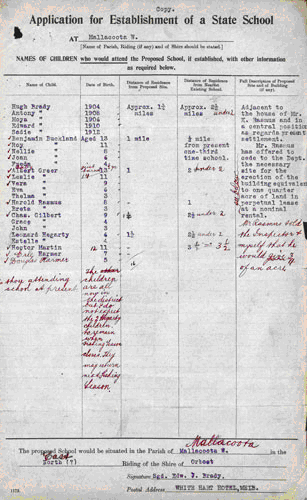 |
| One of many examples of an 'Application for
the Establishment of a State School at Mallacoota' found in the Mallacoota State School files. This example from 1916 was used to argue for a full-time teacher for Mallacoota at the new school site on the Rasmus property. PROV, VPRS 640/P1, Unit 1329, Mallacoota State School 3515 |
While this system was ostensibly free, in
reality the government required local communities
to contribute financially towards this vision.
Frank Buckland assured the Education Department
that the residents would provide 'substantial
building and outhouses' to be rented as a
schoolhouse.(18) Not all residents accepted these requirements
easily. Chris Harrison wrote, 'I thought
the policy of our country was free education,
but when you ask us to contribute 24 pounds
a year besides providing a school I do not
see where the free comes in'.(19) The Education Department should 'stretch
a point' at Mallacoota, he argued and provide
a teacher, 'as we have many disadvantages
here to contend against'.(20)
The first school was located on the western
side of Bottom Lake, in 1906. The building
was neither substantial nor provided with
an outhouse. Laurence Kennedy described it
in a report to the Department as having 'no
locks, defined grounds or outhouses and is
situated 50 yards from the backdoor of WM
Allan's residence and 16 yards from the cow
yard'.(21) Such basic school accommodation was not
unusual. The centenary history of the Victorian
Education Department suggested that, such
was the desire for education in the bush,
parents were prepared to have their children
taught 'in almost any kind of enclosure:
- a bark hut … a room in an operative public
house and the cellar of a bacon factory'.(22)
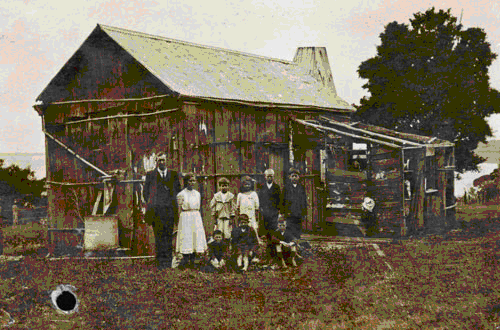 |
| Clement Baker stands outside the 'discreditable
and [sic] insanitary' Mallacoota State School with his pupils, c. 1910. Photograph sent to Frank Tate by EJ Brady when the community was lobbying for a new school building in 1916. PROV, VPRS 795/P0, Unit 1887, Mallacoota Inlet State School 3515 |
The condition of the building is starkly
shown in the 1910 photograph sent to the
Department by Brady. The building looks more
like a shed (which it originally was) than
a schoolhouse.(23) A building report described it as presenting
'a very ragged appearance' and noted care
had to be taken not to fall through the broken
and rotten floor boards.(24) By 1916 the community began agitating for
a new schoolhouse, and also the reappointment
of a full-time teacher. Buckland's original
estimated student population had been inflated
and within a year of his arrival Kennedy
left Mallacoota. Clement Baker, who also
taught at the Wangrabelle and Genoa State
Schools, found himself responsible for a
third school.(25) Rural schools with enrolments of between
five and twelve students were expensive for
the Department and difficult to staff. Part-time
schools and itinerant teachers were a way
of supplying the needs of children in isolated
areas.(26)
Baker spent two and a half days a fortnight
in each school and then left lessons for
the children to complete under their parents'
supervision. His working fortnight included
rowing the twenty-four kilometres to Genoa
to teach for two days and then travelling
by horse sixteen kilometres along a track
through the forest to the Wangrabelle school.
His home was a tent in Genoa where he lived
with his wife. Henry Lawson, who visited
Brady at Mallacoota in 1910, wrote of how
'the school master goes around in a boat,
a launch, to collect his scholars'.(27) He also noted the 'little school kiddies'
knew his work from their school papers.(28)
The position of such rural schools was always
precarious. To ensure a school's survival
parents had to persuade a remote bureaucracy
in the city, using whatever political and
economic clout they could muster, that they
could maintain enrolments. Such campaigns
were often led by strong-willed and determined
figures in the community. The Honorable James
Cameron MLA, the local member, received a
letter on behalf of the Mallacoota families
from EJ Brady in July 1916. Brady argued
that the local families all had children
growing up 'practically without education'.(29) He urged Cameron to obtain a 'concession'
from the Minister, implying that Mallacoota
was worthy of special consideration despite
its small population.(30) Brady then wrote to Tate highlighting the
lack of water and lavatories at the school.(31) A petition from the parents at Mallacoota
was sent three months later requesting a
full-time teacher. The Department seemed
unsympathetic, suggesting that the enrolment
numbers were too low to warrant the necessary
expenditure.(32) Brady's next letter to Tate argued, 'settlers
in East Gippsland deserved better consideration'.
He signed himself EJ Brady, author. As Director
of Education, Tate had wide-ranging powers
and could ignore the advice of his officers.
In a scribbled note on the margin of Brady's
letter he wrote 'this is an urgent matter
which should be attended to at once'.(33)
The Department agreed in 1917 to provide
a new school building. This was a win for
the community, but before long the triumph
turned sour as local families competed to
provide a site for the new school. Frank
Buckland and Carl Rasmus, both from well-established
local families, made the first offers to
the Department. Brady, a relative newcomer,
then put in his bid. Families had an interest
in ensuring the proposed school site was
close to their own properties and, as such,
diagrams were sent in to the Department showing
tracks that led from farms to potential school
sites.(34) Dr Leach, the School Inspector based in
Orbost, had the unenviable task of selecting
the site and negotiating with the locals.(35) Brady lobbied hard and sent a stream of
correspondence to the Department, which became
increasingly angry when his proposal was
rejected. In veiled terms he suggested that
Leach had been 'got at' when the Rasmus block
was selected.(36) Brady threatened to use his influence as
the author of Australia Unlimited, his recently
published survey of Australia, to discredit
the Department and let the public know of
the proposed 'internment camp'.(37)
 |
| One of several diagrams in Mallacoota State
School files showing tracks in relation to
the school. Ensuring the school was accessible to all families was an important consideration for rural schools. PROV, VPRS 795/P0, Unit 1887, Mallacoota State School 3515 |
'There were', wrote Leach to the Secretary
of Education, 'two irreconcilable factions
at Mallacoota', and 'much jealousy between
the old residents and the more recent arrivals'.(38) Leach may well have been aware that Buckland
and Brady were in a long- running dispute
over access to two acres of public land used
as a recreation reserve and camping ground
by seasonal fishermen and locals. This dispute
had involved petition and counter petition
being sent to the Lands Department.(39) Brady dismissed his opponents as 'a small
group of antediluvian savages who take exception
to my humble efforts to spread the Gospel
of Progress in this benighted region'.(40)
Both men were public figures in the community:
Brady, the journalist and writer, intent
on developing Mallacoota and East Gippsland,
and Frank Buckland, the local Justice of
the Peace. Buckland's voice is largely muted
in the public record. It is Brady's strident
and insistent voice which dominates. Leach's
advice to Tate was 'peace at any price' and
as 'neither Buckland nor Brady could build
on another man's property', the Rasmus site
was selected where a temporary building could
be erected.(41) However, the matter did not end there. By
April, the unused Paynesville schoolhouse,
transported by barge, was awaiting the arrival
of workers from the Public Works Department
to supervise its opening. Brady sent a final
barb to the Minister of Education:
But sir, though Nero fiddled Rome continued
to burn and while its official Montagues
and Capulets in Melbourne are fencing with
weapons of departmental sophistry and great
satisfaction a number of tired little Australian
children are still heavily plodding unnecessary
miles in rain and shine ... to an old condemned,
discreditable and insanitary [sic] building.(42)
The new school opened in late 1918 and Clement
Baker was appointed full-time teacher.
Trouble at the Water Tank
The new school building caused further headaches
for the Education Department when in 1921
the pupils and their teacher, Miss Violet
McMeekin, fell ill. Symptoms included nausea,
vomiting, burning sensations in the throat
and headaches.(43) The cause of the illness was traced to the
water tank that a local man, Robert Bruce,
had built and installed at the school. Brady,
Buckland and Rasmus put aside their former
grievances and met as a group of concerned
parents. Water samples were sent to the Public
Health Department for analysis. Tests revealed
high levels of zinc and lead compounds in
the water, and two per cent hydrochloric
acid.(44) Letters were sent to the Department demanding
action. Mr GA Osborne, the Inspector of Schools,
came down and chaired an enquiry. Harold
Rasmus, a schoolboy, claimed to have seen
Bruce accidentally kick a bottle of spirits
of salts into the tank.(45) Bruce refused to attend the meeting and
denied the accusations vigorously, claiming
that if the Department asked 'about the character
of the boy Rasmus you will find no one in
the district daring enough to believe a word
he says'.(46) At the conclusion of the enquiry Bruce was
directed to replace the tank, and no formal
criminal charges were laid.
Such a public drama soured the relationship
between Bruce and some families in Mallacoota
for several years and the school became the
arena where these tensions were played out.
Bruce was asked to explain the non-attendance
of his children at the school in 1923 and
wrote that he had kept his children at home
to save them from catching diphtheria. He
accused the Brady family of bringing the
disease from Melbourne. The matter, he claimed,
was hushed up to stop quarantine restrictions
being implemented leading to the forcible
closure of Mallacoota House, the guesthouse
Brady owned.(47) Bruce went on to report that the local schoolroom
had been used to hold a ball where large
quantities of alcohol were sold and drunk.
This party, he alleged, went on until four
in the morning, 'a ramshackle picture machine
is used in the school as a blind to cover
this disgraceful fracas'.(48) Bruce then accused two drunken locals of
kidnapping his two boys and keeping them
in a shed at Raheen, the Brady family home,
for two days. This was done with the full
knowledge, he claimed, of Violet McMeekin.
Both the School Committee and the Head Teacher
were asked to account for these accusations,
though the Department appeared more interested
in the intoxicating liquor than the kidnapping.(49) Violet McMeekin denied the accusations,
writing that she frequently showed cinematographic
picture shows in the school for the benefit
of the children, but that no alcohol was
consumed.
As for dances -- well since I was the only
girl in Mallacoota for the greater part of
the time, it was only on rare occasions that
we could have a dance at the picture show.
I took a great deal of interest in the school
and worked as hard as I could for the few
children there. It has hurt me deeply to
know that my work has been rewarded by such
false reports being sent in. What encouragement
does it give to a teacher -- especially a
lady teacher -- to work for the school?(50)
Violet was forced to leave Mallacoota when
the senior Bradys departed for Melbourne.
It was unacceptable for her to stay at Raheen
unchaperoned with Brady's two teenage sons.
She could find no other affordable accommodation.
In the poisoning scandal we see a realignment
within the community. Brady, Rasmus and Buckland
presented a united front to the Department
as the responsible voice of Mallacoota. They
put aside their personal animosity and worked
for the good of the school and the students.
The school now became a battleground between
the Brady and Bruce families. Violet was
a friend of the Brady family and was particularly
close to Moya Brady, the eldest daughter,
and maybe this is why Bruce reported her
to the Department. In the local history,
the Bruce family joins the Buckland, Rasmus
and Allan families as the pioneers of Mallacoota
-- there is no hint of scandal.(51)
Brady's personal papers, however, provide
some tantalising glimpses of the local gossip.
In one letter, a friend of Brady reports
on a petition circulating in 1924 accusing
Brady of encouraging the Bruce children to
run away from home. Tom McDonald wrote that,
'it was signed by the elite of Mallacoota
West namely Lady Ellen Dobie, Hosie Wilkins,
Mr and Mrs Dawson, Robert and Freda. All
quite the nastiest people as the Bulletin
puts it'.(52) Competition in the tourist industry between
the local families may have caused further
tension. Brady attempted to have the Inlet
declared a dry zone during the 1920s, which
if successful, would have effectively put
the Dorron's Lakeside Hotel out of business.(53) This would not have endeared him to some
families.
Scandal on the School Committee
Such a remote school was always hard to staff
and for more than five months after Violet
McMeekin's departure there was no school
teacher at Mallacoota. Mrs Dawson wrote to
the Department complaining that if there
was no teacher appointed 'the residents will
have to move away to get their children taught'.(54) Victoria followed the New Zealand experience,
where married men with families were less
likely settle in rural areas where there
was no operating school.(55) Teachers also fulfilled an important social
role in rural communities in organising sporting
and cultural events. Carl Redenbach, who
eventually replaced Violet McMeekin, was
one such teacher. When the locals learned
that the Department intended to transfer
Carl Redenbach in 1925, the parents sent
in a petition, requesting he be kept on,
as 'in a remote place like Mallacoota a young
male teacher of Mr Redenbach's energy and
ability is valuable human asset'.(56) In this, as in other community action, we
see previously warring factions, the Brady,
Rasmus, Dobie, Buckland and Bruce families,
coming together in support of the school.
The school committee was the officially
recognised body that liaised between the
Department and the school. Members were elected
from the parent body. Tate introduced this
system into Victoria in 1910, after seeing
it operating successfully in New Zealand.
He hoped it would encourage local communities
to become more involved with their children's
education.(57) The committee managed a small maintenance
budget, raised money for the school, obtained
accommodation for teachers in rural areas,
investigated complaints against teachers,
and reported to the Department on the condition
and management of the school. Much school
committee correspondence dealt with the more
mundane aspects of school life. Frank Buckland,
the Mallacoota school committee correspondent,
requested a school clock, Australian flag,
tree guards and a gate from the Department
-- all requests were denied.(58) The Department approved the Head Teacher
closing down the school during the February
1926 bushfires.(59) The school committee agreed to fence the
school paddock after Mr Bristow threatened
to withdraw his children from the school
unless his children's pony could be housed.(60)
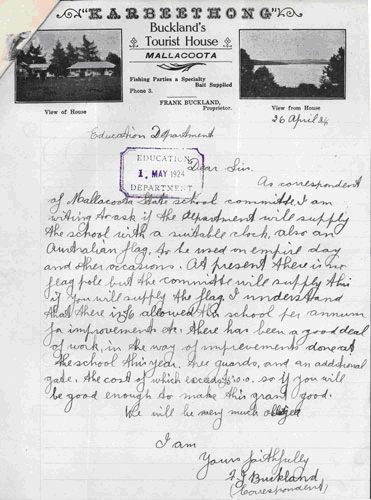 |
| Letter from Frank Buckland to the Department
of Education, 26 April 1924. The letterhead highlights the importance of tourism to the town. PROV, VPRS 640/P1, Unit 1737, Mallacoota State School 3515 |
When the entire Mallacoota school committee,
including Frank Buckland and Norma Brady,
resigned from their positions in 1931 the
Department was yet again required to investigate
the goings-on at Mallacoota. The committee
members objected to James Latta and Mrs Ellen
Bruce serving on the committee.(61) According to correspondence, Latta was living
openly with Mrs Bruce in the Bruce family
home. Robert Bruce was concerned his children
knew of this relationship and in Frank Buckland's
view Mr Latta was 'an improper person to
act on a public body, least of all a school
committee'.(62) The Inspector sent down to investigate the
claims reported to the Department: 'I gather
that nobody in this place wants to antagonise
Latta. He is said to be a man of considerable
force of character and rather good address
determined to serve his own ends and not
too scrupulous about the means to do it.'(63) An Order of Council, signed by the Minister
for Public Instruction on behalf of The Governor
in Council on 26 January 1932, officially
removed both Latta and Ellen Bruce from the
school committee.(64) James Latta appears to have been an unpopular
resident, and the parents' attempt to have
him dismissed from the school committee may
well have been a public and official denunciation
of both his relationship with Ellen Bruce
and his influence within the community.
Depression
The depression of the 1930s saw teachers
and schools in Victoria under attack from
politicians and the press.(65) There was enormous pressure on the Labor
government to cut costs and the State Finance
Committee recommended the closing of rural
schools with small attendances, increasing
fees, and restricting access to secondary
education.(66) In such a precarious economic climate the
people of Mallacoota came together and launched
a campaign to have the schoolhouse removed
from its site on the Rasmus property to the
township reserve surveyed in 1919.(67) The 'township' had been only lines on the
parish plan until the 1920s when a road linked
Mallacoota to the newly opened Princess Highway
and the outside world in 1921. Tourism became
a significant seasonal industry during the
1920s with the Brady, Allan, Dorron and Buckland
families providing accommodation, tours and
transportation for the tourists who came
to visit 'the gem of Victoria'.(68) The locals wanted the school in town, where,
they claimed, it was closer to most families,
but one also suspects, as a way of signalling
Mallacoota's status as a permanent and viable
rural community, rather than a remote farming
outpost.
Initially the Education Department rejected
the proposal. The small enrolment (in June
1934 there were only thirteen students) could
not justify such expenditure.(69) Undeterred, a letter was sent to the Secretary
in January 1935 stating that at a meeting
the parents had voted to withdraw their children
from the school until their demands were
met, but had 'wisely decided' to wait until
the Department visited. The school committee
also noted that six snakes had been killed
in the school grounds that summer.(70) Parents elicited the support of a number
of politicians, most of whom had a connection
with the Brady family through friendship
and politics. Those who wrote letters in
support of the school included AE Lind, their
local Member of Parliament, James Cameron,
a former MLA, and Edward Tunncliffe, Acting
Premier of Victoria.(71) The parents demonstrated local support for
the scheme the following May by sending the
Department the names of those locals who
supported the school's relocation. The names
included former students as well as locals
who also offered their labour to assist in
clearing and fencing the new site.(72)
The names on this petition include most
of the families involved in the various scandals
and campaigns over the previous thirty years.
These included the Brady, Buckland, Allan,
Latta, Bruce, Bristow, Greer and Bolton families,
testament to the importance the school had
in the community even for those who no longer
had children attending. The campaign was
successful and in October 1935 the Public
Works Department agreed to relocate the school
into the township.(73) There is no reason given for the Education
Department's change of heart, but presumably
the work of the politicians and the people
of Mallacoota contributed to a successful
outcome. It should be noted, though, that
both the Labor and the subsequent conservative
government were conscious of the strong influence
of rural electorates in the state parliament
during this period.(74)
Conclusion
A sociological study into country life carried
out during the Second World War by the Melbourne
University Faculty of Agriculture, found
that country people believed that self-help
and cooperation were dominant features of
rural life. The researchers also found, however,
that country towns could be divided along
religious, economic or personal lines. Such
divisions, and the subsequent tensions that
developed, were more intense in the smaller
towns where 'people's relatively few contacts
and interests contain all the emotion which
in a larger community could be more widely
dispersed'.(75) The Education Department records certainly
create the impression of Mallacoota being
an isolated rural hamlet beset with jealousy,
gossip and competition. The school at times
became the site where personal grievances
were played out between neighbours.
The Melbourne University researchers also
suggested that in such deeply divided communities,
cooperative and community effort became 'almost
impossible'.(76) At Mallacoota, though, this does not appear
to have been the case. The school, as well
as representing parents' hopes for their
children's future, became a vital element
in Mallacoota's transformation into a permanent,
viable settlement. Its importance is measured
by the fact that locals could put aside their
personal prejudices, albeit often temporarily,
and work to ensure the school's future. The
school also played an important role in developing
the political and social dimension of community
life, and Brady appears to have played a
significant role here. While sometimes a
difficult neighbour, he was willing to harness
his political contacts and use his skill
as an author to, as a local farmer's wife
wrote, 'do a little pen-fighting for our
little district'.(77)
Endnotes
1. Laurence Kennedy to the Secretary of Education,
3 May 1906, PROV, VPRS 640/P1 Central Inward
Primary Schools Correspondence, Unit 1329,
Mallacoota Inlet State School 3515. Note
that School 3515 was known as both Mallacoota
Inlet State School and Mallacoota State School
in the department files.
2. AG Austin, Australian education, 1788-1900:
church, state and public education in colonial
Australia, Pitman, Melbourne, 1980; Bob Bessant,
Schooling in the colony and state of Victoria,
Centre for Comparative and International
Studies in Education, School of Education,
La Trobe University, Melbourne, 1983; G Rodwell,
'Domestic science, race, motherhood and eugenics
in Australian State Schools, 1900-1960',
History of Education Review, vol. 29, no.
2, 2000; M Crotty, Making of the Australian
male: middle class masculinity 1870-1920,
Melbourne University Press, Carlton, 2001.
3. This approach is more commonly taken in
histories of independent schools. See for
example W Bate, Light school down under:
the history of the Geelong Grammar School,
Oxford University Press, Melbourne, 1990;
Kathleen Fitzpatrick, PLC, Melbourne: the
first century, 1875-1975, Presbyterian Ladies
College, Melbourne, 1975.
4. S Wesson, An historical atlas of the Aborigines
of eastern Victoria and far south-eastern
New South Wales, Monash Publications in Geography
and Environmental Science, no. 53, Monash
University, 2000.
5. K Thomson, A history of the Aboriginal
people of East Gippsland, Report Prepared
for the Land Conservation Council Victoria,
Melbourne, 1995.
6. Wesson, An historical atlas, p. 126.
7. S Mirams, 'For their moral health: James
Barrett, urban progressive ideas and National
Parks in Victoria', Australian Historical
Studies, no. 120, October, 2002; S Mirams,
Mallacoota Lakes National Park: the forgotten
park, MA Thesis, Monash University, 1999.
8. Advertising brochure for Mallacoota House,
NLA, Brady Papers Ms 206, series 13, box
54, folder 13.
9. For the story of these boats see J Little,
Down to the sea, McMillan, Sydney, 2004.
10. See for example EJ Brady, 'East Gippsland:
a neglected country', Herald, 23 June 1910.
11. JB Webb, A critical biography of Edwin
James Brady 1869-1952, PhD thesis, University
of Sydney, 1972.
12. EJ Brady to TG Ellery 20 July 1920, NLA,
Brady Collection Ms 206, series 13, box 52,
folio 5.
13. Application for the Establishment of
a State School 1905, PROV, VPRS 640/P1 Central
Inward Primary Schools Correspondence, Unit
1329, Mallacoota State School 3515.
14. ibid.
15. Chris Harrison to Secretary of Education
20 December 1902, PROV, VPRS 640/P1 Central
Inward Primary Schools Correspondence, Unit
1329, Mallacoota State School 3515.
16. LJ Blake (ed.), Vision and realisation:
a centennial history of state education in
Victoria, vol. 3, Government Printer, Melbourne,
1973, p. 1055.
17. ibid., vol. 1, pp. 323-27.
18. Application For The Establishment Of
State School 1905, PROV, VPRS 640/P1 Central
Inward Primary Schools Correspondence, Unit
1329, Mallacoota State School 3515.
19. Chris Harrison to Secretary of Education
20 December 1902, PROV, VPRS 640/P1 Central
Inward Primary Schools Correspondence, Unit
1329, Mallacoota State School 3515.
20. ibid.
21. Laurence Kennedy to Secretary of Education
31 October 1906, PROV, VPRS 795/P0 Building
Files: Primary Schools, Unit 1887, Mallacoota
State School 3515.
22. Blake, Vision and realisation, vol. 3,
p. 1057.
23. Photograph of Mallacoota State School
c.1910 , PROV, VPRS 795/P0 Building Files:
Primary Schools, Unit 1887, Mallacoota Inlet
State School 3515.
24. Building Report 6 December 1910, PROV,
VPRS 795/P0 Building Files: Primary Schools,
Unit 1887, Mallacoota Inlet State School
3515.
25. Clement Baker to the Secretary of Education
31 October 1906, PROV, VPRS 795/P0 Building
Files: Primary Schools, Unit 1887, Mallacoota
Inlet State School 3515.
26. Blake, Vision and realisation, vol. 3,
p. 398.
27. Henry Lawson to Jim Lawson 22 March 1910,
in C Roderick (ed.), Henry Lawson: letters
1890-1922, Angus and Robertson, Sydney, 1920,
p. 293.
28. ibid.
29. EJ Brady to Hon James Cameron MLA 17
July 1917, PROV, VPRS 795/P0 Building Files:
Primary Schools, Unit 1887, Mallacoota Inlet
State School 3515.
30. ibid.
31. EJ Brady to Frank Tate, 30 July 1916,
PROV, VPRS 795/P0 Building Files: Primary
Schools, Unit 1887, Mallacoota State School
3515.
32. Petition for a Full Time Teacher, Mallacoota
Inlet State School, 5 September 1916, PROV,
VPRS 795/P0 Building Files: Primary Schools,
Unit 1887, Mallacoota State School 3515.
33. EJ Brady to Frank Tate, 30 July 1916,
PROV, VPRS 795/P0 Building Files: Primary
Schools, Unit 1887, Mallacoota State School
3515.
34. EJ Brady to Secretary of Education, 24
September 1917, PROV, VPRS 795/P0 Building
Files: Primary Schools, Unit 1887, Mallacoota
State School 3515.
35. Dr Leach is perhaps best known as the
teacher who introduced nature studies to
the Victorian primary school curriculum.
See C Dowe, 'Nature's life long friends:
thryptomene, nature study and the declaration
of the Lakes National Park', Gippsland Heritage
Journal, no. 29.
36. EJ Brady to Frank Tate, 17 October 1918,
PROV, VPRS 795/P0 Building Files: Primary
Schools, Unit 1887, Mallacoota State School
3515.
37. EJ Brady to Frank Tate, 27 October 1918,
PROV, VPRS 795/P0 Building Files: Primary
Schools, Unit 1887, Mallacoota State School
3515.
38. Dr JA Leach, Memo to Director of Education,
10 November 1917, PROV, VPRS 640/P1, Central
Inward Primary Schools Correspondence, Unit
1737, Mallacoota State School 3515.
39. Department of Land and Survey to EJ Brady
19 May 1917, NLA, EJ Brady Papers, Ms 206,
series 13, scrapbook; EJ Brady to Minister
of Public Works, 27 April 1917, NLA, EJ Brady
Papers, Ms 206, series 13, box 54.
40. EJ Brady to The Minister for Public Works,
27 April 1917, NLA, EJ Brady Papers, Ms 206,
series 13, box 5.
41. Dr JA Leach, Memo to Director of Education,
10 November 1917, PROV, VPRS 640/P1 Central
Inward Primary Schools Correspondence, Unit
1737, Mallacoota State School 3515.
42. EJ Brady to Minister of Education, 30
April 1919, PROV, VPRS 796/P0 Outwards Letter
Books: Primary Schools, Unit 746, Mallacoota
State School 3515.
43. EJ Brady to Director of Education, 29
October 1920, PROV, VPRS 796/P0, Outwards
Letter Books: Primary Schools, Unit 746,
Mallacoota State School 3515.
44. GA Osborne, Inspector of Schools to The
Director, Education Department, 21 February
1921, PROV, VPRS 796/P0 Outwards Letter Books:
Primary Schools, Unit 746, Mallacoota State
School 3515.
45. ibid.
46. Robert E Bruce to the Education Department,
19 March 1921, PROV, VPRS 796/P0 Outwards
Letter Books: Primary Schools, Unit 746,
Mallacoota State School 3515.
47. Robert E Bruce to Secretary of Education,
28 August 1923, PROV, VPRS 640/P1 Central
Inward Primary Schools Correspondence, Unit
1660, Mallacoota State School 3515.
48. ibid.
49. Memorandum to the School Committee No.
3515, 13 September 1923, PROV, VPRS 796/P0
Outwards Letter Books: Primary Schools, Unit
746, Mallacoota State School 3515.
50. Violet McMeekin to Secretary of Education,
4 October 1923, PROV, VPRS 640/P1 Central
Inward Primary Schools Correspondence, Unit
1660, Mallacoota State School 3515.
51. K Howe, Mallacoota reflections, Mallacoota
and District Historical Society, Bairnsdale,
1991.
52. T McDonald to EJ Brady, 10 April 1924,
NLA, EJ Brady Papers, Ms 206, series 13,
box 52, folder 7.
53. Petition to Licences Reduction Board
from EJ Brady, December 1925, NLA, EJ Brady
Papers, Ms 206, series 13, box 52, folder
5.
54. Mrs Dawson to Secretary of Education,
2 February 1924, PROV, VPRS 796/P0 Outwards
Letter Books: Primary Schools, Unit 746,
Mallacoota Primary School 3515.
55. M Lake, The limits of hope: soldier selection
in Victoria 1915-1938, Oxford University
Press, Oxford, 1987, p. 163; G McGeorge,
'The long haul to full school attendance',
New Zealand Journal of History, vol. 40,
no. 1, April 2006, p. 27.
56. Petition to Secretary of Education, 12
March 1925, PROV, VPRS 640/P1 Central Inward
Primary Schools Correspondence, Unit 1737,
Mallacoota State School 3515.
57. Blake, Vision and realisation, vol. 1,
p. 127.
58. Frank Buckland to the Secretary, 26 April
1924, PROV, VPRS 640/P1 Central Inward Primary
Schools Correspondence, Unit 1737, Mallacoota
State School 3515.
59. Secretary to the Head Teacher, 24 February
1926, PROV, VPRS 796/P0 Outwards Letter Books:
Primary Schools, Unit 746, Mallacoota Primary
School 3515.
60. Mallacoota State School Committee to
Secretary, 4 August 1930, PROV, VPRS 796/P0
Outwards Letter Books: Primary Schools, Unit
746, Mallacoota Primary School 3515.
61. Frank Buckland to Secretary of Education,
13 December 1931, PROV, VPRS 640/P1 Central
Inward Primary Schools Correspondence, Unit
1737, Mallacoota State School 3515.
62. Confidential Report, 21 January 1932,
PROV, VPRS 796/P0, Outwards Letter Books:
Primary Schools, Unit 746, Mallacoota Primary
School 3515.
63. ibid.
64. Order of Council, 26 January 1931, PROV,
VPRS 796/P0 Outwards Letter Books: Primary
Schools, Unit 746, Mallacoota Primary School
3515.
65. Bessant, Schooling in the colony, p.
98.
66. ibid., p. 99.
67. A Brady, 'Edward Lees, Surveyor of Mallacoota',
Gippsland Heritage Journal, no. 12, June
1992.
68. Petition to T Hogan, Premier, 30 January
1930, Department of Crown Land and Survey,
National Park Files, Mallacoota Inlet National
Park, Rs.1176.
69. Secretary of Education to James Cameron
MLA, 5 June 1935, PROV, VPRS 796/P0 Outwards
Letter Books: Primary Schools, Unit 746,
Mallacoota State School 3515.
70. WP Bolton to the Education Department,
28 January 1935, PROV, VPRS 796/P0 Outwards
Letter Books: Primary Schools, Unit 746,
Mallacoota State School 3515.
71. The Hon AE Lind to Secretary, 14 February
1935 and 22 May 1935; HR Cameron to Secretary,
5 June 1935; Edward Tunncliffe to Secretary,
27 August 1935 and 14 October 1935, PROV,
VPRS 796/P0 Outwards Letter Books: Primary
Schools, Unit 796, Mallacoota State School
3515.
72. ibid.
73. Public Works Department to Secretary
of Education, 16 October 1935, PROV, VPRS
796/P0 Outwards Letter Books: Primary Schools,
Unit 746, Mallacoota State School 3515.
74. Bessant, Schooling in the colony, p.
101.
75. AJ & JJ McIntyre, Country towns in
Victoria: a social survey, Melbourne University
Press, Carlton, 1944, p. 262.
76. ibid.
77. Mrs Stevens, Wangrabelle, to EJ Brady,
25 July 1925, NLA, EJ Brady Collection, Ms
206, series 13, box 52, folder 8.
