
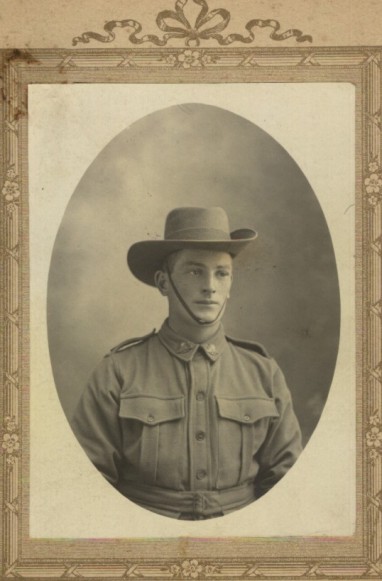
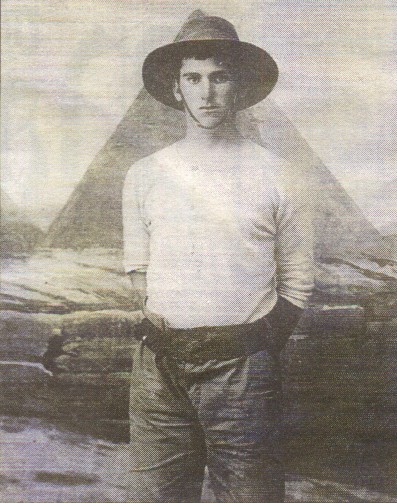
| Pte. E. J. BEASLEY Jean McPaul Collection, Eden Killer Whale Museum |
These two letters below were written by E.
J. Beasley (above) who died fighting in WW1.
Original letters held in the collection of
Eden Killer Whale Museum
  |
TOWAMBA WAR LETTERS (Spelling as written)
Address: Dearest Cousin
Dunblane, Burragate.
New South Wales Tuesday, November 23, 1915
Just a few lines to let you see that I have
not forgotten you altogether. Well dear Cousin
I was in the mumps hospital five weeks. I
had the time of my life while I was in there,
nothing to do but eat and drink. I was a
bit soft for a while when I first came out
but I am going good again now. I don't think
I ever felt better than that I do at present.
My company has all gone, except a few that
was left behind like myself. I am with the
details and we have to drill with the 9th
of the 9th. They have got others to be ready
to go to the front at any time. We have got
to go with them I only wished we were gone
long ago. We are sick of here. Well, dear
Cousin, poor old Hampden (Beasley) left for
the front before I got out of the hospital
and I never saw him but I hope to see him
over there I have never run against a man
that I know yet and you see hundreds of them.
Well dear Cousin the war is getting worse
and worse every day. We are waiting anxiously,
to see which way Greece is going to go anyway
its to be hoped that they will go with the
allies because it will end the thing a lot
quicker. By Jove, it is wonderful to see
where some of the returned soldiers that
has been wounded have been hit and not killed
you would think it impossible for a man to
live the way some of the bullets have gone
through them. Well dear Elsie, by the time
you receive this letter and card I might
know what its like to be wounded perhaps
I will know nothing its what ever your lucks
to be I suppose. I expect you will be feeling
the effect of the plum puddings, cakes and
etc, by the time you get this letter anyway
I hope that you have enjoyed yourselves and
while you were eating them, that you thought
of me. I expect you are beginning to get
some hot weather. We will be going into a
pretty cold place when we land on the peninsular.
I wrote Mrs. Binnie a letter I hope it arrived.
I have posted Ethel a book of views. Well
Elsie I expect the boys have nearly all gone
to the war. I bet theres some hair pulling
amongst you girls to see whos going to have
whats left. Well Elsie I would very much
like to know how they are all at home I have
never heard from them since I left Brisbane.
I had one letter from Elsie Targett, Lochiel
and one from the Pendergasts . Well dear
Cousin I will sign off.
Your ever lovin Cousin, E. J. Beasley.
? Egypt.
France
June 17th, 1916
Dear Cousin,
Just a few lines to you to let you see I
have not forgotten you you will have to forgive
me this time Elsie its a case of better late
than never. Well Dear Cousin Since I last
saw you I have done quite a lot of travelling
and by Jove I have seen sights which if I
am lucky enough to go through this war I
shall never forgett. I did not think when
I left Towamba that I would ever get this
far away from Home. But never the less here
I am right amongst the din of shot and shell.
Just at present as I write you this letter
the guns are booming away for all they are
worth. The noise would nearly deafen you
you can hear the shells screaming through
the air in dozens right over our heads. The
airoplanes are very busy to, fritzy is shelling
them them for all he is worth but I have
never saw one brought down yet. Talk about
brave its no name for our airman its lovely
to see them up in the air. They have got
fritzy properly bluffed. By Jove Elsie when
the big high explosion shells start falling
around about you they do shake you up. The
nearest I have been to one yet was to get
mud thrown all over me. I dont mind the mud
as long as I can duck the pieces of shell
its quite a dangerous place here Elsie especially
at night time when we are on fatigue duty,
rifle and machine gun bullets are flying
every where we have seen a fair bit of experience
in the firing line but I expect it will be
a mere trifle to what we will see before
long if we are spared. It would do your eyes
good to see the lovely grass it looks beautiful
after being so long on the sands of Egypt.
I should reckon this a very pretty country in peace time
it would make you cry to see the lovely homes
that have been destroyed where the fighting
as been. Some people are still living in
old ruins although the shells are falling
round about almost daily.
They take the risk of being killed sooner
than leave the dear old home. They do pretty
well out of the soldiers with eggs, bread,
butter, beer, wine and etc. I have seen brother
Arthur several times since we came to France.
He has got very fat but I have not seen Hampden
since he left Tel-el Kebir(?) Egypt. They
wasnent camped very far away either but then
its hard to find anyone because there are
so many. I hope the other three brothers
get across safe. I was sorry to hear that
Alf had enlisted because he was such a good
help to his mother. By Jove they must of
missed him at home. The Towamba boys responded
to the call well. I never thought they would
let George Dickie go being the only son.
He must of talked his mother over somehow.
Well Elsie, I hear that Lizzie beat you for
first place. I wish them all good luck and
prosperity on their achievement. I suppose
you will be next. I dont no if you are still
at Dunblane anyway I address it to there
if you aint I know you will be sure and get
it. I wrote a letter to your dear mother
a few days ago also one to Aunt Mary Targett.
I asked them to be sure and remember me to
all. I only hope they receive them. I would
like you to remember me to one and all I
would be very pleased if you would remember
me to Auntie Agnus and poor old granmother
Lis I quite forgott them in your mothers
letter. I must drop them a few lines if I
am spared. I receive my letters pretty regularly
from Bertha sometimes a card from dear little
Edna she says that she his keeping all the
kisses I send her until I come home. I would
very much like one of her photos. I would
give anything for one I have one that was
taken when we were out at Nungatta. I would
like to see how she has been growing anyway
I live in hopes of being able to get back
again some day you never know your luck do
you Elsie. I would of sent you a card but
there aint any to be got just here. I have
received some nice letters from the Targetts
at Lochiel via Tantawanglo also some from
Inda (?) and Connie Dickie and a very nice
one from Thelda Hartneady. Well Elsie I will
ring off for this time, with love from Ted. XXX. (Beasley)
Be sure and write soon - address
No. 2555 Pt. E. J. Beasley, A Company. 9th
Battalion, 3rd Brigade. France.
EXCERPT FROM 'THE VALLEY GENEALOGIST'
Dear Editor,
Further to the letters of Ted Beasley; his
body was never recovered but his name is
listed on the memorial to the missing on
the Villers Bretonneux Memorial. Pvt. Beasley
died at Pozieres in the Somme area. Villers
Bretonneux is a village 16 kilometres east
of Amiens on the straight main road to St.
Quentin. The Memorial stands in Villers-Bretonneux
Military Cemetery, which is about 2 kilometres
north of the village on the east side of
the road to Fouilloy.
It may not be generally know that 11,000+
Australians were missing in France and names
are on this memorial. Another 7,000+ missing
in Belgium are on Menin Gate Memorial and
another 300+ on the V.C. Memorial at Fomelles.
The Edna referred to in Ted's letter was
his daughter by May Parker. May died on 18
September, 1909 at or close to Edna's birth,
hence the absence of a mother. When the Towamba
War Memorial was dedicated in 1925 Edna was
presented as the only child of a fallen soldier
in WW1 in the Imlay Shire.
Bernie Cornell
France
20/4/ 17
Mr. Lang (Laing)
Towamba
Via Eden.
N.S.W.
Dear Sir,
It has fallen to my lot to convey to you,
the sympathy of the officers and men of the
2nd Brd, in your recent loss. Your brother
6607 T. Lang (Thomas Laing) was liked and
respected by one and all. During the attack
and capture of Hermies on Easter Monday morning
your brother met his fate. You have this
satisfaction, he fell fighting hard. Right
in the front rank of the charge. As his Platoon
Officer, I miss him, he was a soldier all
through and was popular with all. He is buried
on the field of victory.
Yours sincerely,
R. Raunard. Lt.

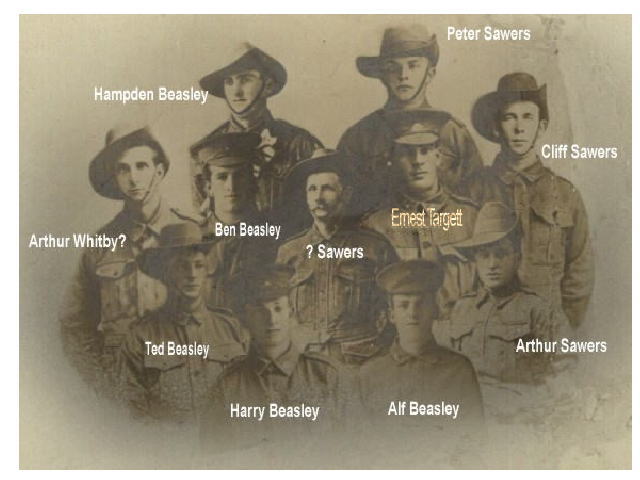
| Photograph found at Mr. & Mrs. Laing's
property. Towamba. The men are unknown. Photo courtesy of L. Macey |
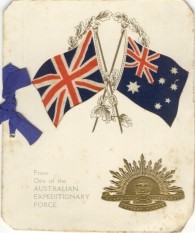
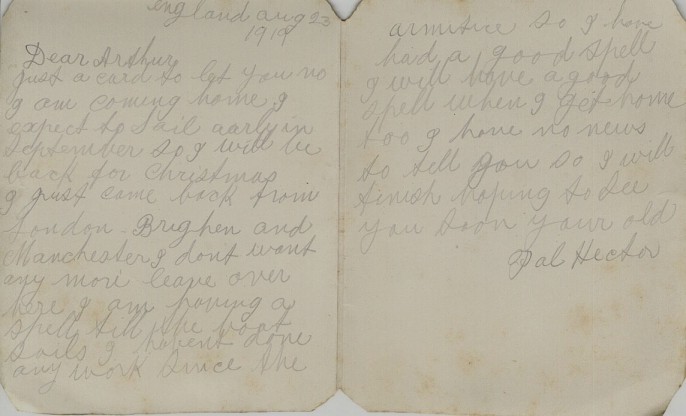
| Greeting card sent home from perhaps Hector Laing, to Towamba from Britain after the WW1 Contents below. READ HECTOR LAING'S OBITUARY IN 'OBITUARIES'. LINK ON INDEX |
 |
| Hampden Beasley |
Excerpt from 'The Pambula Voice' insert in the Magnet Newspaper, April-May 2002
When John Hampden Beasley of Towamba enlisted
to fight in the First World War, he was a
willing volunteer, as were his four brothers
Alf, Harry, Arthur and Ted. Arthur, the youngest,
had to put his age up to be accepted as a
soldier. All five saw active service, Ted
being killed in France. Hampden was the only
one of the brothers to find himself at Gallipoli
when the landing took place on April 25,
1915.
Mr. and Mrs. Grant agree that Hampden never
liked talking about his war experience, particularly
at Gallipoli. (Hampden Beasley was Gloria
Grant's father).
"He used to say that Kitchener pulled
them out because they weren't doing any good
there," Mr. Grant recalls. "It
was the done thing for young men to volunteer
- you couldn't have stopped them."
The Beasley brothers wrote to the girls back
home in Towamba. "All the local girls
used to write to the boys who were on active
service," Mrs. Grant said.
Hampden sent postcard snap-shots of himself
to Thelda Hartneady, who lived at the Towamba
Stores. One is of himself in front of the
Pyramids while he was stationed at Cairo,
and a second from Harefield in Middlesex,
England, while Hampden was recovering from
a gunshot wound to his hand received while
he was in France.
"He came through Gallipoli without a
wound," Mrs. Grant said. "He was
really lucky. Then he went over to France
because Ted was over there. Ted was killed
the day before he arrived, and then Dad was
wounded."
On the back of the postcard showing himself
with his arm in a sling Hampden wrote to
Thelda "Dear Thelda, I have been moved
from Nottingham Hospital to 4 Kent Street,
Harefield. The doctor came around this morning
and had a look at my hand. He marked me down
for a month's home service. I have to pass
the Board. If I succeed I'll be back sooner
or later my hand's nearly alright but I can't
close it just move the points of my fingers.
Well I must bring this card to a close hoping
it finds you all well as it leaves me that
way at present."
Thelda Hartneady wound up marrying Jack McLeod,
Mrs. Grant's mother's brother. Hampden returned
and married Maud McLeod, Mrs. Grant's mother.
Life wasn't easy for the young returned soldiers.
They had been promised land, but they didn't
get it. "Dad wound up picking up rocks
and sticks on a property on the Monaro,"
Gloria said. "They used to get there
on pushbikes and they had to come down Big
Jack Mountain on the way home. They'd have
a log tied to the back of their bikes to
act as a brake and slow them down."
Later Hampden worked for the Imlay Shire
Council, eventually living in Wyndham and
ending his days with Mr. and Mrs Grant.
After seeing an article in the Bega Times
Mrs. Grant sent away for Hampden's Gallipoli
Medal, which came with a certificate stating
"In Commemoration of the heroic deeds
of the men of Anzac Gallipoli in 1915 and
in recognition of the great debt owed by
all Australians. With the compliments of
the Government of the Commonwealth of Australia.
Hampden's discharge papers were signed on Parchment - a deed that Mrs.
Grant still has. They state that his conduct
while on service was "good", and
that he was discharged honourably with a
gunshot wound on the back of his hand, his
age being 22 and 4 months when discharged.
Like so much of Hampden's war history, it
does not say enough. The postcards from the
front join Mr. and Mrs. Grant's other treasured
possessions, mementos of a man who did what
he knew he had to do with quiet courage and
good humour, but seldom spoke of it.
