

With kind permission
EXCERPTS FROM:
'A JOURNEY THROUGH TIME'
Compiled by Nola O'Connor and Kathy Jones
ACKNOWLEDGEMENTS
Our sincere thanks to all those who have
shared their time, resources and memories
and therefore preserved the histories of
those who journeyed before us.
We would especially like to thank these people,
in no particular order; Mr Claude
Trenery for his assistance in the stories
Robert and Mary Theresa, Arthur John and
Robert Patrick Alexander, his recollections
and sharing of photographs are very much
appreciated.
Mr Arthur and Mrs Gray Trenery who spent
so much time searching, providing research
materials and sending photographs for us
to use. We can not say how grateful we are
for their help.
Mr Ken Howarth, Mrs Edith Sutherland and
Mrs Eileen Price for their overwhelming
offers of assistance, research, gathering
of information and providing a number of
photographs. Their generosity knew no bounds.
Mr Scott Egan for sharing his information
on the Egan branch and writing the story
about Ruth Ann Alexander and Mrs Eileen Woods
for also assisting with the story on
Ruth Ann, submitting the story of her father
and kindly helped with research and shared
her findings.
Mrs Robyn Ryan for her generosity in allowing
us access to Max's research and
photographs.
Mrs Jill Barry who has been of so much help
in the writing of the story on Jessie Emma
Alexander and allowing us to use a excerpt
from her book.
Mrs Nardia Ryan-Taylor and Gail Hanger who
provided so much information on the
Robert Alexander (2nd generation) branch
and the Pendergast family.
Mrs Doreen Membrey who generously shared
many photographs from her collection
and Mrs Ruth Farmer who gave so much of her
time to gather information and copy
photographs for our use.
Mr Allan Peisley and Mrs Anke de Geus for
taking so much time to help verify facts
and provide information on the families who
lived in Genoa.
FOREWORD
Writing a history such as this requires time,
perseverance and often the assistance of
many others who generously give of their
time and resources. Even after hours of
writing, crosschecking,letters etc... mistakes
can still occur. We sincerely apologise
for any errors or omissions that may be found
within this book, but it is accurate to our
knowledge at the time of printing.
Many months of research have been put in
to compile this book and each story has had
its own designated compiler.
Nola O'Connor has worked tirelessly to bring
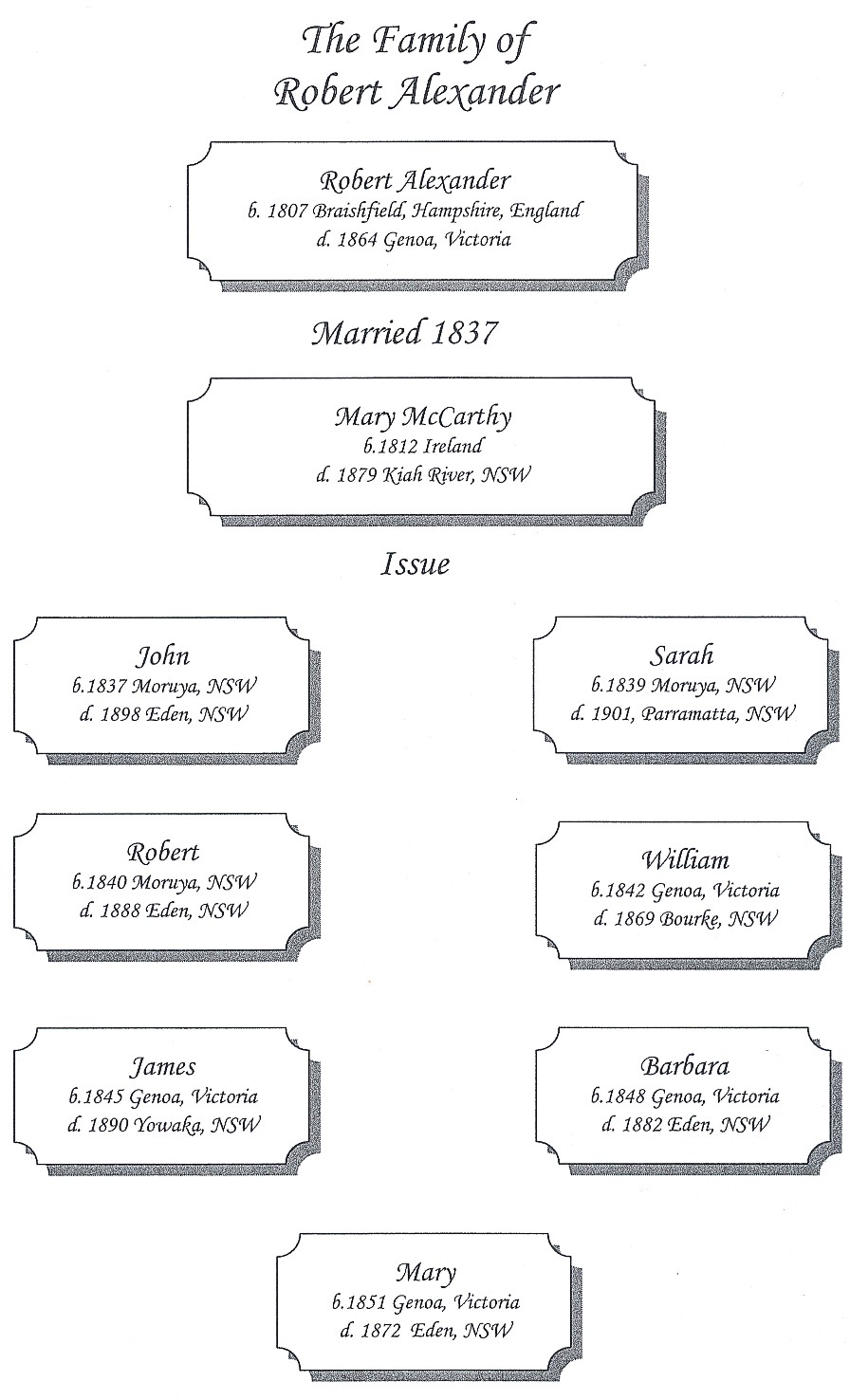
you the lives of Robert Alexander and
Mary Theresa McCarthy; of the second generation:
John, Sarah, William and Mary and
of the third generation: Sarah, Arthur John,
Robert Patrick, Adeline Barbara, Herman
William Leo, Norman Harold, James Clarence
(McNee) and Barbara Mary Ellen
(McNee).
Kathy Jones has compiled the stories about,
Robert, James and Barbara Alexander from
the second generation and Elizabeth Mary,
John Thomas, Barbara, Robert, Robert (Bo),
Percy Vemon William, Florence Ada, Horace
Eden, Sydney Eden, Alfred Ernest,
Alfred Ernest (2), Veronie, Patience May,
Mary Victoria, Johanna Amy, Maurice
Walter, James Creighton, Mary May Amelia,
Florence Ada (2), Jessie Emma and
Isabella from the third generation.
The story of Ruth Ann has been especially
written by Scott Egan. The story of Lance
Egan has been written and submitted by Eileen
Woods.
We hope that you enjoy reading about the
lives of our ancestors and see them as more
than just dates and places, but rather as
people who lived during one of the more
interesting eras of Australia's history.
INTRODUCTION
Every person has a story to tell; no two
are the same and yet everyone is important.
Some people have tales of daring and adventure
or of fame and fortune. Most however, work
hard, find their love, raise a family and
grow old telling their stories to the next
generation.
Herein lie tales of hardship, of travel,
of love and heartbreak, of success and failure,
of laughter and tears and of the past and
the present.
May you enjoy the journey and remember that
those who journey after us will be just as
fascinated with our stories as we are with
those who have gone before us. Record those
stories and label those photographs, so that
future generations will be able to continue
the Journey Through Time...................
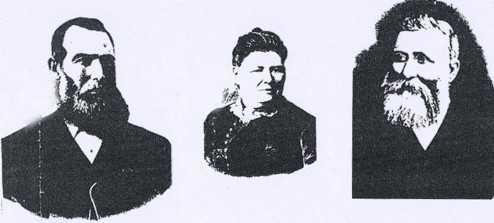 |
| Portraits from the Seahorse Inn believed
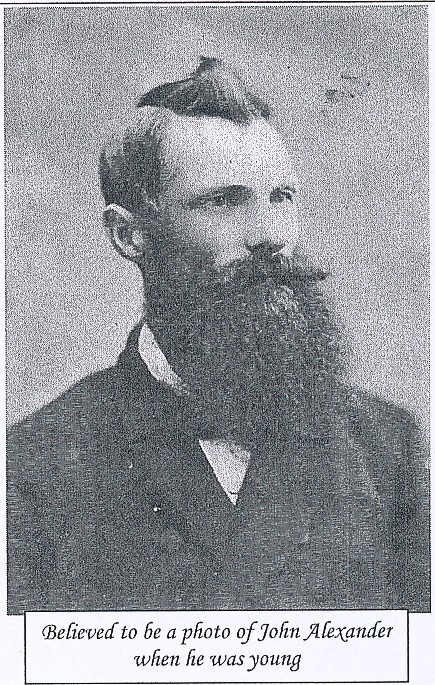
to be from left to right: John Alexander, Elizabeth Alexander and Robert Alexander. |
CHAPTER 1
THE JOURNEY BEGINS....
ROBERT ALEXANDER AND THERESA McCARTHY
The speeding motorist on the Princes Highway
might hardly notice Genoa, the
"last town in Victoria".
There's not much to notice; a hotel, a closed
store and school, a petrol station,
some houses, a few farms and an old bridge.
You could pass history, pass a place rich
in natural treasures,
... a place where people lived and worked
and played,
who had hopes and dreams successes and failures,
laughter and tears.
Excerpt from "Border Tales"
Reproduced with the kind permission
of the Genoa Town Committee
 |
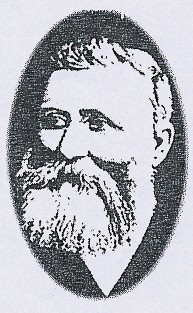 |
| ROBERT ALEXANDER 1807 - 1864 |
PART 1
It was 1807, the year that slavery was abolished
in the British Empire, King George III
was on the throne, Pall Mall became London's
first street lit by gaslight and
England's first railway passenger service
began. On 9 April that year, at Braishfield,
a
small hamlet in the parish of Michelmersh,
in Hampshire, England, Robert Alexander
came into the world, in the scheme of things,
this was a seemingly insignificant event,
however, none of the following stories would
exist without this one event.
Robert was the seventh of eight children
born to John Alexander, an agricultural
labourer and his wife, Mary Ann, he was baptised
on 17 May 1807 at St Mary's in
Michelmersh. This church played a large part
in the lives of the Alexander family,
Roberts siblings - James 1792, Maria 1797,
Barbara 1799, William 1801, Charles 1805
and Sarah 1809 were all baptised there and
a number of them were also married at St
Mary's, his parents, John 1762-1835 and Mary
1764-1836 are buried there.
Nothing is known of Robert's childhood, only
that he did not receive an education, as
his convict indent states that he could neither
read nor write. He grew up in the
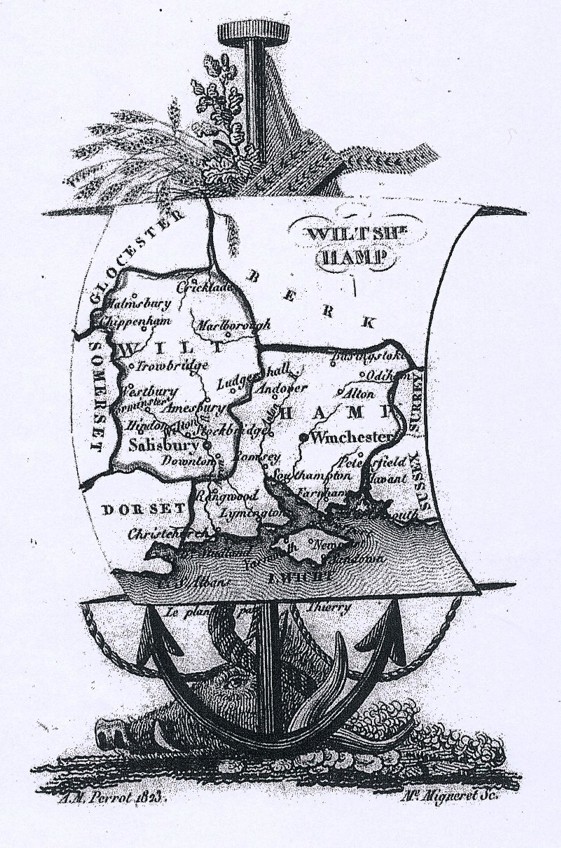
important maritime and agricultural county
of Hampshire on the south coast of England,
which overlooks the English Channel towards
the Isle of Wight. Hampshire is
surrounded by counties Sussex and Surry to
the east, Wiltshire and Dorset to the west
and Berkshire on the northern side.
At the age of 20 Robert was working as a
servant and ploughman at Hunt's Farm in the
Romsey district, his wage would have been
around 18 pence or 15 cents per twelve-hour
day, a grand total of around 9/- or 90c for
a six day week. Standards of living in the
Hampstrire country side were poor, work was
increasingly harder to come by with the
advance of the agricultural and industrial
revolution in England, men were being
replaced by machines.
On 27 October 1827 Robert was brought before
Sir W Heathcote at the Romsey
Quarter Sessions where it was alleged that
he and another youth, Joseph Collins used
force to rob a Mr George Scammel of silver
coins totalling 19 shillings (around two
weeks wages at that time - today (2003) this
would be the equivalent of approximately
AU$800). A written case was presented to
a 'Grand Jury', which was effectively a
selection of men of the upper classes, who
found there were grounds for a trial.
Although both young men pleaded not guilty
when brought to trial at the Winchester
Assizes on the 5th March 1828, the evidence
against them (including that of Mr
Scammel) was seemingly conclusive and they
were found guilty of highway robbery.
The initial sentence was 'death' which was
later changed to transportation to the new
penal colony of New South Wales. Joseph received
seven years and Robert was given a
life sentence.
The Romsey Extra New Forest area was the
ideal location for highway robbers, as there
is a road junction for the cities of Winchester,
Salisbury and Southampton. The
penalties for what we would consider petty
crime were high, so what would induce
Robert to take such a risk? Well, family
legend has it that Robert maintained his
innocence right up until his death. He admitted
that he and Joseph were in the New
Forest that night on the retum journey from
a night out, but they had no involvement
in
any robbery. If this were true, why would
such a crime be fabricated? One possible
scenario could be that Robert's sweetheart
'E.H.' (tattooed on his arm) was the daughter
of Mr Hunt for whom Robert worked, maybe
his attentions to the young lady were not
exactly what Mr Hunt had in mind for his
daughter, and here was a foolproof plan to
get
young Robert out of the way permanently.
Stranger things happened during this period
of history.
For the next five months, while awaiting
transportation, Robert was confined to the
hulk
'York' in Portsmouth Harbour. These deplorable
dungeons lay anchored bow to stern
in rows on the grey heaving waters of southern
England and had the appearance of slum
tenements. Within these hell holes convicts
lead a miserable existence, each felon had
a
14lb (6kg) iron riveted to his right ankle
and endured conditions such as inadequate
clothing; putrid food and cramped, wet, dark,
vile smelling quarters.
At Portsmouth as at other places, the convicts
worked for the Royal Navy in the
government dockyards, they were taken off
the hulk at dawn and rowed back to it at
dusk. They became an object of public ridicule
for people to heckle and stare at, this
amplified their feelings of shame, self-debasement
and loss of personal pride.
Throughout his time in prison and on the
hulks, Robert's records show only good
behaviour. He was transferred to the 'Royal George' on the l6th August 1828, which
was an 8yr old E1 class sailing ship weighiqg
486 tons. Aboard were a total of 159
convicts, a guard of thirty men from the
63rd Regiment, the Surgeon Superintendent,
Dr
Gregor R.N and Captain Embleton.
On 26 August 1828, the Royal George set sail from Spithead, the journey seems
to have
been uneventful, with the weather generally
good and very hot at times. The Surgeon's
Journal shows that Robert was treated for
an ailment from 6-11 November, for which
he
was ".. .blistered and bleeded..." and given opium and laudanum at varying
intervals.
A note on the front page of this journal
states, "As this surgeon is in a state of
derangement or imbecility of mind, let this
journal be verified', perhaps he got into the
laudanum?? On Christmas Eve 1828, after a
passage of 120 days, the Royal
George reached Sydney Cove.
We know from the Convict lndent records that
Robert was five feet six inches tall, of
ruddy complexion with brown hair and grey
eyes. Other remarks pertaining to his
appearance state that tattooed on his right
arm there was a heart with the initials E.H.
inside and the year 1828 and a woman underneath,
on the underside of his left arm was
tattooed another woman, he also had a scar
on the front of his chin and another across
the middle fingers of his right hand. There
has been a study conducted on the convict
tattoos and they are considered a useful
source of information, often giving insight
into
the lives they left behind. The "tattoos"
were gouged into the skin with soot -ouch!!!
At the time of Robert Alexander's arrival
in Sydney, the white population of the forty-
year-old colony as recorded on the Census
of 1828 was 36,598, of this number 15,728
were convicts. The authority in the colony
was Lieutenant Ralph Darling as Governor,
and Sir Thomas Mitchell, as the NSW Surveyor-General.
A couple of weeks prior to
Robert's arrival in Australia, Captain Charles
Sturt along with Hamilton Hume set out
from Sydney to explore the inland river system
and the colony was in the third year of a
severe drought which was adversely affecting
the economy.
At the tender age of 2l , Robert Alexander,
Prisoner No 28/2267 had received a 'Life'
sentence for a crime to which he pleaded
innocent, been discarded by his native land
and transported to an isolated penal colony
on the other side of the world; and suffered
the squalor and inhumanity of servitude in
a prison hulk and convict transport. He
would never see his native home or family
again. His first day in this wild new land
was Christmas Day 1828 ... what a grim Christmas
that must have been.
While awaiting 'assignment', it is highly
likely that Robert was confined to the rat
infested Convict Barracks in Macquarie Street,
where convicts slept in rows of
hammocks less than an arms length apart.
Sometime early in 1829, Robert was
assigned to William Turney Morris, a free
settler who arrived in the colony in July
1828
aboard 'Ship of Australia'. On 13 January 1829 Morris was granted a
selection of land
at Mooramoorang, which is located on the
coast about 18 kilometres north of Bateman's
Bay. Interestingly enough, Mr Morris had
come from the same region as Robert;
Romsey Marsh in Hampshire. He had emigrated
from England because he suffered
'Marsh Fever' and hoped the change of climate
would improve his health. This
relationship would be one that would greatly
affect the future of Robert; bringing
changes to his status, firstly with a conditional
pardon, and secondly in becoming a
landowner at Genoa, Victoria.
Morris sold the Mooramoorang grant in 1835
and staked a claim in a squatting area
across the river from Moruya, he named this
station 'Gundary'. He and Robert were
two of the minority of white folk who attempted
to live in the then isolated wilds far
from the colony's civilisation of Port Jackson
and surrounding townships. Problems
were evident in September 1830, when William
Morris made a complaint to the
Colonial Secretary about the local aboriginal
tribes spearing the cattle. His request to
either shoot the ringleaders or have a guard
of soldiers were both denied, although a
patrol was sent to resolve the problem with
mediation.
The Bungonia Bench recommended Robert's application
for his first Ticket of Leave in
November 1836 and TOL no 37/411 was issued
on 28 February 1837 and stated he was "Allowed to remain in the District of
St Vincent". Ticket of Leave no 41/734 was issued
on 30 March 1841 with a notation stating
"ln lieu 37/411 dated 28 February 1837,
deposed to be lost".
Now that he had his TOL, Robert was in a
position to marry, and wasting no time, in
the
following month of December 1836, he applied
to the Principle Superintendent of
Convicts for permission to marry, this was
granted. The object of his affections was
Mary Theresa McCarthy ..........
PART 11
MARY THERESA McCARTHY
1812-1879
An entry in the family bible documents that
Mary was born on 7 September 1812,
she was the daughter of John McCarthy and
Joharura Flanagan of Cork in Ireland.
To date, no information on Mary's early life
or her family has been located. l812 was
a
significant year in a literary sense with
the births of both Charles Dickens and Robert
Browning. On the continent, Napoleon Bonaparte
was invading Russia and in America
the US declared war against Great Britain.
Meanwhile, the introduction of the Waltz
in
London ballrooms was causing a scandal.
According to family legend, Mary lived in
a convent in Cork and had trained as a
nursing sister. There were six different
religious orders in Ireland around this time
and
they ran an ever-increasing number of convents
catering to the poor with a network of
schools, orphanages, reformatories, industrial
schools, Magdalen asylums and homes
for the elderly and the extent of their activities
made them a powerful force in shaping
Irish society. Nuns had a high social status
in nineteenth-century Ireland and entering
a
convent was the ideal for Irish Catholic
women of that time, becoming a wife and
mother was considered a second best option.
The major form of relief work carried out
by nuns before 1850 was sick visitation and
thousands of visits were made to the homes
of the poor every year.
Following some 'trouble' with one of the
priests, Mary left the convent, it was a
very
brave decision as she was leaving the relative
security and protection of the convent to
live in an overcrowded city where unemployment
and crime were rife and there were
not many options available for a young woman
her age. Therefore, the free passages
being offered to able-bodied women of good
health and character to immigrate to
Australia would have seemed preferable to
a paupers existence in Ireland. Over the
years, Mary was often to warn the women of
the family not to trust clergymen and to
ensure that they were never alone with one.
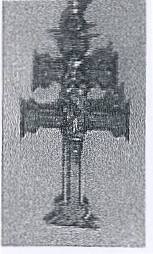
Mary had in her possession a large silver
double barred cross about 8cm
high, on one side is a figurine of Christ
and on the other is the Holy
Mother, both are coated in gold. The double
barred cross is the 'Cross of
Lorraine' associated with Joan of Arc. There
are two theories regarding
the origins of this cross, one is that it
was a family heirloom passed down
through the McCarthy family, dating from
the 1500's when a number of
Spanish galleons were sunk off the coast
of Ireland by the McCarthy Clan
and the loot was distributed among the family
with the trinkets going to
the women. The second theory is that this
cross is a relict from her time in
the convent.
 |
Mary came to Australia as a free settler
aboard the 'Duchess of Northumberland' which
sailed from Cork in Ireland, there were two
other McCarthy girls on board, Anna and
Ellen, but no evidence has been found to
establish their relationship, if any, to
Mary.
Mary emigrated under the Women's Immigtation
Scheme and, it was stated in a
despatch to the Colonial Secretaryon 8 May
1835, that "...with regard to the young women
by
the Duchess of Northumberland that they have
been represented ... to be most virtuous
and best adapted
for the colony that have hitherto arrived
under similar circumstances ... In consequence
the greatest care
has been taken in selecting good situations
for them." Previous to this, many of the women who
had arrived in the colony were either convicts
or women of ill repute, often the product
of the appalling circumstances in England
and Ireland at that time. In direct contrast
to
this poverty, 1835 was an eventful year in
the Arts, Madame Tussaud opened her Wax
Museum in London, Hans Christian Andersen
published his first book of fairy tales and
Chopin was busy composing his waltzes.
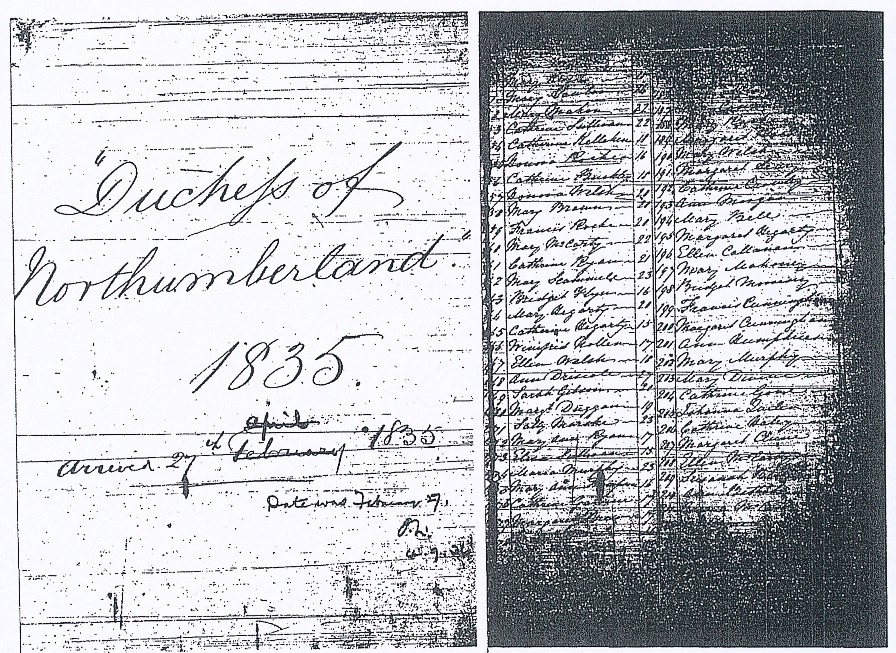 |
After arrival in Sydney on 27 February 1835,
the 220 women from the Duchess of
Northumberland were accommodated at the lumberyard buildings
where interviews
with prospective employers took place. Within
three weeks, all the women had found
employment. Following is an extract from
the despatch of 8 May 1835 to the Colonial
Secretary in response to complaints re the
accommodation of the women.
"...I am further called on to reply
to the observations ... on reports current
in England regarding
treatment of the emigrants on their arrival
in this colony. It is said they were 'placed
in the lumber-yard,
at that time stated to be in very bad repair;' and it is added, 'that the provisions served out to them were
of the worst description, and that no attention
whatever was paid to their comforts.
.. I beg leave to remark that in this colony
there are very few public buildings which
are not constantly
required for the purposes for which they
have been appropriated; and that to find
accommodation of any
sort for between 200 and 300 women in Sydney
is a matter of some difficulty. The lumber-yard
buildings
were those which offered the greatest conveniences
for the reception of the emigrants..... The
apartments, though out of order, were safe,
and furnished with the most needful articles
for taking food
and rest, and generally, I believe, superior
in such accommodation to the ship the women
had just left,
and to the dwellings of many of them in the
countries of their birth.... The complaint
of badness of
provisions is wholly without foundation,
and the ration, composed as is stated ...
will probably be
considered as furnishing not only what is
required for mere sustenance, but for some
degree of comfort.
Military Bread1 1/4lbs; Fresh Beef 1 2oz;
Vegetables 8oz; Tea 1/4oz; Sugar1 1/2 oz:
Salt 1/2oz; Soap
1/4oz. Upon the whole, therefore, I cannot
admit that the female emigrants have met
with any neglect
from this Government.'
At the time of Mary's arrival in the colony,
a land route had just been opened between
Sydney and Port Phillip, John Batman was
exploring Port Phillip and the Yarra River,
the Anti-Transportation League was founded
in Sydney and Governor Bourke,
Governor of New South Wales proclaimed that
Aboriginal people "...do not own their
land...".
Mary's first position in the colony was as
housemaid to Mrs Cook of Castlereagh Street,
Sydney, her yearly wage was £10 plus
board and lodging or around 3/9½ a
week
(38cents). How long Mary stayed in Mrs Cook's
employ is not known, but it must have
been less than a year, as she was living
on the south coast by December 1836 when
Robert sought permission to marry her, and
so begins their journey together.....
 |
PART 111
ROBERT AND MARY
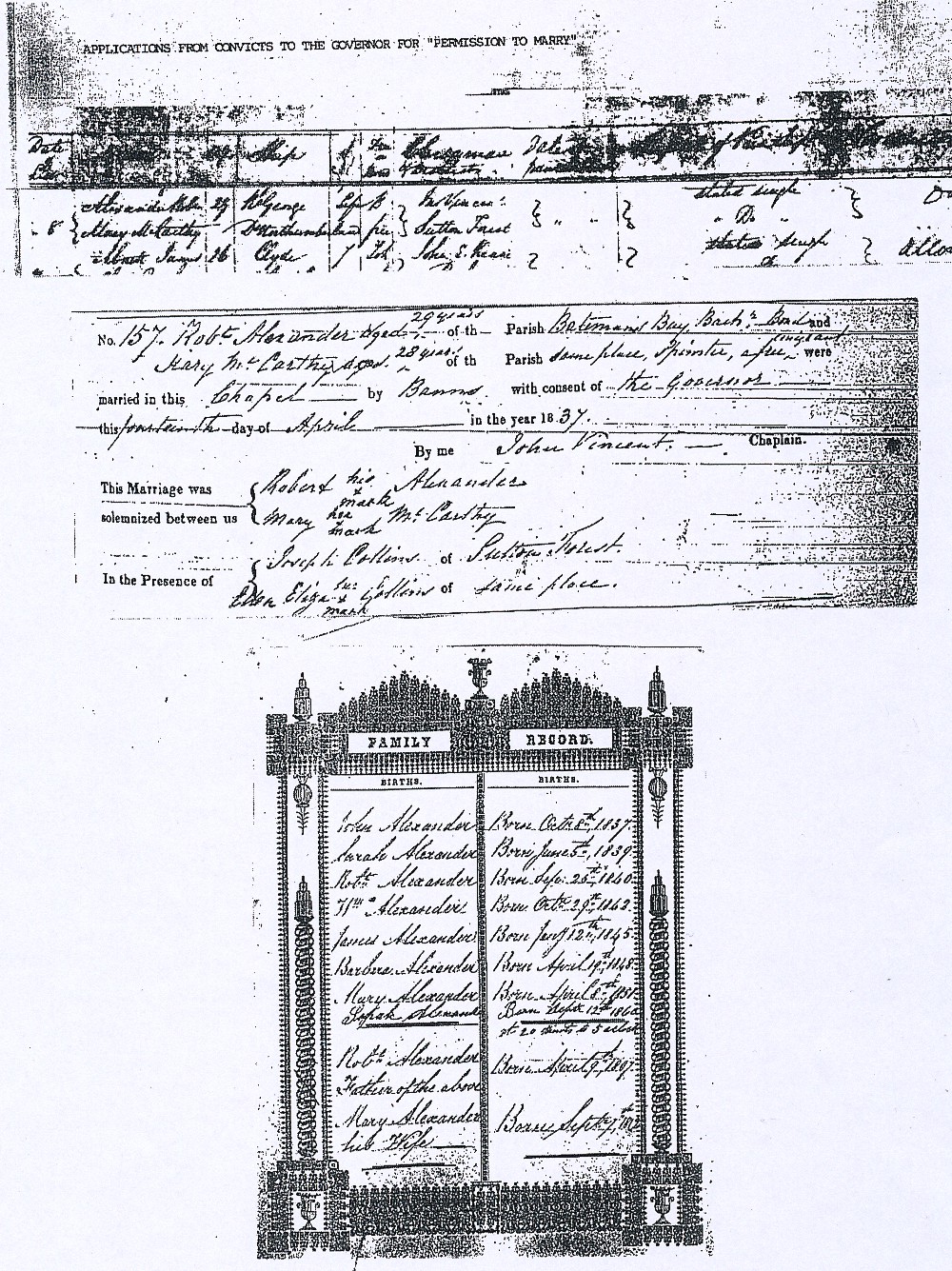
On 14 April 1837 at the Church of England
Chapel at Sutton Forest, Robert
Alexander married Mary Theresa McCarthy,
the witnesses to this marriage were
Joseph Collins, Robert's partner in crime,
and his wife Ellen Eliza Collins.
At the time of their marriage, Robert was
living at Bateman's Bay, as was Mary, after
their marriage they lived at Morris's new
property 'Gundary' near Moruya. Their
first child, John 1837, was born here and
Robert's occupation is stated as 'servant'.
Their second child, Sarah was born in 1839
and the place of residence when their third
child Robert was born in 1840 is Yerrulla,
on this registration, Robert's occupation
is
'farmer'.
In November 1839, Robert's employer, William
Morris expanded his interests to
include property at Nungatta and he named
this station 'Nangutta' (not a little
confusing), on 14 August 1840 he obtained
a further licence for land at Genoa River
which he incorporated into 'Nangutta' as
an outstation, this area became known as
the
'Heifer Paddock'. Robert and Mary took up
residence at the 'Heifer Paddock' where
Robert was employed as the stock-keeper.
Although the date is not certain, it was
around 1841-42,making them the first white
settlers in the district. It was here that
their
next four children, William 1842, James 1845,
Barbara 1848 and Mary 1851 were born,
we are not sure whether these children were
actually born at Genoa, their baptism
registrations clearly state 'Nangutta' as
their father's 'place of abode'. As Nangutta
was
the name of the property on which Robert
worked the Heifer Paddock at the Genoa end,
and not the name of the locality of the main
home station of the run which was
Nungatta, it is likely that they were in
fact born at Genoa -this would make William
the
first white child born at Genoa River.
The journey from Moruya to Genoa could be
tackled in two ways, the easiest and fastest
way being by coastal steamer, however, this
was not the way Robert and Mary
travelled; they took the far more arduous
route travelling overland on foot with a
pack
bullock to transport their supplies and belongings.
The coastal strip was rugged and
heavily timbered, virtually all heavy forest,
with a number of streams and rivers along
the way that would have to be crossed, with
the odd coastal settlement such as Twofold
Bay to break the journey. Progress would
have been exceedingly slow, bullocks
travelling on a road could travel a distance
of 5-6 kilometres an hour, but in this rugged
terrain, 2 kilometres an hour would be considered
'good going'. The distance from
Moruya to Genoa is approximately 350km, so
the journey would have taken around 3-4
weeks. We can barely imagine the fortitude
and perseverance required to endure such
a
journey, let alone with three young children
in tow, Mary must truly have been a
remarkable woman, as were many of our female
pioneers.
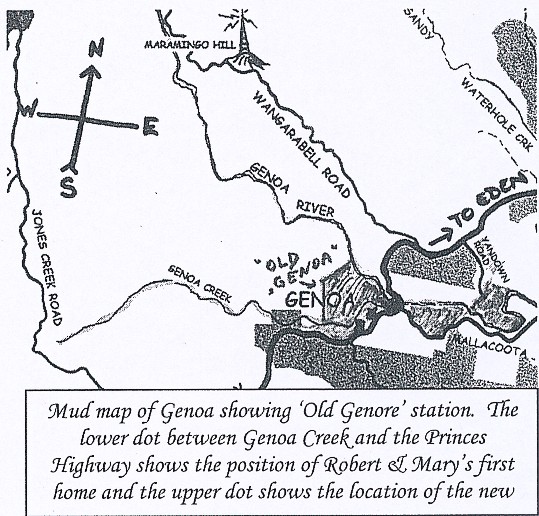
Living conditions at Genoa were primitive
their first residence was built on a 'cut
and
fill' site on the eastern side of Genoa Creek,
to the south of the Genoa River and west
of
the present day township, not far from the
old Princes Highway, pieces of cutlery and
other household items can still be found
in this vicinity even today. We can only
wonder at the determination, ingenuity and
selflessness that must have been required
to
raise a family under these conditions in
an isolated corner of Australia with no
amenities whatsoever, the supply of provisions
would have been very meager -perhaps
some tea, sugar and flour. Not to mention
the lack of any form of help if one of the
children became ill or incurred an injury,
there was also the constant threat of trouble
with the aborigines. Mary must have wondered
at the predicament she now found
herself in so far removed from life as she
had once known it.
 |
A house was later built on the
river flats, to the east of the
original dwelling. This
building is still standing and is
the second CRB cottage, and
today it is owned by Mr John
Peisley (2003). We are not
certain of the date this new
house came into use, or if
Robert ever took up residence
in this new abode.
The following are excerpts
from "A Narrative of the Journey to and from
New South Wales
including Seven Years
Residence in that Country" by
Joseph Lingard, published 9
April 1846, the date of this journey is not
stated but it is presumed it was circa 1843,
it
paints a vivid picture of the journey and
deprivations endured by the Alexanders and
other pioneers :
" ...Arriving at Liscome's property
(Bondi) at the foot of the mountain, I met
Capt. Stevenson who had
formed a station near Cape Howe ... Stevenson
and his family had been there about three
months. He
invited me to go down there, stating that
it was the finest place he had ever seen
... for sea birds. We
stayed at Liscome's for a month, then set
out for Stevenson's following a marked tree
line ....
About five miles from "Bundi" (Bondi,)
we became lost and had to retrace our path,
then with dfficulty
got over Morris' Mountain. The timber was
of almost incredible size ... We came to
a cattle station
which was managed by Weatherhead (Nangutta)
... I saw trees one hundred and twenty yards
high (?)
named by the natives Stingy Bark or Messmate.
Next morning with Weatherhead's man's assistance
we were again put on the tree marked trail.
There
were seven miles through great forests ...
between mountain ranges. Then we came down
to the river, to
hear the call of bell birds and whip birds,
which were in great numbers. About an hour
before sundown
... we saw two men ploughing with bullocks.
This proved to be Wang-a-ra-bar (Wangrabell)
owned by a
Scot named Donald ... I asked if we might
stay the night. ... after shooting a brace
of ducks for Mrs
Donald we set off again and were put on our
way by one of the boys.
We had a river to cross, ... came to some
heavily timbered ranges where parrots abounded,
then came
down to the river again and our tree marked
trail ... Just before sundown ... we saw
Genore station
(Genoa). We had come some fifteen miles.
There were two stations here on either side
of the river (Allans
north side, Alexanders south side) The river
at this point was tidal."
Lingard then travels on to Mallacoota and
following is his description of the circumstances
in which he
found Mrs Stevenson :
" ...Soon after a woman and three children
made their appearance ... The woman was frightened,
thinking we were bushrangers ....We all went
towards the hut, I said have you any tea
and sugar .. she
said no ... we have had none of these for
four months ... soon returned with about
a pound of tea and
eight pounds of sugar. This proved a very
acceptable treat....I went bird shooting
and drying skins until
ten weeks had expired. ... Spring drawing
on, the snakes began to make their appearance
... The Captain
and his man had to go to Genore ... I stopped
there two days, the stock keeper (Alexander)
was going to
Nan-gutty (Nangutta) for some calves .. .
I bid the Captain farewell ... and we anived
at Wong-a-ra-bar
in the evening."
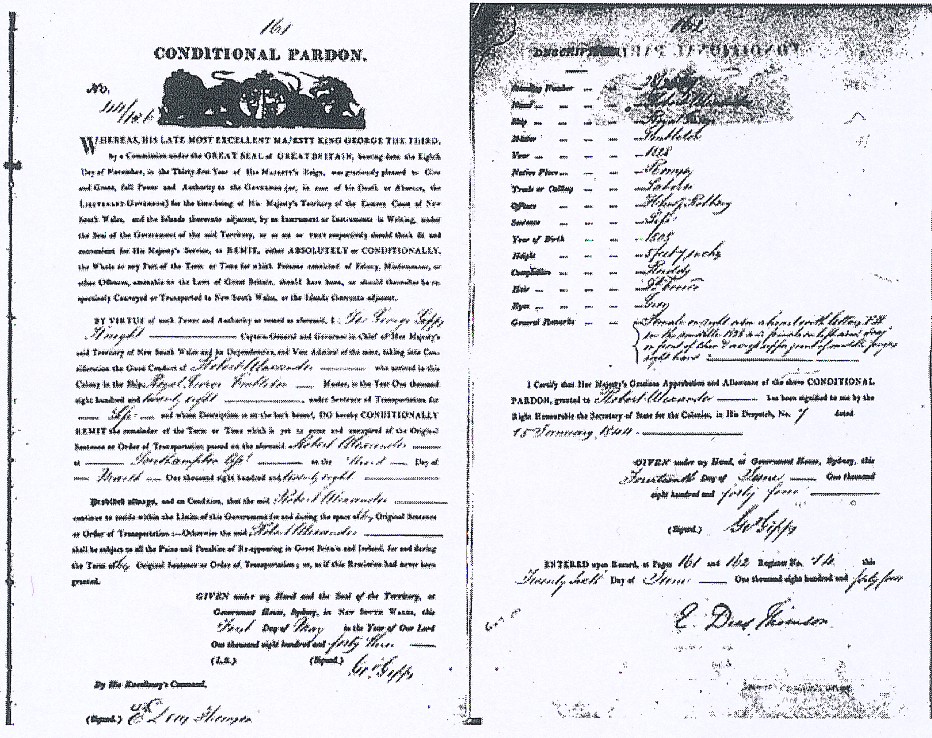 |
On 1 May 1843, Robert was granted a Conditional
Pardon; his recommendation was
signed by - N Oldrey JP, W T Morris, F C
Walden, R Urquhart and Geo Macfee.
George Macfee was a Presbyterian Minister
and had been associated with Robert and
Mary for a number of years, officiating at
the baptism of their son Robert.
Over the next few years, the Nangutta property
was sold on a number of occasions. First
to Abercrombie & Co and then to Campbell
& Co who in turn sold it to Peter Imlay,
one of the three Imlay brothers who established
the whaling operation at Twofold Bay.
In 1853, Imlay sold the Nangutta portion
of the Run to a Melbourne buyer but as a
settlement for wages owed, he applied for
a transfer of title for the Genoa portion
to
Robert Alexander, together with a number
of cattle. The lease rights were £10
p.a. This
holding became known as 'Genore Station'
and is still referred to as 'Old Genore
Station', the land is now owned by Mr Alan
Peisley (2003).
By 1856, no longer a bondsman, Robert appears
on the Gippsland Electoral Roll and
was attempting to broaden his holdings from
Genoa toward Cann River; his Stock
Assessment for April 1856 was £10/13/-,
based on 180 head of cattle and 15 horses.
An
opportunity for further land acquisition
was provided in 1861 by the introduction
of Sir
John Robertson's Land Act. One of the areas
available was the Parish of Pericoe, where
land was offered for sale at auction in December
1861 but passed in. Robert Alexander
of Genoa acquired two of these blocks on
28th May and 3rd August 1863 respectively
at an 'upset price' after the attempted sale
by Auction. It was said that Robert on one
of
his expeditions in the 1830's and 40's discovered
Pericoe and as a way of distinguishing
him from Robert his son, he was often referred
to as 'Old Pericoe'.
Hence Robert became a legitimate landowner.
It had been a long and eventful journey
from that Christmas Eve in 1828 and in the
ensuing twenty four years he had served his
time, married, had a family of seven and
received a Conditional Pardon. He had
actively been involved in expeditions into
unexplored country and in the expansion of
white settlement of the far south coast.
The impression that has been passed down
through the generations is that Robert
Alexander was a hard man, and no doubt, given
his experiences to date and those that
follow, he would have needed strength of
character not found in the ordinary man.
As Robert expanded his cattle grazing into
the Cann River district, problems with the
aborigines escalated. The local tribes were
said to be very savage and there are reports
of shipwrecked survivors stumbling ashore
only to be speared to death on the beach.
There is a local legend that tells the story
of an aboriginal youth, Dough Boy, who went
to work for the Alexanders, after a time
he took himself a wife from another tribe
-this
was frowned upon by his tribe and the punishment
for such a misdemeanor was death.
A posse was sent out from his tribe to find
him and carry out the punishment, they hid
down in the cornfield for days awaiting an
opportunity. Finally it came, and it is said
that Dough Boy came to Robert with a hatchet
buried in his skull, Robert pulled the axe
from his head and he dropped down dead. Robert
is then said to have followed the tribe
back to Wingan and shot them all. This was
no mean feat as the aborigines walked in
single file in each other's footsteps to
avoid detection and to make it appear as
if only
one person had travelled that path.
Through the years there was the continuing
problem of native tribes spearing cattle,
whether this occurred due to their belief
in animals on the land being available to
anyone who hunts them or whether it was a
result of white settlement invading their
hunting lands is something that will remain
unknown.
Another massacre related in local folklore
claims that .. ."an Alexander girl was
taken
by a local tribe and unable to cope, she
died. Alexander is said to have found members
of the tribe wearing her clothing as headbands
and subsequently, arranged a posse and
shot all of them. However, birth and death
records of his children tend to dispel this
version. It seems evident that the massacre
did take place and it is claimed that by
the
time word reached the police at Orbost, the
bodies had been hidden under the water or
buried on an island in the river, the site
was later accidentally uncovered while
ploughing, however the remains were washed
away in one of the large
floods."...excerpt from "A Place called Pericoe".
Personal tragedy was also evident within
the family, in 1858 Robert and Mary's first
daughter; Sarah was admitted to the Gladesville
Lunatic Asylum as a 'pauper patient',
she was eighteen years old at the time. We
could put two and two together and surmise
that the story of the missing Albxander girl
was not so outlandish, and may have been
the story put about after Sarah mysteriously
'disappeared' and the rest of the legend
grew from there.
It is also alleged that the aborigines killed
one of Robert and Mary's sons, however, no
birth or death registrations can be found
to support this tale.
On a brighter note, Robert must have formed
more friendly relationships with other
aborigines, as he learned some useful insights
into their way of life and how they
managed the environment. It was claimed the
old aboriginal Genore Jack taught Robert
that the answer to bush fire prevention was
to back-burn. This must be done every five
years and must be carried out at the right
time of year, February/ March after the longest
day when the sap begins to go down. During
that period there are westerly winds in the
morning that change to the northeast in the
afternoon, which provide natural burn back.
A softer side of Robert can be seen in his
obvious affection for the family he left
behind
in Hampshire, this is evident in the naming
of his children, John his first born was
named for both his and Mary's fathers, Robert
for himself, the next four children, Sarah,
William, James and Barbara all bore the names
of his siblings. Mary, their last child
named after her mother.
Robert Alexander died at Genoa from cancer
on25
January 1864, aged 56 years, he was buried
in the
Eden Cemetery on 27 January 1864. The inscription
on his weathered headstone reads
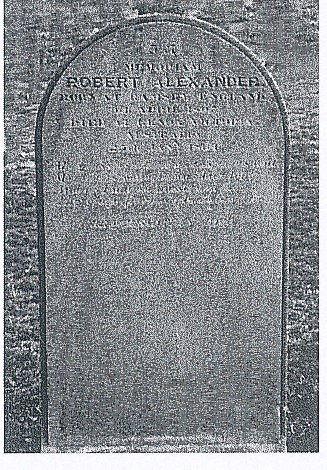 |
In Memoriam Robert Alexander Bom at Ramsey (sic) England 9th April 1807 Died at Genoa Victoria Australia 25 January 1864 "My class is run my days are spent My life is gone it was but lent, and as I arn so must you be therefore prepare to follow me" |
Elsewhere in the world in 1864, Jules Vern
was writing, "Journey to the Centre
of the
Earth" and Queen Victoria began the
legendary friendship with her Scottish servant,
John Brown.
Robert's estate was to be divided among the
family with Mary's inheritance to be
distributed evenly between Barbara and Mary
with her passing. If one of the daughters
then passed away, her portion was to go to
the remaining sister. The Executors,
Alexander Weatherhead, John and Robert Alexander,
were to care for Robert's wife and
become the guardians of the other children,
James aged 19, Barbara aged l6 and Mary
who was 13.
In her later years, Mary lived at the Catholic
Settlement at Kiah, where she died on 31
August 1879 from bronchitis. 1879 was the
year the world saw it's first chain store,
when Mr Woolworth opened his first 'nothing
over 5c store' in New York and that
Australia's first national park, the Royal
National Park was gazetted.
Because Mary had been married to a protestant,
burial in the 'pure' catholic cemetery at
Kiah was denied her, so the family requested
that she be buried at Eden with Robert and
other members of her family, but the catholic
priest refused to bury her in the protestant
section, this understandably caused outrage
within the family. And thus, she is interred
alone in the catholic section, apart from
her family at the opposite end of the cemetery.
Mary's monument is made of marble and has
stood the ravages of wind and weather
well, the inscription reads
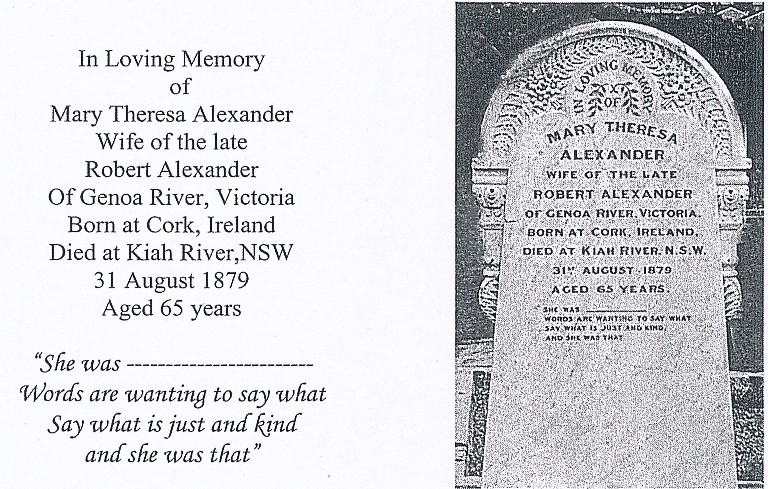 |
The graves of Robert and Mary are almost
symbolic, they stand at opposite ends of
the
cemetery, facing the sea across which they
came from different worlds, on the coastline
along which they made their separate voyages
to New South Wales, where they would
be united and begin the heritage for which
each one of us is exceedingly grateful.
 |
CHAPTER 2
THE NEXT GENERATION'S JOURNEY
The story of John Alexander is taken almost
in its entirety from
"A Place Called Pericoe" by Max Ryan (1993)
Variations have been made to the original
document to reflect new
research discoveries.
 |
| JOHN ALEXANDER 1837-1898 |
It was the year of our Lord 1837, the year
that Queen Victoria then aged eighteen
ascended the throne to begin her sixty three
year reign, that John Alexander was born
on 8 October at Gundary, a property near
Moruya on the south coast of New South
Wales. He was the first-born child of Robert
and Mary Alexander, who were living on
the property where Robert, a convict with
a Ticket of Leave, was working as a
'government man' or bonded servant to Mr
William Morris. 1837 was a year to
remember for a number of reasons, three inventions
which changed the course of our
daily lives were, Samuel Morse perfected
his Morse Code, Mr Pittman devised his
system of steno shorthand and perhaps most
notably and probably least well known is
that the first flush model, valve operated
'loo' was invented by Sir Thomas Crapper,
it
was also the year that an Australian, Thomas
Morris, entered the record books by
skipping rope 22,806 times.
At the tender age of five in 1842, John made
the overland trek by pack bullock from
Moruya to Genoa with his parents; they became
the first white settlers in the area and
made their residence on the Genoa River at
the 'Heifer Paddock' - the stock raising
section of Morris's Nangutta Run. Not much
detail is known of John's early life, but
it
would be assumed that from an early age he
was involved in the day to day running of
the heifer station working alongside his
father, and keeping an eye on his mother
and
siblings while his father was away. He must
have received some rudimentary form of
education, as he was able to read and write.
From a young age, John travelled the
countryside alone, and on one occasion, at
the age of twelve in 1849, while retuming
to
Genoa from Eden, he was nearly drowned. The
story straight from Alexander
Weatherhead's diary is as follows:
"Mr John Alexander, now of Pericoe who
was then a boy of 12, was returning from
Eden and the creek
being up, he was washed off his horse. It
was nearly night and very cold, with stormy
weather, and our
girl was outside getting wood for the morning's
fire, thought she heard a coo-ee, and presently
we saw a
horse coming from the crossing place. I then
ran to the creek and found that young Alexander
was on the
trunk of a tree, holding on to a large branch,
and up to his waist in the water. I could
not get him out on
the side I was on, so I told him not to be
afraid and I would soon rescue him. I got
my horse from the
stable and a light rope and went up the creek
to where it was much wider, and got near
him on the other
side, I then threw him the end of the rope
which he tied round his waist and pulled
him out. We soon had
him in the house where a change of dry clothes,
and afterwards a warm bed, restored him."
John married Elizabeth Smith, eldest daughter
of Thomas Smith and Mary Barclay, on 6
October 1859 at Pambula, John's younger brother
Robert and Flora McPherson were
the witnesses on the day. Elizabeth was born
on 12 February 1843, the first white child
born at Candelo, New South Wales. Her father,
Thomas Smith was a well-known
identity in the Pambula/Wolumla area, he
was at various times the local Undertaker,
a
storekeeper and the proprietor of one of
the local hotels, the 'Plough Inn'.
 |
After their marriage, John and Elizabeth
moved to an area
just north of Cann River called 'The Island',
conditions were
primitive, and a bark hut, most likely made
of 'wattle and
daub' was constructed. Elizabeth, as was
the custom in those
days when your time for 'lying in' approached,
travelled
home to her parents at Pambula to give birth
to their first
three children - Sarah 1860, Elizabeth Mary
1862 and John
Thomas 1863. It appears the family only remained
in the
Cann River locality for about four years
until the constant
problem of the local aboriginal tribes spearing
the cattle
forced John to look for a more viable alternative.
This
presented itself in the form of Sir John
Robertson's Land Act
of 1861, which made land available to settlers
at an initial
price that could be paid at an undetermined
future date subject to the fulfilment of
certain conditions regarding its use. Subsequently,
on 14 May 1863, John purchased an
initial block of 153 acres in the Parish
of Pericoe. Pericoe is situated inland from
Eden
in the Towamba Valley, about 12km from the
township of Towamba. The area is
named after the creek running through it
and is surrounded by well-covered hilly terrain.
He abandoned his holdings at Cann River and
it was eventually claimed by the Morgan
family who moved to the district circa 1869,
the old Morgan Homestead still stands.
It would appear that the family took up residence
at Pericoe in late 1863, as John's
recorded place of residence in November 1863
when he witnessed his father, Robert's
Last Will and Testament is Pericoe. The birthplace
of their fourth child, Barbara in
1864 is recorded as Pericoe. They were definitely
residing at Pericoe by the time their
fifth child Robert was born in 1866 as his
birth and death were reported in the Bega
Gazette with Pericoe as the location.
Over the ensuing years, John took up further
allotments in his own name and the names
of his children and toward the end of the
century, the Alexander family owned over
6000 acres in the parish.
To begin with, John concentrated on breeding
and selling cattle to the Melbourne cattle
market, then diversified into the dairy industry.
Pericoe became renowned on the South
Coast as one of the most well run, state
of the art enterprises of its time.
John and Elizabeth were to have another ten
children in the following years - Robert
(Bo) 1867, Ruth Ann 1870, Percy Vernon William
1872, Florence Ada 1875, Horatio
(Horace) Eden 1876, Sydney Evan 1879, Alfred
Ernest 1880-1881, Alfred Ernest 1881,
Veronie Adelaide 1883 and Patience May 1885
a total of fifteen children in all, two of
these, Robert born 1866 and Alfred Ernest
born 1880 (not to be confused with their
namesakes) died in infancy. In the isolated
parish of Pericoe, this family of thirteen
children grew up on property that could sustain
most of their needs through crops, pigs,
cattle, dairy and the vegetable garden. The
girls helped their mother with younger
siblings, while learning the skills required
to run a large and for its time, modern
household, they helped produce seasonal jams
and preserves from the array of fruits
available in the extensive orchard, as well
as learning the refinements that any
accomplished young lady should possess such
as needlework, music and social graces.
The girls were by no means confined to the
house; they were involved with many
outdoor activities as well.
All members of the Alexander family could
ride well and were known to be exceptional
horsemen and women and often raced from home
to the top of Mount Imlay near Eden.
Three of the notable riders were Alf, a master
with horses and Veronie (Queenie) and
Barbara who could not only ride well, but
did it side saddle!
The boys were involved in the running of
the property from quite an early age, there
were cows to be milked, horses and bullocks
to be trained, sheep and pigs to be cared
for along with the beef cattle which once
fattened, had to be overlanded to market.
In
addition, there were approximately 40 acres
under cultivation with various crops, and
also hay making.
On the whole, life was very busy, and the
smooth running of the property depended on
everyone pulling their weight and completing
the chores they were responsible for, even
(to the chagrin of many a school teacher)
if it meant being late for or missing school,
and there was certainly no time for homework,
teachers at the school often felt they
lacked the support of parents as demonstrated
by Miss Armstrong's report to her
Inspector in March 1889 expressing the following
concerns:
..."no encouragententfrom the parents
here to remain in Pericoe Public School as
I can not induce them
to allow their children to do any home lessons
whatsoever... "
Another report
complained about
attendance times.
..."Most of the children come
to school very late indeed as
most of the people around
Pericoe are dairy people.
Therefore only 4 children
that I can say come to school
on time. The others come at
9.45, 10, 10.1 5, 10.20, 10.30,
11 and some very often after
11 O'clock. That I think with
the poor attendance is quite
sufficient to obtain low
results "...
 |
| Pericoe School |
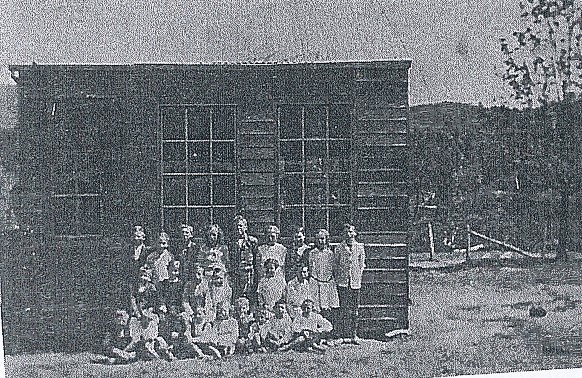
As a result of these problems, the Pericoe
Public School closed later in 1889. John
must
have considered the education of his children
important as it was through his
perseverance and donation of land that the
school originally opened in September 1884
with the appointed teacher Miss Sercombe. The following
Alexander children appeared
on the roll - Ruth 13, Percy 11, Florence
9, Eden 7, Sydney 4 and Sarah Alexander's
son, William Harmer aged 5. Although John
and Elizabeth also provided lodgings, the
teachers, mostly young women, did not stay
in the district long due to the remoteness
of
the area and the frustration they encountered
due to the problems reported above. After
the school closed John employed a tutor for
his children so they could continue their
education. The school reopened in 1896.
Over the years many reports were printed
in the local newspapers regarding Pericoe
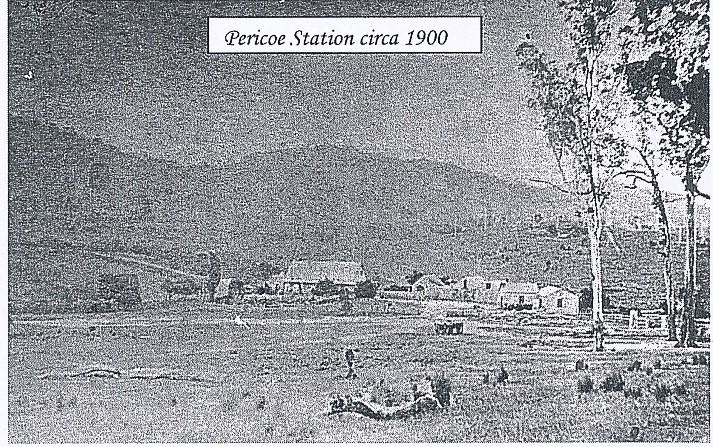
Station and the following paragraphs, from 'A Place Called Pericoe' outline the
remarkable innovations of the time.
"The focal point of the Pericoe operation
was the dairy, which produced large quantities
of high quality
butter and cheese. The milking cattle were
largely Ayrshire and Shorthorns and at its
peak up to 300
cows were being milked. An undated newspaper
article makes the comment that the factory
was - "the
most complete and extensive to be found throughout
the whole district, and eclipses many of
the large
factories around Bega and elsewhere"
The original dairy was destroyed by fire
and is understood to have had a steam driven
cream separator.
The dairy was rebuilt and was located near
the house, it utilised the most modern equipment
available
and made use of some unique innovations.
A six horsepower Soho-Tangy engine, a separator
producing
320 gallons per hour, a patent churn, and
a revolving butter worker were installed.
Up to five tons of
butter per week was sent to Sydney in "kegs",
marked with the "Pericoe Creamery"
brand. The cheese
factory was further down the creek and also
despatched large quantities of cheese.
A unique feature referred to in most articles
on the property was the system created to
provide running
water to the house and dairy. A small weir
was built in a rocky part of the creek into
which a 75mm (3 ")
diameter pipe was placed. It had a fall of
about 2m (6') to a hydraulic ram worked by
the action of the
water running into it. It in turn lifted
the water 45 metres (150') upstream (on a
one in five grade) into a
tank on a 3m (10') high stand from which
pipes were directed to several tanks. From
these holding tanks,
pipes were run to the kitchen, bathroom,
garden, dairy and wherever necessary. In
the kitchen pipes
passed through the bread oven and stove to
supply hot water on tap.
 |
| Bullock Team at Pericoe. Bill Harmer in front |
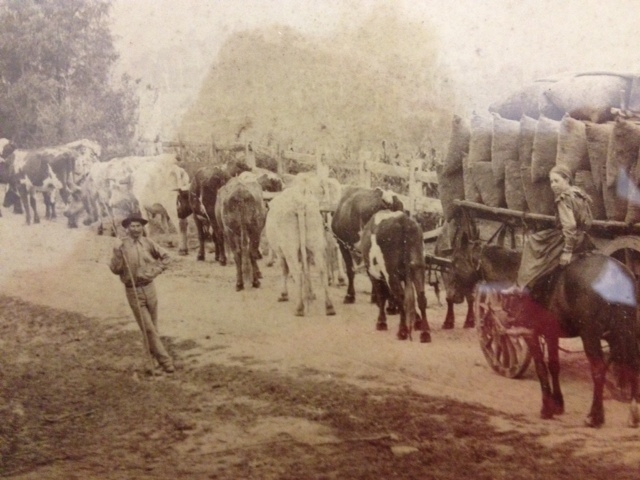
Cattle breeding and fattening functions were
also significant. Large Shorthorn bullocks
in prime
condition were often despatched by road to
various sale points. They were driven very
steadily to enable
them to arrive in prime condition. One undated
newspaper clipping c.1896 refers to a couple
of prize
bullock reared by the Alexanders that won
first and second prizes at the Orbost and
Bairnsdale shows.
The winner was estimated to weigh seventeen-hundredweight.
The operation also included sheep and
pigs; large numbers of pigs were regularly
shipped from Eden to market.
Then there were horses. Contact with the
world was basically dependent on the horse
and as indicated,
the Alexander's were known for their knowledge
of and ability with horses. Pericoe had a
reputation for
producing fine horses -hacks, draughts and
spring cart or buggy horses. It was suggested
that the most
fastidious horse purchaser could be thoroughly
suited at the Alexander's, and that ..."When
you went to
Pericoe they asked what breed the horse was".
It was also common knowledge that, if a horse
could not
be tamed elsewhere, the advice was :.."take
it to the Alexander's".
The property produced a range of crops and
hay in sizeable proportions. An area of about
40 acres was
under cultivation growing excellent crops
of corn, peas and potatoes. There were also
wattles, an
orchard and a large vegetable garden was
laid out on the banks of Pericoe Creek"
Pericoe Station was a family business and
although each person knew the general
workings of the entire station, every individual
had a speciality in the smooth running of
the property. Alfred was in control of the
dairy, Robert (Bo) was in charge of the
horses, Eden did the droving and Percy was
responsible for the secretarial and
bookkeeping area.
 |
With the exception of John Thomas, the boys
settled into various homes on the Pericoe
Estate, with each block known by its individual
name. Bo called his home 'Hayfield',
Percy named his 'Normanhurst' which was a
mile from the homestead and near Pericoe
creek, Sydney had 'Bonnie Doon', Eden called
his 'Fairview' and Alf had the home
dairy. Some of the girls married, continuing
to live on or near the estate while others
left.
Over the years, Pericoe was not immune to
that great Australian catastrophe, the
'bushfire', being in a valley surrounded
by timbered mountains and hilly terrain they
were a real threat. Many buildings, notably
the school (on a number of occasions), the
dairy, a machine shed and Percy's home 'Normanhurst'
were lost in various fires over
the years.
Bushfires were only one of the hardships
that affected those in the country during
this
era especially when the isolation from facilities
made it impossible for help to arrive
during a crisis, people had to acquire knowledge
on many different fronts in order to
care for their families and increase their
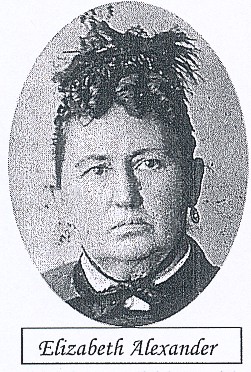
chances of survival. Elizabeth Alexander
was
called upon throughout the district to help
with various ailments and broken bones as
well as delivering babies. In most cases,
doctors were too far away to render any
assistance in an emergency, so those involved
had to deal with cases of snakebite, crush
injuries from falling timber and other accidents
as best they could.
 |
Life at Pericoe Station was not all work
and no play. In fact, social activities played
an
active role not only within the family but
in the surrounding community. The 'Hare
Drive', an Australian version of the English
Foxhunt was not only a social occasion, but
also allowed the participants to display
their prowess at shooting and riding. Of
course,
the passion of the era was cricket and Pericoe
had its own team. A photograph exists of
eleven men (some of whom it is said are Alexanders)
as well as a painting at the Eden
Museum titled 'The Massacre at Towamba' about
a cricket match between Pericoe and
Towamba. When it was painted or even who
won is still unknown.
The Alexander hospitality was legendary.
From 'A Place Called Pericoe', comes a
story of a woman who came to visit
... "A tale is told of a woman from Sydney,
arriving to stay with the Alexander's. On
her first day, she was handed a large box full of polished cutlery
and asked to set the table using the enlire
contents. She
was then sent to the dairy for a bucket of
cream, she complied with these instruclions
even though, as the
new girl, she was sure she was being set
up. She was then asked to ring the bell -
and people came from
everywhere; from the farm, people passing
down the road, from all over the place. When
she looked
around there was hardly an empty place. This
was the protocol for lunch. There were always
two joints
on the table and two large steam puddings.
Shearer's who worked at the property were
provided with
lunch as described and hot breakfasts of
meat and vegetables, bread, butter and jam.
This was in addition
to the morning and afternoon teas with homemade
biscuits and hot scones. No one ever went
hungry at
Pericoe."
Through his campaigning for local advancement,
John became a highly esteemed and
prominent man in the district. Among his
achievements were the establishment of the
Pericoe Public School and the appointment
of a policeman at Towamba in 1891. Over
the years John and Elizabeth Alexander saw
many changes to the region, with the
development of communications, transport
(such as the coach run by the Strickland
family from Eden to Yambulla via Towamba
and Pericoe) the establishment of Eden as
a major port and of course the gold rush
at Yambulla in the early 1890's which broke
down the walls of isolation that had surrounded
those at Pericoe.
In 1886, the year after the birth of his
last child, John's health began to fail;
he
developed pleurisy from a severe cold, which
weakened his constitution. In 1896, he
travelled to Sydney to consult with health
professionals regarding a heart condition.
John displayed symptoms of 'dropsy' and his
health gradually deteriorated culminating
in his death at The Great Southern Hotel
Eden on 20th April 1898.
John's passing was reported at length in
the local newspapers, giving us some idea
of
the esteem with which this man and his family
were held in the community.
"I deeply regret having to record the
sad death of Mr Jno Alexander, the well-known
proprietor of
Pericoe station, which occurred at the Great
Southern Hotel Eden during last night. Mr
Alexander was
very widely known and respected and his many
acts of kindness and generosity to those
in deed will not
soon be forgotten. He was one of the pioneers
of the district, and did a great deal for
its advancement.
His loss will be keenly felt. The funeral
takes place tomorrow, Thursday." Pambula Voice -22 April
1898
OBITUARY
"The death of Mr John Alexander will
be felt throughout the length and breadth
of the district. He was
regarded as one of the pioneers of the south
coast district, and resided at Pericoe for
a period of 38
years. Born at Moruya, his parents soon after
removed across the border into Victoria,
and he passed his
early years on his father's stations at Genoa.
At the age of 22 he married a Miss Smith,
and made his
home at Pericoe, selecting and buying a large
tract of land, which he utilised for dairying,
pig rearing
and grazing purposes. Mr Alexander was perhaps
the largest dairyman in the surrounding district,
and
also supplied a lot of cattle to the Melbourne
market. He took an active interest in public
affairs, being
for a long time a trustee of the Towamba
Eden road, and was also twice elected on
the directorate of the
late Freezing Company. The deceased gentleman
leaves a widow and large family, for whom
widespread
sympathy is felt. The funeral on Thursday
at the C E cemetery, Eden, was well attended,
the Rev G
Jennings conducting the burial service. A
large number of wreaths and floral tributes
were sent, as well
as telegrams and letters of sympathy from
friends in all parts of the colony."
Pambula Voice -29 April, 1898
PERICOE
"The news of Mr John Alexander's death
was received in this locality with expressions
of the deepest
regret. The cause of his death was heart
disease, supervening on dropsy. Mr Alexander
was a native of
the colony, having been born at Moruya. He
was the first selector to take up land at
Pericoe, and resided
here for 34 years. He was about 60 years
of age. By his clear foresight and sound
judgement he got
together a fine estate at Pericoe, consisting
of over 6000 acres of fair pastoral and some
agricultural
land. The deceased gentleman leaves a wife
and 13 children (most of whom are grown up)
to mourn their
loss, and they have the sympathy of the whole
cornmunity. The funeral took place on Thursday,
the
remains being interred in the Eden cemetery
in the presence of a large concourse of relatives
and
friends."
Pambula Voice, 29 April 1898
"Mr John Alexander was a gentleman...
of exemplary habits, just, upright and liberal
disposition, and
essentially temperate mode of life. Although
of a distinctly domestic temperament he yet
took a keen
interest in public affairs, and particularly
in the welfare of the district in which he
lived. He was besides,
well known as a dispenser of genuine hospitality
and won the respect and esteem of all who
knew him.. "
Bega Standard
"Mrs Alexander and family desire to
express their thanks to all who so kindly
sent floral tributes, letters
and telegrams in their late bereavement."
Pambula Voice 29 April 1898
John was buried in the Church of England
Cemetery
at Eden on Thursday, 21st April, 1898.
The inscription on his granite headstone
reads
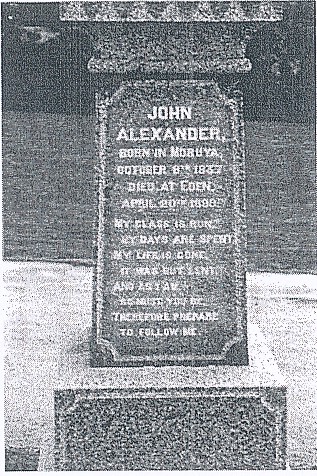 |
JOHN ALEXANDER Born in Moruya October 8th 1837 Died at Eden April 20th 1898 "My class is run, my days are spent My life is gone It was but lent And as I am, So you must be Therefore prepare To follow me" |
Elizabeth's devotion to her beloved John
is expressed in the following memorial:
In affectionate remembrance of John Alexander,
who died at the Great Southern Hotel, Eden,
20th April, 1898.
One year today, ah, who could tell how anxiously
I stood
Beside my darling husband's bed to keep him
if I could.
Friends and physicians gently tried to soothe,
but all in vain;
Ah; as the morning hours drew on,God eased
him of his pain'.
Inserted by his loving wife and children
John lived during one of the most fascinating
eras of Australian history. Born during a
time when the colony was in its infancy,
saw the development of towns, roads and
bridges, the end of convict transportation,
experienced the days when bushrangers were
common and feared and not considered heroes
and heard years of debate about the
federating of the colonies, only to pass
away a couple of years before seeing Federation
become a reality.
In his will dated 8th February 1898 John
appointed sons Robert, Percy and Eden as
trustees of the Estate. Elizabeth received
£50 p.a. and the residue of the Estate
for life.
If she remarried or passed away, the estate
was to be divided between sons Percy, Eden,
Syd and Alf (John Thomas and Bo had been
provided for previously). Upon the death
of their mother, the girls (excluding Sarah)
were to receive any money remaining from
the insurance payout as well as £400
in £80 instalments. The total value
of the estate
was £7630 less £6358 representing
loans from the Australian Joint Stock Bank
taken
out by John in 1876 and money owed to the
Crown under the Conditional Purchase
System, leaving a net worth of £1272.
Even after the death of their patriarch,
the smooth running of the property continued
as
it had done over many years, under the direction
of Elizabeth who it has been said stood
firm at the helm overseeing the operation
of the station.
In the years that followed, Elizabeth continued
to be a revered citizen in the Pericoe
Towamba district and played host to many
social and community functions as well as
family weddings and one notable occasion,
the extended visit of her eldest son John
Thomas who had settled in Queensland, was
celebrated with parties, sporting events
and
a farewell dance held in his honour.
By 1906 another great change had occurred
in the valley with the establishment of a
telephone line from Towamba to Yambulla,
this occasion was celebrated with a
function at the Pericoe Post Office. The
first message was sent from the Postmaster
General, The Hon. Austin Chapman, MP to Elizabeth
Alexander, it read:
"Kindly convey my hearty congratulations
all residents on establishment Telephone
communication with
Pericoe. I trust it will be of much convenience
and advantage to the district. " 10
August 1906
Towards the end of the first decade of the
new century however, problems were
beginning to emerge, the Eden branch of the
Bank of New South Wales had taken over
the debt on Pericoe and were applying pressure
for settlement after becoming aware of
conflict concerning the administration of
the estate (the National Mutual Life Assurance
Company eventually cleared this debt in 1911).
The combination of the debt, the
drought of 1910 which impacted on the local
dairying and crop industries, the rabbit
menace and the growing disharmony among the
family eventually lead to the
dissipation of the empire.
Around 1913, Elizabeth now in her 70's, left
Pericoe and moved in with her daughter
Veronie (Queenie) and her husband Austin
O'Hara at Adaminaby. By this time only a
handful of family members were still residing
at Pericoe.
Elizabeth passed away at the home of her
daughter Queenie O'Hara at Adaminaby on 3
June 1918 her death flagged the passing of
a dynasty, she had given birth to fifteen
children, dealt with all the subsequent hardships
that life threw her way, as well as
coping with the stress of the various dramas
within the family over the years, mourned
the death of her beloved John, and then seen
the gradual demise of all they had worked
so hard to achieve.
Elizabeth's death was reported in the Twofold
Bay Magnet and the Bombala Times as
follows:
"Mrs Alexander, relict of the late Mr
Alexander, of Pericoe, died at the residence
of her son-in-law, Mr
A.B. O'Hara, aged 77 years. Born at Candelo,
it is believed she was the first white child
to be born
there."
Bombala Times 14 June, l918
"From the Adaminaby "Advocate"
we take the following particulars of Mrs
Alexander formerly of
Pericoe. Deceased had been living at Adaminaby
for the past 6½ (?) years with her
son-in-law Mr
A.B. O'Hara. A month back she took ill while
on a visit to Nimitybelle, and only returned
to Adaminaby
the Saturday before her death. Deceased was
77 years of age and a native of Candelo,
so she was not
only the first white child born at Candelo,
but in this district. She married early,
and with her husband
assisted in opening up the Cann River district
in Victoria. Later on they settled at Pericoe,
and acquired
considerable property. The "Advocate"
says that during her stay up there Mrs Alexander
made friends of
all by her kindness and
practical sympathy in sickness and distress.
The funeral took place on 5th instant, the
remains being
conveyed to St. John's Church, where after
a short service they were conveyed to her
last resting place in
the C.E. portion of Adaminaby cemetery. The
Rev. H.J. Gedney officiating at the graveside.
"
Twofold
Bay Magnet 15 June1918
Elizabeth was buried in the St John's Church
of England Cemetery at Adaminaby, one
would think that she would have chosen to
be interred at Eden with her beloved
husband and those of her children that had
preceded her, but this may not have been
possible, as it was near the end of the Great
War, a time when things were pretty grim
on the home front.
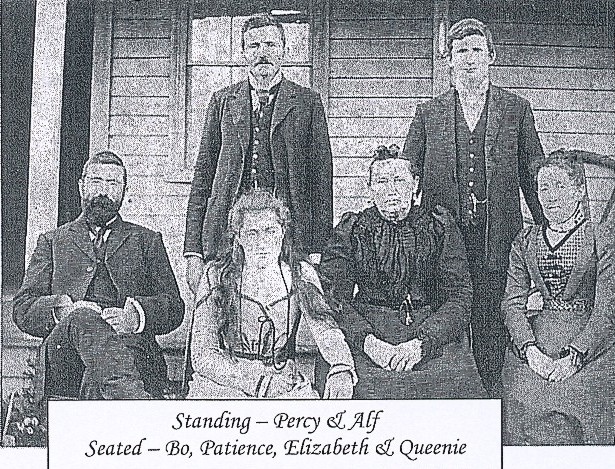 |
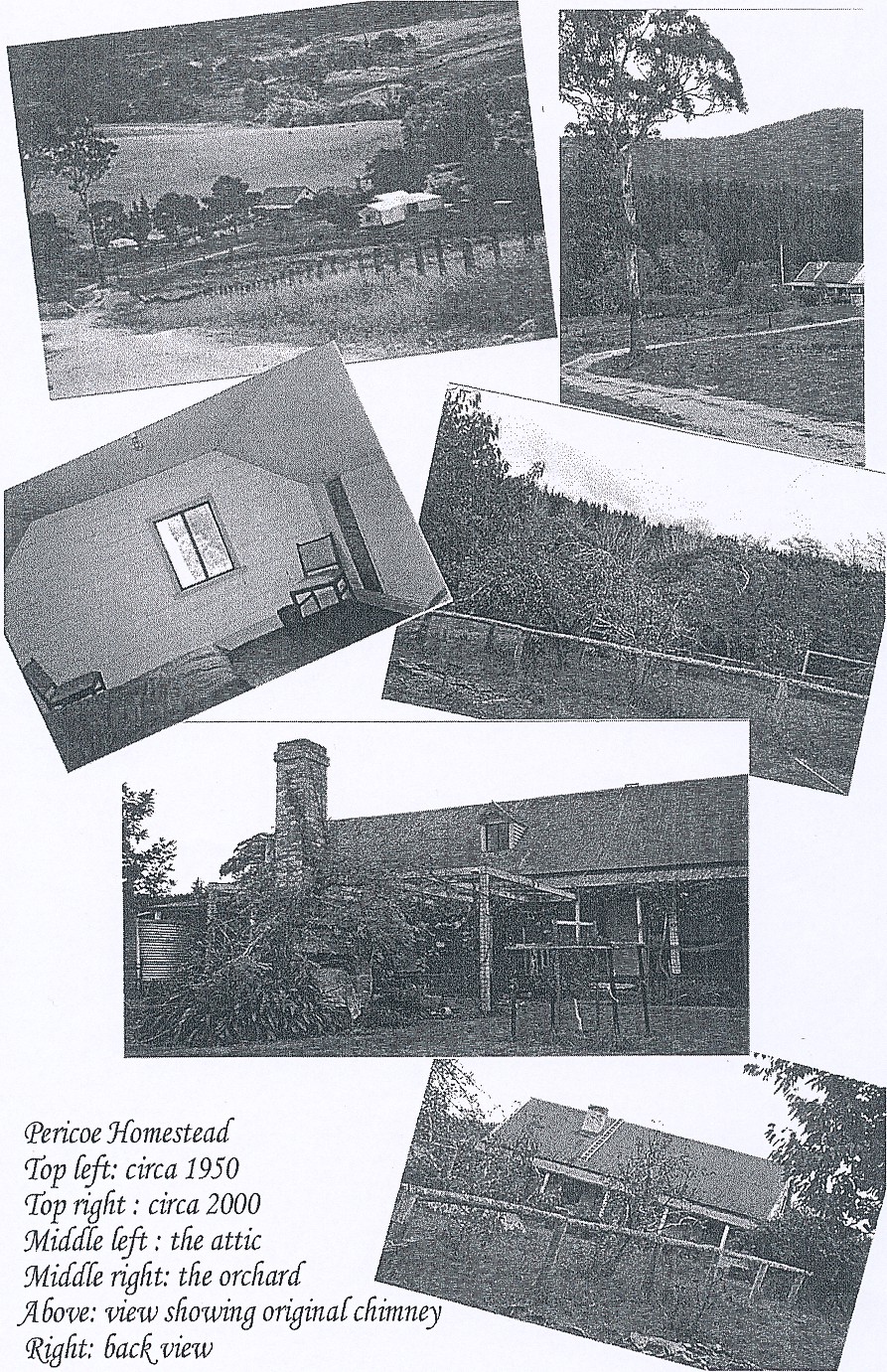 |
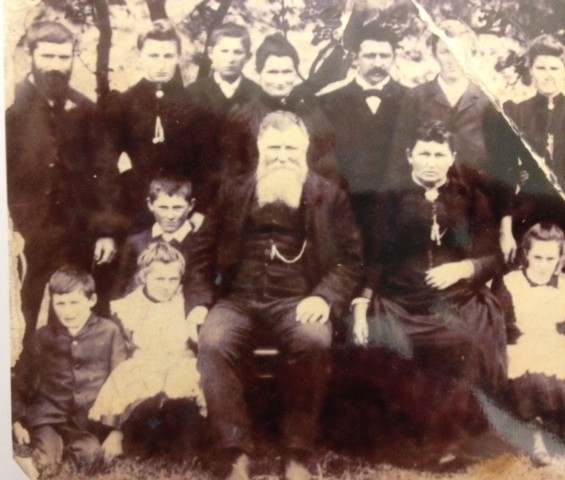 |
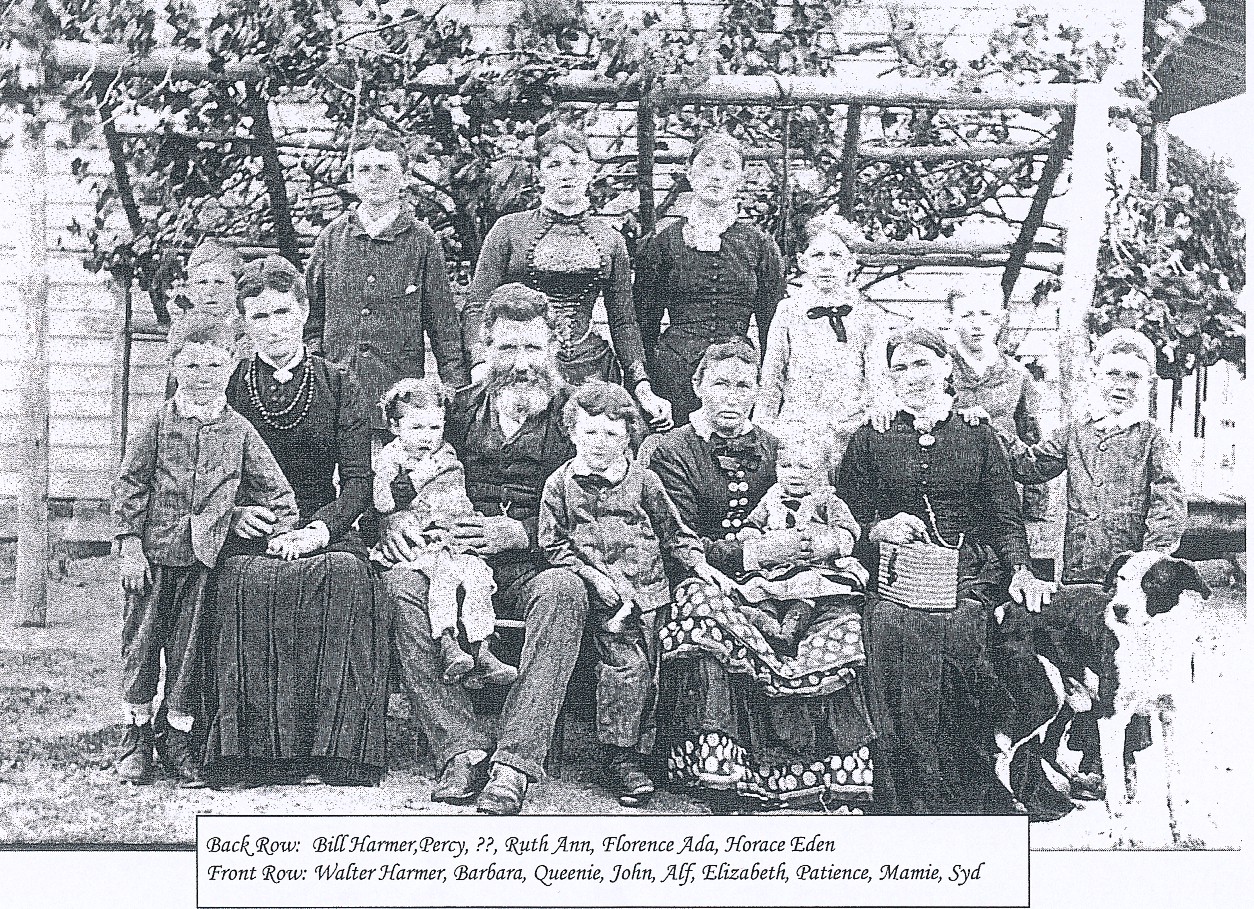
| Standing: Bo, Ruth Ann, William Harmer, Barbara,
Percy, Horace, Elizabeth Mary, Florence,
Walter Harmer Seated: Alf, Syd, Patience, John and Elizabeth, Verance. |
 |
 |
||
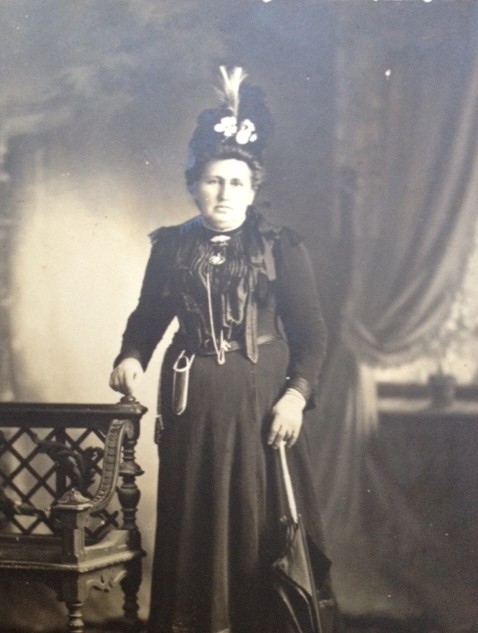
| Elizabeth Alexander (nee Smith) | |||
SARAH ALEXANDER
1839 - 1901
It was the winter of 1839, when Robert and
Mary Alexander welcomed their second child,
a daughter, into this world on June 5, at
Gundary, a property near Moruya where Robert
was an assigned man to Mr. Morris. They named
their little daughter Sarah after Robert's
sister back in the old country.
Unfortunately, little sarah was not the healthy
child we all pray for, she was afflicted
with a cleft palate and was developmentally
delayed - the latter may have been brought
on by a difficult labour and lack of oxygen
to the baby's brain - or it may have been
part of her genetic condition.
When Sarah was only a little mite, she made
the long journey from Moruya to Genoa with
her parents and two brothers John 5 and Robert
2. It seems that older brother John may have
had a special affection for his little sister
as he named his first born after her. Sarah
was brought up on the Genoa River at the
'Heifer Station' where her father was at
first the head stockkeeper before later acquiring
the land in lieu of wages.
The lifestyle was simplistic by today's standards
and the family made do with a bush hut cut
into the side of a hill overlooking Genoa
Creek. It appears that by her late teens,
for reasons unknown, the family decided they
could no longer care for Sarah.
Tragically, in February 1858 at the age of
18, she was admitted to the Gladesville Lunatic
Asylum, then known as 'Tarban Creek' as a
'pauper patient.'
A letter of Application for Admission was
made to the Colonial secretary, it was signed
by her father, Robert Alexander and Sarah's
unstable state of mind was verified by two
doctors and a judge; the report written on
admission states...
February 18, 1858
"This young person is a native of this
colony, a spinster admitted from her father's
home at Wide Bay for chronic mania. She is
tall, strong, symmetrical, with a graceful
figure were her movements under the power
of reason and her habits regulated by taste.
The temperament is bilious, irises dark and
glowing with complexion of the lightest swarthy.
She has fine salient features and under happier
conditions would be an attractive and interesting
woman.
It is a year since she became affected with
lunacy and is supposed by her father to be
in some measure the offspring of disappointed
affections.... Her soft palate is destroyed;
and she speaks indistinctly through her nose.
She is well conducted; her moral habits have
always been blameless and her father states
that she is inoffensive but playful and occasionally
a little mischievous. I fear the case is
both more inveterate and constitutional than
her father cares to confess. The brain appears
to be collapsed and the bony covering contracting
around it; the head is small and the epicranium
loose and dense. Below the head, the organization
is sound; she eats and sleeps well."
February 28, 1858
"It has just been reported by persons
who have known this girl since her birth
that she has been little better than an idiot
all her life and that her present state is
only and exaggerated condition of her usual
phrenopathy."
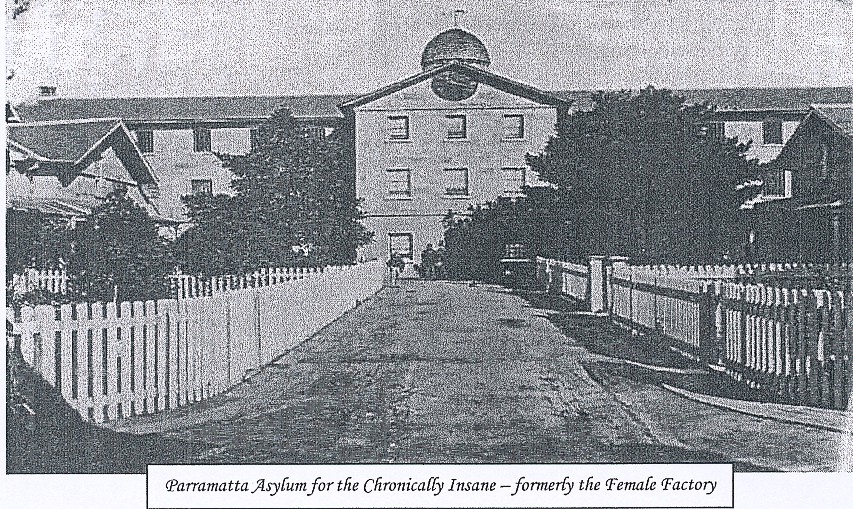
Sarah's stay at Tarban Creek was only short,
in May that year; she was transferred to
Parramatta Asylum for the Chronically Insane,
which was housed in what was originally the
Female factory at Parramatta.
Sarah was to outlive all her siblings, and
although she is included on her father's
death certificate, she is not mentioned in
his Last Will and Testament. By the time
of her mother's death in 1879 it seems that
'out of sight - out of mind' was the rule
and she is therefore not recorded on the
death certificate. Sarah's condition progressively
deteriorated over the years until late January
1901, just as the new Commonwealth of Australia
was being born, Sarah, now 61, contracted
pneumonia and died on 7 February 1901 at
the Hospital for the Insane, Parramatta,
NSW. She was buried the next day at Sydney's
Rookwood Cemeterty in the Roman Catholic
section.
 |
It is interesting to note, that on her death
certificate, she is a virtual 'unknown',
this being the stated answer to the relevant
questions regarding her indentity, ie place
of birth and names of parents. A sad testament
to the existence of a woman who was once
loved and cherished as both a sister and
a daughter.
 |
| ROBERT ALEXANDER 1840-1888 |
In the third year of the reign of Queen Victoria
of England, on the 25th September
1840, Mary Theresa Alexander gave birth to
her third child, Robert Alexander, who
was named after his father. At this time
the Alexander family was living at Yerrulla
(Moruya) in New South Wales, a colony only
fifty-two years old and compared with
today's standards probably quite primitive.
Elsewhere in the world, the first postage
stamp had been introduced, the telegraph
was a new invention and the popular author
of
the era was Charles Dickens.
ln 1842 the Alexander family travelled the
long journey by pack bullock to Nangutta
which is part of the Genoa region of Victoria,
to make their home at "Heifer Paddock".
It is perhaps because of the move, which
in those days was a long and arduous task,
that
Robert (the son) was not baptised until the
29th June 1842 which, according to the
baptism certificate, was held in the Presbyterian
Church of the Broulee District.
Little is known of the family's life in the
early days in Genoa. It is assumed that Robert
grew up learning about farming and working
on the family property during the years
that his father was first head stockman and
later a farmer in his own right. Since later
certificates have his writing or signatures
on them, it is also assumed that Robert (the
son) received at least rudimentary schooling.
Catherine Pendergast was born on the 5th
July 1846 in the district of Delegate NSW.
She was the eldest of l3 children of Patrick
Pendergast and Johanna Ryan of Kiah River
Station NSW and was raised in the Roman Catholic
faith. She was baptised in the
district of Manaroo NSW on the 1st November
1846 and grew up at Kiah River Station,
probably helping on the station and assisting
with the younger children. Her siblings
continued to have a close relationship with
Catherine as they were often witnesses at
weddings and sponsors at the baptisms of
her children. Catherine's sister Johanna
Pendergast married Thomas Greer and two of
their daughters married descendants of
John Alexander.
During either the late 1860's or early 1870's,
Robert met Catherine Pendergast. Theirs
seems to have been a rocky romance. According
to family stories, Robert was deemed
an unsuitable husband for Catherine in the
eyes of her family, due to the fact he was
raised a Protestant and she a Catholic. (Another
tale states that a second reason was that
the prospective groom was the son of a convict.
This however seems unlikely as
Catherine's father was a convict himself.)
The religious difference was obviously such
a problem, that according to their descendants,
Robert and Catherine eloped, marrying
on the 4th January 1872 in the Bombala Church
of England, NSW, Robert's occupation
at this time is listed as a squatter and
his usual residence being Genoa Station,
Catherine's being Kiah River Station.
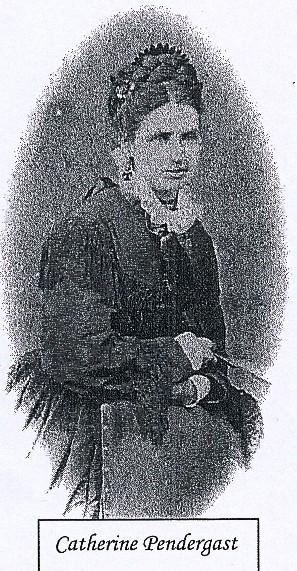 |
Robert and Catherine made their home in Genoa,
south of the Genoa River on part of the Alexander
property that had belonged to his father
(also Robert)
which had been transferred from Peter Imlay
in lieu of
wages. Adjoining land was owned by his brothers
John and James Alexander, so perhaps the
original
property had been divided between the sons
at the
time of Robert senior's death. It is believed
the house
Robert and Catherine lived in was built in
the early
1870's, possibly 1872, the year they married
which
was also the year Robert's youngest sister
Mary
passed away and probably the year his mother
left to
live at Kiah River Catholic Settlement.
Their home was later known as 'Alexander's
Hotel'
and was used as a boarding house and one
room was
used as a hotel. This home still stands and
is second
in the row of CRB cottages and is currently
owned by
Mr John Peisley (2003).
From early on Catherine took on the roll
of doctor and nurse to both the aboriginal
and
white families in the district when it came
to birth of babies, and it is believed she
continued to do so until advanced in years
as was often the case for experienced women
in rural regions.
Their first child, born not long after their
marriage, was sadly still born. The following
year, a son, Arthur John, was born in Genoa
in 1873 soon to be followed by Robert
Patrick in 1877. Although both boys were
bom in Genoa, their birth registrations were
made in the town of Bendoc.
The family continued to grow in the town
of Genoa with Catherine giving birth to their
first daughter, Mary Victoria (1878) followed
by Robert and Catherine's other children,
Johanna Amy (1880), Adeline Barbara (1882),
Herman William Leo (1885) and
Norman Harold (1887).
Robert continued to work the land, concentrating
on farming and the cattle run,
although he did take a vested interest in
events affecting the local community. In
1885,
he wrote to the Education Department requesting
a State School for the local children
who were, "totally destitute of educational training
for the want of a school".
Attached was a list of names and ages of
children and a rough map of the homes in
the
area and suitable sites for a school. The
reply stated that there were not enough children
to build a school, but if the locals erected
a building then the department would provide
furniture and a teacher. Several months later
in February 1886 Robert wrote that a
simple building with windows and a chimney
could be built but the site could not be
agreed upon. Due to arguments over the site
among the locals, the school was not built.
In the meantime, a neighbour, William Allan
employed a tutor to teach the Allan, Curtis
and Alexander children privately even though
other families could not afford the tuition.
(The school was eventually opened in 1891,
after more letters by the local families
and
the repeated offer by the Education Department
in 1888.)
1888 was a year that made headlines in the
colonies as well as the motherland, for two
very different reasons. It was the year the
colony recognised 100 years of white
settlement since the arrival of the First
Fleet, the up and coming young author of
the day
was Henry Lawson (who incidentally spent
a lot of time at Mallacoota and Gypsy Point
as they were two of his favourite haunts)
and the Cream Separator which was to be of
huge benefit to John Alexander was invented.
In England, the capital, London was in
the grip of terror with the horrific slayings
of 5 women in the East End by the notorious
Jack the Ripper. On the 17th August 1888,
in Peisley's Commercial Hotel on Imlay
Street in Eden, Robert died of Malignant
Disease of the lungs, a similar condition
had
resulted in the death of his father 24yrs
earlier. His brother John, who lived at Pericoe,
was listed as the informant.
His death was sadly reported in the "Candelo
& Eden lJnion" as well as the "Bega
Standard''...
Death of Mr Robert Alexander
" Mr Robert Alexander of Genoa River
quietly passed away on the morning of the
17th inst. at Peisley's
Hotel, after a long and painful illness,
and his remains were interred in the Eden
Cemetery in the
presence of a large number of sorrowing relatives
and friends, many of whom came over 40 miles
to pay
their last tribute of respect. The funeral
is said to be the largest ever known in Eden.
The deceased
leaves a widow and seven children well provided
for, having in early days secured a considerable
quantity of the rich flats on the Genoa River,
besides being insured for a large sum. His
illness was
brought on by repeated colds, which at last
settled on his lungs. For some time past
he was under Dr
Tarrant's care in Sydney, but, in spite of
all that medical skill could devise, he gradually
passed away.
His medical adviser recommended him to return
to Eden, as he had no hopes of his recovery.
His wife
and his brother, Mr John Alexander, have
been in constant atlendance during his illness,
and have done
all that love and sympathy could suggest
to sooth and comfort the short time left,
until his spirit took its
flight from this world of pain and sorrow.
Mr Alexander 's father I am informed was
one of the earliest
pioneers of the Twofold Bay district coming
here with Mr Morris in charge of Nangatta
and Genoa
Stations. His son Mr J. Alexander, crossed
the border into NSW and secured a large area
of land at
Pericoe, under the Land Act of '6l while
his sons James and the deceased continued
to live at Genoa.During his youth Mr Alexander applied his
time chiefly to grazing purposes, as he had
a large run for
cattle, but, for the last few years, he turned
his attention to growing maize and pig farming,
a purpose for
which the alluvial flats on the Genoa River
are specially adapted. The deceased was only
48 years at the
time of his death, and never knew what sickness
was until he took what only seemed to be
an ordinary
cold of too trifling a nature to need nursing."
Candelo & Eden Union -20 August, 1888
DEATH
"On Friday 17 August at the Commercial
Hotel, Eden, Robert Alexander of Genoa, Victoria,
a native of
Moruya NSW 47 years".
Bega Standard -29 August, 1888
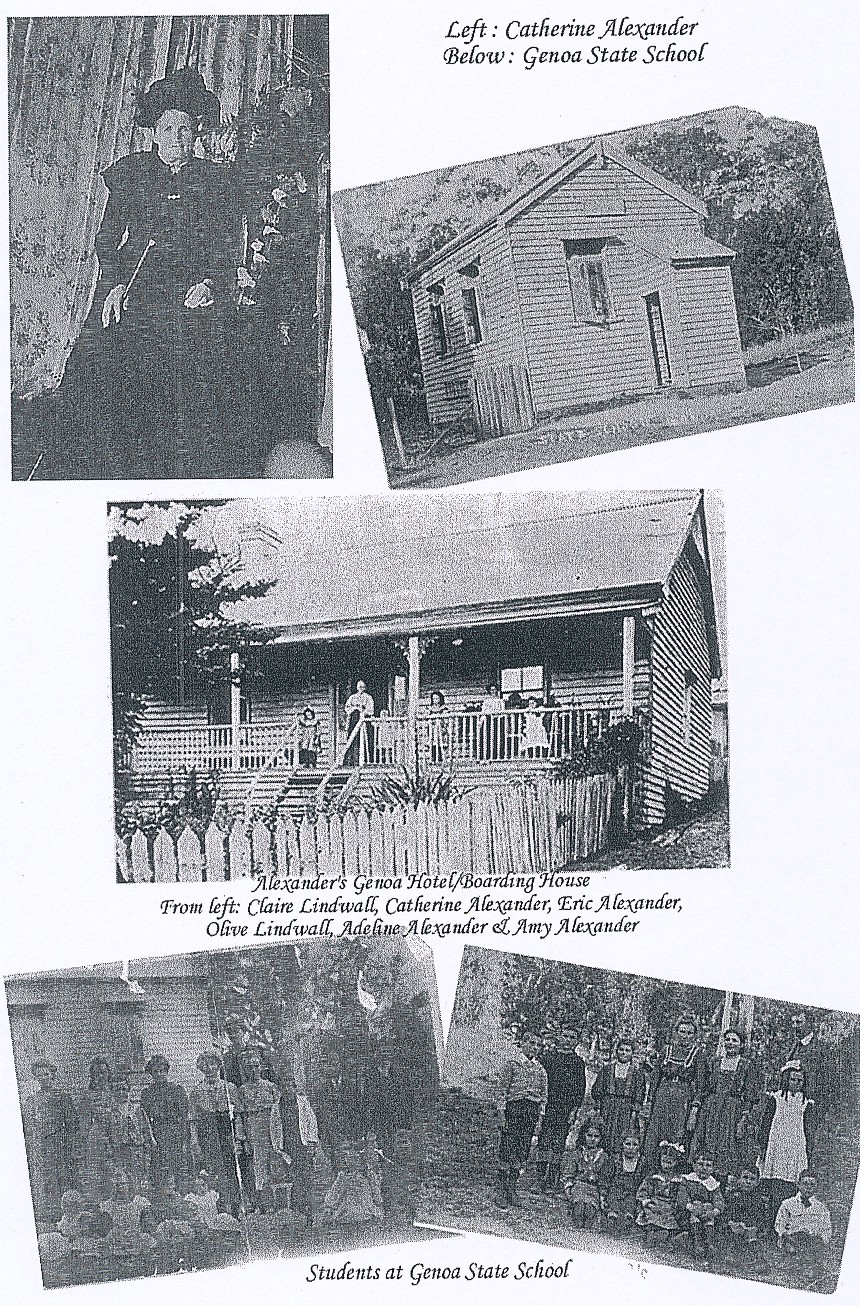 |
Robert was buried the following day in the
Church of
England Cemetery, Eden with his father Robert
and sisters
Barbara and Mary. His headstone reads :
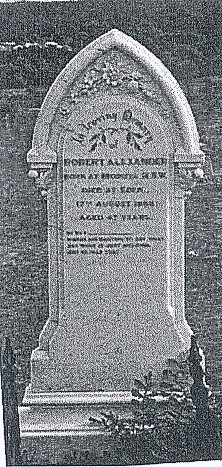 |
In Loving Memory of Robert Alexander Born at Moruya NSW Died at Eden 17th August 1888 Aged 47 years "He was.................................. Words are wanting to say what Say what is just and kind and he was that." |
Robert's brother John placed the following
thank you in the Bega Standard:
THANKS
"I hereby tender my sincere and heartfelt
thanks to the inhabitants of Eden and District
for their great
kindness to my late brother, Robert Alexander
during his severe illness.
John Alexander Perico 27 August, 1888" .
Bega Standard -29 August, 1888
Catherine Alexander lived for another 32yrs
after the death of her husband. She
continued to live at Genoa, and helped look
after the next generation of Alexander
children. She ran the Alexander Hotel as
part of her home and later; as one of the
respected members of the community, Catherine
opened the new Genoa Bridge when
she was an elderly lady. The bridge stood
only two years before being washed away
during the huge floods of 1919.
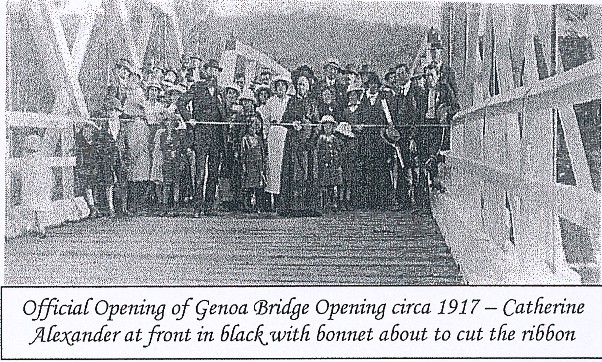 |
The family story has it that Catherine traveled
to Pambula to care for her daughter
Adeline Barbara who had pneumonia and caught
the disease herself. Catherine passed
away one week after the death of her daughter
Adeline, on the 5 November 1920 in
Eden and was buried the following day in
the Eden Cemetery.
WILLIAM ALEXANDER
1842-1869
William Alexander, the fourth child of Robert
and Mary Alexander was the first
white child born to them after they took
up residence at Genoa River. He was born
on
29 October 1842 and the baptism register
states his father's place of abode as Nangutta
- this being the name of the property upon
which Robert was employed as a stock
keeper at the Genoa portion of the 'run',
alternatively known as 'Heifer Paddock'.
As
the actual place of birth was not required
on baptism registers, it is possible that
William was the first white child bom at
Genoa. He was baptised along with his brother
James on 4 July 1845.
A number of other notable events occurred
in 1842, in December of that year Benjamin
Boyd arrived at Twofold Bay aboard his steamship
'Seahorse' which was operating a
service from Sydney to Melboume and Launceston.
He remained in Twofold Bay
while the 'Seahorse' returned to Sydney for
repairs and recognising the potential of
the
area, Boyd immediately set to work in planning
a self-sufficient township. Also that
year, Sydney was "incorporated"
as a city and Melbourne as a town. It was
also the
birth year of Mary McKillop who started the
order of the "Sisters of St Joseph".
In
1994, she was canonised as Australia's first
saint.
We can assume that William grew up helping
his father and older brothers John and
Robert with the cattle at the heifer station.
If he had an education, it was home based
and administered by his mother. One can only
imagine the delights of life as a young
boy growing up in the wilderness of the far
south coast with a creek and river at the
doorstep, an abundance of wildlife not to
mention the excitement a young boy would
derive from the conflict with the aborigines.
William who it seems never married, met a
sad end; his death registration has been
located at Bourke. His certificate states
that he died on 22 May 1869 at Mooronoa
Station, Cuttaburra in the District of Bourke,
where it seems he was working on one of
"Hungry" Tyson's holdings. Tyson
had acquired a holding at Heyfield in south
west
Gippsland in 1866, and this may have been
where William started his association with
the Tyson dynasty.
His certificate also states that he was about
28 years of age - he was in fact 26, and
that
he was from the Bega district. The cause
of death was suicide.
An inquest was held into William's death
and the finding was "Fels-de-se by shooting
himself with a revolver."
He is mentioned in the book "History
of Bourke", Volume IX, pge 159 where
it says :
"01/07/1869 -Cunnamulla. Wm Alexander
shot himself on a Tyson property on the Warrego."
William was buried at Mooranoa Station, Cuttaburra
on 28 May 1869.
'Tyson' was an eccentric squatter who owned
large tracts of land throughout western
NSW. His stations provided a chain of supply
that stretched from North Queensland to
Gippsland, Victoria and fed beef to the Melbourne,
Sydney and Brisbane markets. They
included Mooroonowa in New South Wales and
Heyfield in Victoria. He had a
reputation for dropping in unannounced dressed
in the garb of a 'swaggie' to check on
his managers and staff.
At the time of his death in 1898, Tyson's
estate comprised around 5,329,214 acres and
realized £2.36 million, (well over
a billion dollars today -2003) as he died
unmarried
and intestate, this sum was divided among
his next of kin.
His generosity to a wide range of charities
was legendary; a very frugal man, he was
never known to drink, smoke or swear. A byword
for wealth and a legend in his own
lifetime, Tyson was nicknamed 'Hungry' by
the Bulletin and was commemorated by
A.B. Patterson in 'T.Y.S.O.N.'.
JAMES ALEXANDER
1845-1890
In l845 Queen Victoria was ruling the British
Empire and Ireland was in the fierce
grip of famine as the potato crop completely
failed leading many people to immigrate
to various countries, one of these being
Australia. In the colony, expeditions were
being
conducted by many, one man in particular,
Ludwig Leichhardt was well known for his
exploration and in 1845 was in Queensland
travelling from the Moreton Bay District
to
the Gulf of Carpentaria. The travelling party
returned in December 1845, eight months
late and given up for lost. In the centre
of the country, Charles Sturt spent the entire
year searching for the inland sea he believed
existed, only to retum to Adelaide bitterly
disappointed in January 1846.
On the l2th January 1845 in the family's
Nangutta home, James Alexander was born.
He was the 5th child of Robert and Mary Theresa
Alexander. James was baptised on the
4th of July 1845 with his brother William
at a time when his father was still the overseer
of Nangutta. Although little is known of
his early years in the Genoa region, it is
believed that like his other siblings, he
learnt about farming from working on the
family
property and received basic education.
Jessie Allan, the eldest daughter of James
Allan and Amelia Stevenson was bom on the
22nd August 1845 in Brogo, NSW. Both the
Allan and Stevenson families had settled
in
the East Gippsland District earlier taking
up stations at Bondi (Rockton) and
Wangrabelle. Amelia Stevenson was the daughter
of Captain John Stevenson who
around 1842, took up land near the entrance
to Captains Flat, calling the station
'Mallagoota' which has been credited with
the founding of the town now known as
Mallacoota.
Around 1870, the Allan family was living
at Maramingo Station, Genoa River which
was opposite the Alexander property. James
Alexander and Jessie Allan were married
on the 29th August 1871 in the District of
Eden. We are not sure where James and
Jessie lived after their marriage and no
birth records can be found for their first
two
children, both sons, Maurice Walter (1871)
and James Creighton (1873), whom we
know of from the family bible, although,
the death certificate of Maurice Walter states
that his place of birth was Eden.
After the birth of their second son the family
was certainly living in the Eden district
where James is listed on the Eden electoral
roll in 1875 as living at Pericoe and having
Freehold land. In the 1875-76 Post Office
Directory (Eden) James is listed as living
at
Genoa with the occupation of squatter. It
was here that their remaining children were
bom, Mary May Amelia (1876), Florence Ada
(1877), Jessie Emma (1881) and Isabella
(1884).
In 1885 James is listed as living in Eden
with the occupation of carter. It is known
that
at this time James had his own property at
Genoa, which bordered the land owned by
his brother Robert, as well as owning land
in Pambula NSW. James next appears in the
Eden electoral roll in 1888-89 as having
a residence at Yowaka, in the Eden District.
1890 had been a fascinating year for the
colony. After at least 60 years breeders
finally
bred the perfect working dog....the blue
heeler, a cross between the blue-mottled
Scotch
collie, dingo (for tireless workers), a dalmation
(to give a love of horses) and a kelpie
(for intelligence). This was also the year
that Westem Australia gained it's
independence, Dr Constance Stone became the
first woman doctor to be registered by
the medical board in Victoria (after studying
in the United States) and Carbine won the
Melbourne Cup.
It seems that James lived at Yowaka, near
Pambula for several years before suffering
from heart problems on the morning of the
4th July 1890, when he died aged 45yrs. The
inquest into his death was reported in the
"Bega Standard"...
Inquest
"An inquest was held at Pambula on Saturday
last by Mr John Davis, J.P., coroner, regarding
the death
of James Alexander. From the evidence taken
it appears that the deceased, who was about
44 years of
age, had resided in Pambula for sorne time,
and was in treaty for the purchase of the
Roan Horse Hotel.
On Thursday night he complained of feeling
poorly, with pains about the region of the
heart. He walked
about the room for some time, and eventually
threw himself on a sofa and expired in two
or three minutes, about 8 o'clock on Friday morning. Medical
evidence was given by Dr. R.E. Kane, a medical
gentleman who recently took up his abode
in Pambula, and he gave it as his opinion
that death ensued
from aneurism of the heart. Sergeant Woods
gave evidence that he had known deceased
for some time,
and that he had been suffering from severe
cold and a most distressing cough. A verdict
of death from
natural causes was recorded. "
Bega Standard -1 1 July, 1890
James left behind a wife and six children
and was buried in the Eden cemetery along
with other members of his family. How difficult
those years must have been for Jessie.
She was 45yrs old with six children under
18yrs. The eldest two boys were probably
working around this time to support their
mother and younger sisters as it was still
a
time when women didn't have the vote, let
alone have the right to own property.
Six years after the death of her husband,
on the 28th November 1896 in the Wyndham
Church of England, Jessie Alexander married
Thomas Leech Day, a bachelor with the
occupation stated as miner. Little is known
of her years as Mrs Day, but it seems the
famiiy moved to Sydney as she died in Paddington
on the 29th August 1925 aged
80years. At least two of her daughters and
their families lived nearby and all of her
children, except Maurice Walter were still
living at that time. Jessie was buried two
days later in the Church of England Cemetery,
Woronora.
BARBARA ALEXANDER
1848-1882
It was the year that the young colony turned
60, the Melbourne Hospital opened in
March, chloroform was used for the first
time in Australia and it is the generally
accepted year that Ludwig Leichhardt, the
explorer, died while attempting to cross
Australia from Sydney to Perth.
Barbara, the sixth child of Robert and Mary
Theresa Alexander was born on the 19th
April 1848 in the family's home at Nangutta,
Victoria and was baptised into the Roman
Catholic Church in the District of Twofold
Bay by Reverend Michael Kavanagh on the
l2th September 1848. She grew up in the Genoa
region and unlike her brothers she
probably did not help with the cattle, but
more likely helped her mother in the house.
Her eldest sister is believed to have been
retarded since birth and her younger sister
suffered severe asthma and bronchitis all
her life. No doubt her mother (who suffered
from asthma herself) relied on Barbara to
help with the household chores as well as
looking after her sisters.
James McNee was the third son of Donald McNee
and Mary Cameron born on the 3rd
June 1848 at Mt Cooper Station, Monaro. In
the 1872 Post Office Directory both father
and son were listed as living at Black Lake,
Bibbenluke with the occupation of
shepherds.
Barbara and James married in the district
of Bombala on the 26th February 1877 and
lived in the Eden district during the late
1870's and early 1880's. This era was one
of
unrest due to bushrangers, especially the
Kelly Gang who were making a name for
themselves in the border regions of New South
Wales and Victoria. James Clarence,
the first born of James and Barbara was born
in 1880 in the district of Eden the same
year that Ned Kelly was hung in the Melboume
Gaol and Andrew George Scott alias
Captain Moonlight went to the scaffold. This
was also the year that the University of
Melboume finally admitted female students,
although not to study medicine, the city
of
Melbourne held its grand exhibition in the
well known Exhibition Building in the
suburb of Carlton and the telephone (only
4yrs old, patented by Alexander Graham
Bell) became a reality to those living in
parts of Melboume, Sydney and Brisbane.
During these interesting times, the McNee
family continued living in the Eden district
where their second child, a daughter, Barbara
Mary Ellen was bom in 1882.
It is believed that Barbara (the mother)
had a hard time with the birth of her daughter,
suffering complications and she died one
week later on the l8th July 1882.
Barbara is buried alongside her father, Robert
and sister, Mary in the Eden Church of
England Cemetery.
The inscription on her headstone reads...
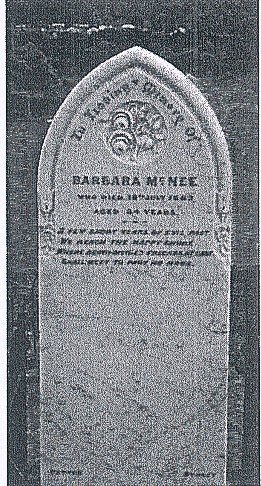 |
In Loving Memory of Barbara McNee Who died 18th July 1882 Aged 34yrs A few short years of evil past We reach the happy shore Where death divided friends at last ShaII meet and part no more. |
Barbara left behind her husband, two year
old son and one week old daughter. Instead
of staying in the Eden district to be supported
by the Alexanders, it seems James (the
father) took the children to live in the
Bombala district to be near his family after
the
death of his wife and little is known of
their lives after that time. We are unsure
if he
remarried or had more children, although
there is a marriage record for a James McNee
and Margaret McDonald in the Bombala district
in l893 (who had five children), at this
stage it is only speculation. James died
in 1912 while still living in the Bombala
district.
MARY ALEXANDER
1851-1872
The last child born to Robert and Mary Alexander,
a daughter, arrived on 29 April
1851 in the small hamlet of Genoa, where
her parents were the first white settlers.
Although she was named Mary after her mother,
she was known within the family as
May. Only months before Mary was born, bushfires
ravaged the state of Victoria and
February 6 became known as 'Black Thursday'.
Australia received its first Governor-
General, Sir Charles Fitzroy and later that
year gold was discovered at Ballarat,
Bendigo, Bunninyong and Mt Alexander in Victoria.
Mary was baptised at St Mary's Roman Catholic
Church in Moruya on 23 October
1854, her sponsors were Patrick and Mary
Whalen.
Young May spent her youth on the family property
at Genoa River; she was not a robust
child and suffered all her life from asthma
and bronchitis. Being the baby of the family,
and sickly, she was most likely cosseted
and encouraged not to over exert herself,
possibly confining her activities to helping
her mother around the home.
May suffered a severe attack of asthma and
bronchitis on 27 August 1872 that resulted
in her death; she was just twenty-one years
and four months of age. It is noted on her
death certificate that she had suffered from
the condition since infancy. William
Charles Wentworth also died in 1872 and only
days before Mary's death, Mt Vesuvius
erupted.
Other notable events were the discovery of
the worlds largest recorded single mass of
gold, the 'Beyers & Holtermann Specimen'
found at Hill
End in NSW, it weighed 215kg. Also that year,
Levi
Strauss patented a garment that changed the
fashion world
forever denim jeans.
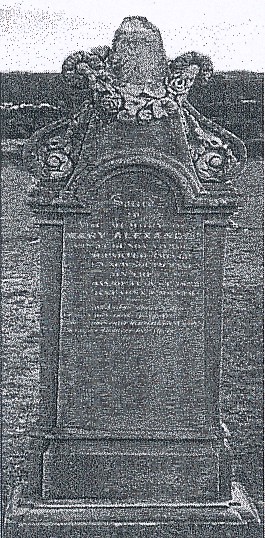 |
Sacred to the memory of Mary Alexander Born at Genoa Victoria Departed this life at Eden New South Wales on the 27 Day of August 1872 Aged 2I years 4 months Shes dead alas forever gone O God our souls prepare That we may enter heavens -----gate In hopes to meet her there. |
Mary was buried on 28 August 1872 in the
family plot at
Eden Cemetery alongside her father. The headstone
inscription reads :
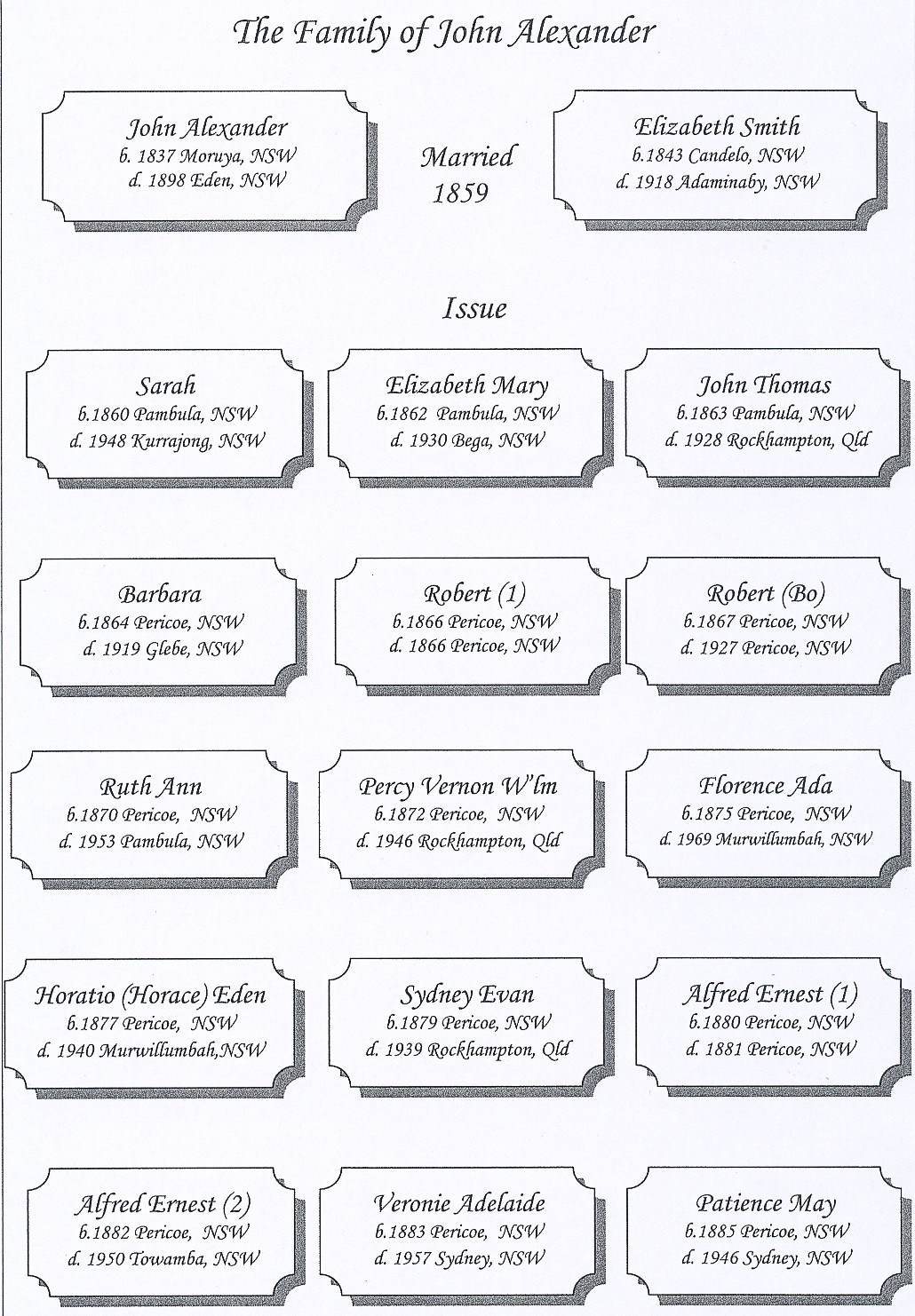 |
