

DAVID FARRELL'S HOUSE. ROCKY HALL. C.1888
In 1843, Benjamin Boyd engaged two surveyors
from Sydney to define a route from Boyd Town
on Twofold Bay, to his station 'Bibbenluke'
on the Monaro, then known as Maneroo. This
route crossed the coastal ranges and proceeded
through today's settlements of Towamba, Burragate
and Rocky Hall, up the Big Jack Mountain
to Cathcart on the Monaro. Construction of
this road commenced in October 1843. This
was to be the main route bringing future
produce from Boyd's vast holdings there to
the coast for shipment.
By the early 1860's, with Boyd just a memory,
many large leases along this route had been
sub-divided and the settlements of Burragate,
Sturt (now Towamba), Pericoe, Rocky Hall
and Kiah on the coast, attracted settlers
as land became available. These pioneers
set about with hand axe and crosscut saw,
horse and bullock, clearing trees to widen
the grass areas to grow crops for their livestock
and build basic dwellings with the felled
timber.
While the husband was clearing the land
or away with horse and bullock teams, the
role of the wife quickly became one of wide
variation. Her realm spread over both house
and farm. She was wife, mother, teacher,
cook, dairy hand and farm worker. With the
nearest hospital a day's buggy ride away,
she became a skilled nurse and if necessary,
midwife.
For their own survival these early settlers
grew maize for stock feed and market, milked
cows, fattened pigs, salted and smoked meat,
made butter and bread and preserved fruit
and vegetables from their gardens. They worked
long and hard to survive in this remote south-east
corner of New South Wales.
December 22, 1932
'Delegate Argus'
*
According to Sir Oswald Brierley's diaries,
the first load of wool from Monaro to arrive
at Twofold Bay was brought in by one of the
Rixon brothers, who reached the bay on 21st
December, 1843, via Towamba.
LINKS :










 |






| EARLY DAYS IN THE TOWAMBA DISTRICT |
'Morning Chronicle'
Wednesday 10 September 1845
Auckland, 50, acres, parish unnamed, at Yuglamah,
on the Towamba River, between Maneroo and
Twofold Bay. Upset price £1. per acre.
'The Sydney Morning Herald'
Thursday 3 May 1849
CROWN LANDS BROUGHT WITHIN
THE SETTLED DISTRICTS.
(REQUIRING PAYMENT OF RENT FOR APPROVED
SELECTIONS UNDER PRE-EMPTION.)
COUNTY OF AUCKLAND, DISTRICT OF MONARO.-Applicant,
Boyd. Benjamin: No. of Lot:
1, 930 acres, parish of Kiah, at Mowwary;
2,1160 acres, parish of Kiah, near Mowwary;
3-6, 640 acres each ; 7,720 acres, parish
of Kiah, on Towamba River;
8, 1120 acres, parish of Nullica, on Towamba
River;
9, 1230 acres, parish of Kiah, on Towamba
River ;
10, 11, 640 acres each ;
12, 1020 acres, parish of Kiah.
* From Granny McCarthy's bible. "William McCarthy born in London, March
17, 1820. His wife, Jean Craigie, born Strathaven,
Scotland, January 2, (no year stated) married
at Boydtown May 4, 1848. Eldest son born
at Eden 27 March, 1849."
My mother born at Towamba, December 5, 1850.
Our grandfather was in charge of Towamba
(Station) for Ben Boyd, as head stockman.
We believe it was the only house there then,
the remains of their old cottage was across
the river opposite Bollman's. Old fruit trees
there in our time in Towamba.
What lonely times for young folk from Sydney.
Grannie often told us of the wild Blacks
from the tablelands meeting the coastal tribes
and holding corroborees on the flats where
Bollman's farm was in our time. Grannie sat
up all night and watched them while Grandfather
was away with cattle to Boydtown, all the
company she had was a tame Black Gin. Grannie,
only 18 when she married.'
Source: Excerpt from a letter. Mrs. J. G. Stevenson
writing to Mr. Bert Egan (former curator
of Eden Killer Whale Museum) in 1958.
In 1848 William Walker Jnr. bought the run,
Tuambo. Estimated area, thirty-five thousand
two hundred acres. Estimated grazing capabilities,
one thousand cattle and two thousand sheep.
The area from Rocky Hall to the foot of Mount
Imlay, to the Jingera Mountain and six miles
down both sides of the Towamba River. It
was an enormous sheep station, though some
of the area was inaccessible mountainous
land. It was known as 'Pussy Cat Station'. Some
of the country consisted of rich grassy flats
of fertile black soil.
Pussy Cat Station was later sold to Sir William
Manning and Mr. Stiles for a cattle run.
Early records show that this was one of the
earliest settled areas in New South Wales.
December 14, 1859
'The Sydney Morning Herald'
NEW TOWN.
A site has been fixed upon for a town to
be called Sturt, situated on the Towamba
River, about fifteen miles from Eden, on
the road from Monaro to Eden. Copies of the
approved plan have been deposited at the
Surveyor-General's office, in Sydney, and
at the police office, Eden.
STURT declared a village 20/3/1885 ( Now Towamba village) BURRAGATE declared a village 10/6/1881 WYNDHAM declared a village 1887 KIAH declared a village 1886 |
'The Sydney Morning Herald'
Saturday 6 October 1860
EDEN (at the Police Office) on MONDAY, 12th
NOVEMBER -SUBURBAN LOTS. County of Auckland:
25 lots (2 acres to 3 acres 2 roods 25 perches)
at Sturt, on the Towamba River, about 12
miles south westerly from Eden, parish of
Towamba, allotments 1 to 6 of section 1,
I to 8 of section 2, 1 to 7 of section 3,
1 to l of section 4. (Upset price, £3 per
acre.)
TOWN LOTS County of Auckland : 26 lots (2
roods each) in the village of Sturt, parish
of Towamba, allotments 1 to 10 of section
7, 1 to 3 and 8 to 10 of section 8,1 to 10
of section 9. (Upset price, £8 per acre.)
See GOVERNMENT GAZETTE, NO. 177.
'The Sydney Morning Herald'
Monday 15 April 1861
That dreadful epidemic, diphtheria, has made
its appearance in our midst. We have only
yet heard of two cases, one an adult, the
other a child; but we may naturally anticipate
that it will spread. The population of Towamba
is increasing, and if the Government could
only be prevailed upon to render the road
passable between that place and Eden, there
is not a shadow of a doubt but that the township
of Sturt would be a township indeed.
'The Moreton Bay Courier'
Thursday 3 January 1861
SURVEY REFORM.
Sir,- Resuming the subject of my last letter,
I purpose somewhat to retrace my steps, by
adducing the following facts, and drawing
from the whole their natural inferences.
In laying out Bega, a township about 37 miles
north-west of Twofold Bay, the chain was
lengthened still more than at Eden, and so
incorrectly were the bearings taken, that
the rectangular form was not obtained in
some of the sections.
At Sturt, a new township on the Towamba River,
county of Auckland, there was the same irregularity
in the form of the sections. Though correctly
measured as regards the lengths of the town
lots, there was one suburban section on the
banks of the river, the inner side line of
which should have been made 7 chains 80 links,
so as to coincide with the town sections
in a line with it, but not yet surveyed it
was, however, measured eight chains, and
although the surveyor was afterwards made
fully aware of the mistake, he neither rectified
nor acknowledged it but represented the section
on the plan as having been marked out in
strict accordance with the design.
I must here mention that neither at Eden,
Sturt, nor I believe Bega was the theodolite
ever used except for taking a few levels,
although the reports which accompanied the
plans stated that "the surveys were
made by theodolite and circumferentor. "
In the survey of a pre emptive application
for one hundred and sixty acres at Bondi,
county of Auckland - a block twenty chains
wide - the lines on either side were measured
ten chains more than recorded on the plan.
Thus the ground marked out actually contained
twenty acres, or one eighth more than applied
for, or supposed to be granted.
Besides these cases which I can speak to
with certainty, from their having come under
my own observation, I know one instance in
which a lot of dairy farms were planned as
though surveyed, and paid for without anything
being done to them beyond cutting their numbers
on the criner trees of the adjoining allotments.
I will now anticipate a query which will
probably suggest itself to some of my readers
- namely, How happens it that these errors
have not been discovered by comparing the
plans with the surveyor's field books? The
answer is simply this first, that such a
comparison is rarely, if ever made - at any
rate, not before the land is sold , and even
if it were, it would elicit nothing , as
the originals were never sent to the Survey
Office, but others concocted in their place,
from the plans forwarded.
The defenders of the system will here meet
me by asserting that though these errors
may have been committed in a particular district,
it by no means follows that they are at all
general, or attributable to the system itself.
That they are general I have not stated,
nor do I even believe them to be so, inasmuch
as I know very many surveys to be accurately
and conscientiously carried out, and most
members of the profession to be honorable
and skilful men.
That I am justified in impeaching the efficiency
of the system has, I think, been shown by
the foregoing facts, which prove -
1st. That it fails to ensure accuracy ,
2nd. That errors continuing over a period
of several years remained undiscovered and
un-guarded against;
3rd. That surveyor's plans cannot of them-selves
be relied upon as representing the work actually
done,
4th. That when a glaring error became appa
rrant, no systematic enquiry was made to
accertain the cause;
5th. That such inaccuracies open up an end
less field for future litigation;
6th. That the country was the loser of huge
quantities of valuable land; and
7th. That from surveys, so conducted, it
is impossible to compile any reliable register
of the extent, features, and natural divisions
of the country.
AN ADVOCATE FOR SURVEY REFORM.
The Manaro Mercury, and Cooma and Bombala
Advertiser
Saturday 23 October 1880
Village Boundaries of Sturt
County of Auckland, parish of Towamba, area
about 122 acres. Commencing on the north
side of Towamba Street, at a point where
the west side of Manning street meets that
street; thence bounded on the west by the
west side of Manning street bearing south
to the south side of Genoa street; thence
on the south by the south side of that street
bearing east till it is intercepted by the
south prolongation of the east side of the
lane forming the east boundaries of allotments
Nos. 4, 3, 2, and 1, of section 19; thence
on the east by the east side of that lane
and its prolongation passing through section
No. 10 north to the north side of Towamba
street aforesaid; and on the north by the
north side of that , street west, to the
point of commencement.
Suburban Boundaries of Sturt. County of Auckland,
parish of Towamba, area about 260 acres.
Commencing on the north bank of the Towamba
River, at a point where the west side of
Manning street meets that river ; thence
bounded on part of the west by the west side
of Manning street south to the south side
of Thompson street; thence on the south by
part of the south side of that street to
the west side of Albert street; thence on
the remainder of the west by part of the
west side of that street south till it meets
the north-westerly prolongation of the north-west
side of a road forming the south- west boundaries
of section Nos. 29 and 28; thence bounded
on the north-west by that prolongation and
the south-west side of that road south-easterly
till it meets the prolongation of the north?-east
side of a road forming the south-east boundary
of section
No. 27; thence bounded on the south-east
by that prolongation and the south-east side
of that road north-easterly to the Towamba
River aforesaid; and thence bounded by the
river upwards, to the point of commencement.
Note.- But exclusive of the town lands, the
boundaries of which have been notified this
day.
Excerpt from 'Bygone Days of Cathcart' by
Laurie Platts 1989 (with permission)
Starting from scratch to make a living in
the days of first settlement for the pioneer
could not have been an easy road. No roads,
no communication, no money, no markets.
The early pioneers' first shelters were
mainly constructed of stringy bark and saplings.
The bark would be removed from either the
fallen tree after cutting into the lengths
required or direct from the standing tree.
The bark was cut with the axe with a sawtooth
effect up the log, hit a few times with the
back of the axe to loosen it from the wood,
and then prised from the log using the blade
of the axe as a lever. Care was taken not
to straighten the bark too much to prevent
it splitting. After removal it had the shape
of the tree (pipe effect), which was filled
with dry grass or fern and set alight. When
the bark was hot which prevents splitting,
it was straightened out with a weight placed
on top for it to dry. From a good tree sheets
of ten feet long by four or more feet wide
were common. this was used for walls and
roof, placed on a frame made of sapling rails
with another on top to hold it together.
Wooden pegs held these together, The fireplace
at one end of the hut was usually made of
round timber, with stone hobs at the back;
it was a constant threat to fire burning
the hut. Earth floors, doors and window shutters
hinged with greenhide, split log table and
stools, beds made of animal hides laces to
rails with greenhide, on posts in the ground
completed the dwelling.
Words cannot describe or give an adequate
idea of the lack of comfort they endured
for the first few years. Hygiene with their
foodstuffs in summer was near impossible,
with no cupboards and persistent flies depositing
their maggots no matter how they tried to
prevent it happening. Flour bags were a godsend
in those days but really an inadequate commodity
for the job. Cheese that was made was dipped
in boiling whey to harden the outer crust
to prevent the maggots penetrating the cheese.
Heavy salting of butter and meats was used
to help thwart the fly menace. Can you imagine
how rancid butter could get with no refrigeration?
No bird or animal was safe, for it would
end up in a stew for what else did they have
to eat, until stock numbers built up or fruit
trees grew. Later on, when fruits became
available, many meals consisted only of bread
and jams so pantry shelves were always stacked
with homemade jams and preserves from every
piece of fruit that could be procured. The
jam jars had been made from an assortment
of bottles with the neck cut off at the shoulder.
The good housewife made these jars by heating
an iron circle (made to the approximate size
of the bottle) and by placing that ring over
the bottle when the iron ring was red-hot
and after holding the ring around the bottle
for a short time, the bottle was then dropped
in to cold water and the bottleneck would
break off cleanly, leaving a good jar. The
jam after being poured into the jar was sealed
by pasting a brown paper cap over the top.
In those early times iron spoons, were never
used to stir jam while it was cooking because
it spoiled the colour of the jam. To prevent
the sugars and jams sticking and burning
on the bottom of the pot, three or four sterilised
silver coins were placed in the pot (half
crowns).
The camp oven that could be hung on a hook
over the fire served for cooking damper and
bread, roasting meat and stews, plus every
other dish that was cooked for the table.
The camp oven would be the most adaptable
utensil used in the bush for many decades
and still can be found in use today.
Lighting was by candles and the old lantern
but before this a discarded panikin half
filled with mutton fat and a wick gave light
at night. As time progressed the table lamp
displaced the candle. These lights used kerosene,
which came in four-gallon tins, two tins
to a pine wooden case.
The kerosene tin was the most useful utensil
the early settlers enjoyed. It was light
in weight, adaptable and handy. It was used
for everything from carting water, boiling
clothes, making soap, feeding the calves
etc. The box these tins came in was a sought
after item used for furniture, stacked together
for cupboards, shelving, stools and with
a lid with greenhide hinges storing foodstuffs,
clothing and any other contrivance people
could think of.
EARLY WOMEN PIONEERS
We should remember and think about the hardship
of the women in the life of the early pioneer
for they deserve all the recognition that
can be bestowed upon them, for in many cases
their lives must have been sheer hell. They
were expected to work from daylight to dark
helping their husbands carve a home from
the bush, as well as rearing a family, working
many hours after dark. Cooking, mending,
washing nappies (no disposables then) and
playing the dutiful wife, submitting to the
conjugal rights was expected by some men
as their right no matter what her inclinations
might be. They spent the larger part of their
lives pregnant often with families of up
to 20 with 12 to 15 children not an uncommon
size, despite many miscarriages. It is no
wonder many died young, or so many infants
died at an early age. All this happened at
first in a bark hut, with a dirt floor, cooking
over an open fire with pots or camp oven.
Think of the cold winter winds whistling
through the cracks of the bark hut, almost
as freely as on 'Taylor's Flat' or McLeay's
runs. The women carried water from creek
or spring for all household requirements.
In sickness the lack of medical attention
or remedies and the worry and heartbreak
of many infants or loved ones weighed on
early pioneer's minds. The very limited medicine
chest containing Condy's Crystals that were
used on septic wounds, snake bites etc.,
Quinine tablets or laudanurm for 'bush fever'.
Epsom salts, the cure of all stomach complaints
or castor oil, and for dysentery large quantities
of Worcestershire sauce. Rum or whisky in
quantities enough to kill the pain was the
anesthetic for setting broken bones in rough
wooden splints, and to stop bleeding, flour,
which would cake around the wound. These
good women were doctors, nurse or any other
term you could apply to them for they administered
to all the ills that befell their lot.
Another comfort we take for granted is the
matchbox. These early folk, to light a fire
were only one step in front of the Aboriginal
for they did not have matches, but used a
flint and steel to strike a spark (often
a piece of quartz stone and a pocket knife.)
Imagine in wet conditions lighting a fire.
Matches did not arrive in Australia until
the 1840s with wax matches many years later.
The modern phrase 'Life was not meant to
be easy' surely applied then.
THE UNRAVELLING OF A LONG KEPT SECRET
Research by Pat Raymond (Research Officer
at the Pambula Genealogy Society)
Article from 'The Valley Genealogist' by Pat Raymond
For how long can a secret be kept? In this
case, 152 years!
For many, many years descendants of three
local families have searched and tried to
find out on what vessel their ancestor had
come. They knew approximately the year of
arrival and that the three men, Robert Turbet,
James Love and George Martin had sailed on
the one vessel, but all searches had drawn
a blank. It was quite by accident that last
year I came across the following letter which
appeared in Film No 2681 Bench of Magistrates,
Eden.
" From - Police Office Eden,
11th December, 1849
To - The Principal,
Superintendent of Convicts
Sir, In reply to your letter of the 30th
ultimo requesting information as to the accommodation
that can be procured at Eden or Boyd Town
for fifty or sixty men whom it was in contemplation
to forward to Twofold Bay on the arrival
of the next convict ship. We have the honor
to inform you that Messrs Layton & Co.
have placed at our disposal the buildings
at Boyd Town formerly occupied by the immigrants
per 'Bermondsey', and have further undertaken
to ration them according to the scale specified
in your communications referred to, at the
rate of eight pence per diem for each male,
and seven pence per diem for each female.
2. At present there is no building at Eden
suitable for the reception of these men and
we are therefore disposed to recommend that
the offer of Messrs Layton & Co. be accepted,
altho some inconvenience will doubtly arise
in the Superintendence of the prisoners from
the fact of the parties under whose care
they will be placed being stationed at Eden.
3. The Police Force at the disposal of the
Eden Bench consists of a Chief Constable
and four Ordinary Constables, the former
with two Ordinary Constables is located at
Eden, the other two are stationed at Panbula,
but will be ordered to remove to Eden as
soon as we receive intimation of the arrival
of the prisoners.
We have the honor
For the Bench - Signed H.H. Massie J.P."
As I was unaware of the arrival into our
area of a group of convicts of this number,
the search was on for more information. I
learnt that the Adelaide was the last of the convict ships to arrive
in New South Wales and that when it docked
in Sydney on 24 December, 1849 there were
259 male convicts on board, 40 having already
disembarked at Hobart. On the 2nd January
1850, fifty of these convicts under the supervision
of Lieutenant Isdell, two soldiers from the
99th Regiment and three constables, boarded
the coastal steamer Shamrock bound for Twofold Bay. These convicts had
been awarded their Tickets of Leave on the
30th December, 1849 and were assigned to
the Broulee District, of which in those early
days, Eden was a part.
Ben Boyd had earlier departed from Boydtown
so the buildings were now being leased by
Edward Layton of Layton & Co. and arrangements
were made for these 50 convicts to be housed
at this site. At this time Anthony Falkner
was the Landlord of the Seahorse Hotel and
the exiles were housed in the workers' huts
at the back of the Store.
Mr. Bagnal was the overseer of these men
and, because of his good management, no behavioural
problems were encountered. As there was no
suitable accommodation for Mr. Bagnal to
reside at Boydtown, each day James McDonnell,
the licensed waterman at Eden, would ferry
him back and forwards from Eden. The whole
aim of these convicts being sent en masse
to Twofold Bay was for them to relieve the
shortage of labourers on the coastal area
as well as up on the Monaro. As employment
was found, they moved away from Twofold Bay
to start their lives afresh.
To date I have only been able to confirm
the names of 25 of these 50 convicts and
they are listed below.
| James Case | Convicted Gloucester | 7 years |
| Jas Clarke | Convicted Lancaster | 10 years |
| Harry Cone/Henry Cane | Convicted Stafford | 7 years |
| Joseph Crofts | Convicted Northampton | 7 years |
| William Falconer | Convicted Scotland | 10 years |
| William Haswell | Convicted Scotland | 7 years |
| Robert Hazelgrove | Convicted Suffolk | 7 years |
| William Hill | Convicted Surrey | 10 years |
| Alex R. Hunter/Henry A. Hunter | Convicted Scotland | 7 years |
| Wm Johnson | Convicted Northumberland | 10 years |
| George Jones | Convicted Middlesex | 10 years |
| James Key | Convicted Norfolk | 10 years |
| George Law | Convicted Stafford | 7 years |
| George Lee | Convicted Monmouth | 10 years |
| James Love | Convicted Middlesex | 7 years |
| Daniel McHag/McKay | Convicted Scotland | 10 years |
| George Martin * See 'Obituaries' | Convicted Lancaster | 10 years |
| Reuben Packer | Convicted Gloucester | 7 years |
| Frederick Powell | Convicted Central Criminal Court | 10 years |
| Jno Reid | Convicted Middlesex | 10 years |
| Will Riley | Convicted Stafford | 7 years |
| James Shanly/Shanley | Convicted Central Criminal Court | 10 years |
| Henry Taylor | Convicted Brecon | 7 years |
| Robert Turbet | Convicted Scotland | 10 years |
| Joseph Worland | Convicted Cambridge | 7 years |
Possibly Charles Bailey, Edward George Brotherton,
John Coates, George Morris and William Scott
also were among the men who arrived at Twofold
Bay on board the 'Shamrock'.
 |
 |
||
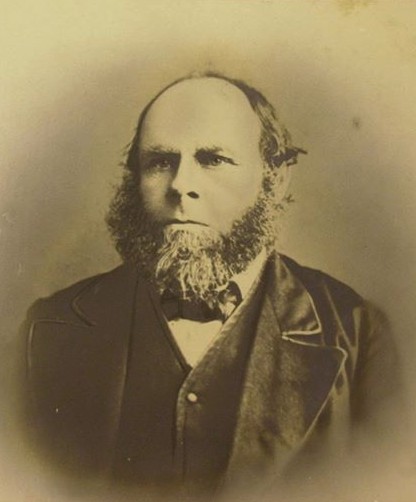
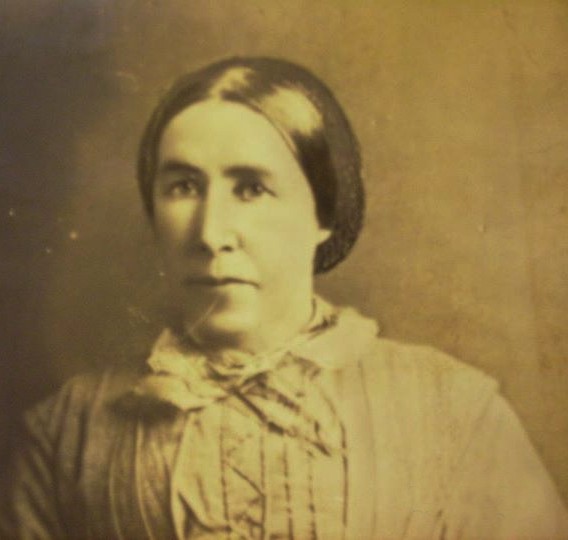
| George Martin | Elizabeth Martin nee Hart |
'Magnet' January 19, 1923
'The Sydney Morning Herald'
102 YEARS OLD
DANCES A JIG
ENTHUSIASTIC CENTENARIAN
* At Mr. Chapman's meeting at Towamba, in
the Eden-Monaro electorate recently, Mr.
George Martin, who is 102 years of age, moved
a vote of thanks to Mr. Chapman, who, at
the close of the meeting, offered the old
gentleman a lift in his motor car. "I
won't bother you, thanks," replied the
centenarian, "I have only a mile and
a half to go", and he then danced a
jig in the roadway to show his agility.
James Clarke was a resident of Bega in 1859.
Joseph Crofts married Ann Davis in 1859
at Eden and in 1862 he was working at Bibbenluke.
William Falconer married Agnes McClung in
1851 and by 1855 he was a carpenter at Bombala.
William Johnson worked at Bibbenluke in
1853.
James Love lived at Eden and Towamba. He
carried the mail between Towamba and Nangutta,after
which he took up farming and died at Pambula
in 1906.
Daniel McKay was employed on Aston Station,
Bombala district in 1850 , and in 1851 employed
by Mr. Robertson at Pambula.
George Martin lived his life at Towamba
and reached the grand age of 104 years. (See
'Obituaries')
James Maxwell was a Sheepwasher at Bibbenluke
in 1851.
Reuben Packer was a shepherd at Bibbenluke
in 1853, a labourer residing at Bega in 1863,
in 1867 was at Numbugga and by 1872 was working
at Gourlay, Kameruka.
Frederick Powell married Mary Ann Hagerty
at Eden in 1853. In 1859 he was working at
Bibbenluke and in that same year returned
to Mitchell St., Eden.
Robert Turbet married Mary Peacock in 1852
at Sydney. In the mid 1850s he was the Eden
Customs boatman and in 1860 he applied for
a publican's licence for the Scottish Chief
at Wyndham. He died in 1894 at Wyndham.
Joseph Worland married Ann Crawford in 1852
at Bombala and by 1853 he was working at
Bibbenluke as a cook and shearer. He died
at Numeralla in 1898.
James Love, George Martin and Robert Turbet
remained for the rest of their days in the
Towamba/Eden/Wyndham area. It would appear
that the three of them joined ranks and decided
to withhold the truth about their past history
of arriving at our shores as convicts. James
apparently loved to tell the tale to anyone
who would listen about how Ben Boyd's sloop
with 6 guns aboard used to periodically trade
between California and Twofold Bay and that
he at one time had worked for him. However,
Boyd had already departed Boydtown sometime
in 1849 prior to the arrival of the exiles
on board the Shamrock. Boyd was never to return again and by January
1850 he was on his way to Tahiti heading
towards San Francisco. Obviously James' path
had never crossed Ben Boyd's. George Martin's
obituary stated "George was of a roving
disposition. He followed the sea for many
years on vessels trading to Russia, Denmark,
America, Japan and China. Finally he became
imbued with the idea of emigrating to Australia
and on Christmas Day in the year 1849 he
arrived in Sydney Harbour." No hint
there of arriving as a convict! So James,
George and Robert, who were highly respected
pioneers of our area, succeeded in hiding
their past from their descendants for 152
years.
Information from:
Eden Bench Book & Letter Files - Film
No. 2681
Empire of Straw by Tom Mead
Sheep & Shepherds: Sheepwashers &
Shearers on Bibbenluke 1851-1867
Imlay Magnet and Pambula Voice.
'The Bega Gazette and Eden District or Southern
Coast Advertiser'
4 October 1882
The New Country,
Towamba and Genoa Rivers
Although for years there has been a scattered
population between Eden and the mouth of
the Genoa River, few, beyond those whom business
has taken into this region, know much of
a part of country that may be de scribed
as "new." In view of the approaching
opening up of the Towamba estate the following
notes of Genoa may not be uninteresting:-
The "Genoa" River has its origin
at Bondi, flows pretty well due south and
empties into the sea in Victorian territory.
In rainy seasons the stream soon rises, rapidly
flows, and quickly subsides. The country
round about is of varied character, and sparsely
settled. Here and there are patches of rich
brush land, and plenty of scope for making
grazing farms, though the work of clearing
will operate against profitable settlement
for some time to come. Heavy timber costs
money to get rid of it, and the creation
of grassy pad docks is, as at some parts
of the Tanja country, a work that time must
be asked to aid in. We notice settlement
is gradually progressing below Eden, and
thence to the Victorian border and across
into the adjoining country. Some of the settlers
have been located there for years. At the
mouth of the Genoa River is Mr. Robert Devlin,
who pegs away his bachelor life, and gives
his celibate attention to raising some fine
horse stock. Devlin's heavy greys are known
in Bega, a fine draft having been sold here
about eight years ago. A similar lot would
now command 50 per cent, higher prices in
this market. Mr. Devlin belongs to the Victorian
side, and has a freehold of 75 acres, with
practically unlimited run.
Fourteen miles up the river, and 8 miles
from the boundary, on the Victorian side,
is Mr. J. Alexander's "Genoa" of
142 acres, consisting of some of the richest
land fit to grow anything, from potatoes
to maize and tobacco. Schooners can come
up to within five miles of "Genoa,"
the loading place being at Gipsy Point, so
called in honor of Mrs. Barclay's ill-fated
schooner that was the first vessel to open
up communication with the interior about
eleven years ago. Two regular traders bring
stores from Melbourne -the schooners "Julius,"
about 70 tons, and "Gippslander"
40 tons. These vessels make fortnightly trips.
At regular periods the "Martha,"
a fine craft of 300 tons, puts in an appearance,
and, like the other vessels goes back laden
with bark principally. This article has commanded
grand prices in Melbourne, going in free
of duty, selling chopped, in bags, up to
£?6 per ton. The freight charged by these
vessels is 35s. per ton. Adjoining Mr. Alexander,
is his brother Robert, having 320 acres.
Just across the river is Mr. Robert Allan,
who has 200 acres of N.S. Wales land and
vis a vis on the Victorian side, is Mr. William
Allan with 320 acres, and an extensive run
known as "Merrimingle.'' Ten miles higher
towards Bondi comes Mr. Stevenson, of Wangerable,
in Victoria. There is yet open to selection
along the Genoa, both in Victoria and N.
S. Wales a large quantity of unoccupied country.
People from this side have been deterred
from prospecting by the bad road between
Eden and Kiah, but this has received some
attention from Road Superintendents, and
can and will be robbed of its terrors by
side-cut tings. From Kiah to the mouth of
the Genoa is a stretch of fairly level country,
along which, even now, a buggy can be easily
driven, as has already been done by Mr. Curtis,
and by one or two others. More settlers are
required. At present only 19 children can
be mustered; the great want is a school,
and with the advent of one or two extra families
a provisional school could be started.
The sale of Towamba,(Station) and its breaking
up into smaller holdings will draw attention
to all the surrounding country, and we shall
eventually find a large and thriving population
in what has, so far, been almost a terra
incognita.
'The Bega Gazette and Eden District or Southern
Coast Advertiser'
25 November 1882
Information. - For the last time: "Towamba";
perhaps you may have seen the name in the
papers? Perhaps you will not see so much
"Towamba" again, at least for a
few months after next Tuesday, when Rixon
and Macleod intend to give away Towamba to
the highest bidder. But before business begins
on Tuesday, some "phizz" has to
be opened, and General Sir E. Suttle is to
marshal an attack on Tell-the-Karver at the
school of Arts entrenchments. Noon for the
hospitality; a brief hour, and then "Gentlemen,
the terms and conditions of sale are etc,"
The next we shall hear of Towamba will be
in connection with the T. Hotel, the T. School
of Arts, the T. Store, the T. Jockey Club,
and may be the "Towamba Gazette."
Without joke, a large settlement about Towamba
is only a work of time, and we expect not
a few people know as much about this as we
can tell them, and will try to back their
belief at the sale on Tuesday.
'Pambula Voice' July 7, 1893
PERICOE
Pericoe is geographically speaking still
in the same place and your own have very
little to chronicle. Mrs. Ryan from the Post
Office is now in Candelo, very unwell and
has been attended by Dr. Meeke for six weeks.
Much sympathy is felt for on account of her
kindness and stirling worth.
 |
|
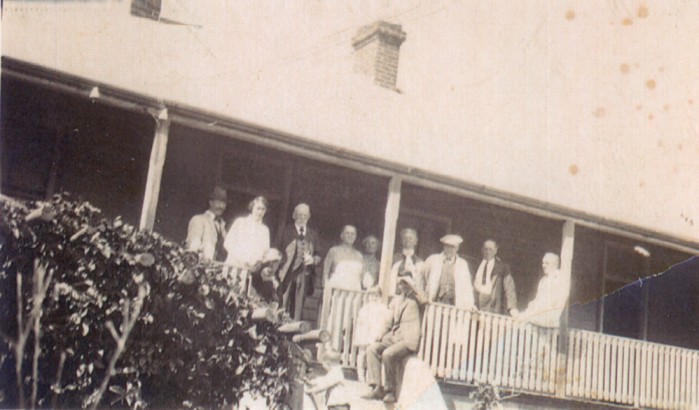
| Group on veranda at Dunblane, Burragate -
c.1930-36 Third from left - possibly Alexander Binnie, third from right - Alfred Sylvester Richards. Others possibly: - (extreme right sitting) John Kenneth Richards, Harold Binnie. Lady second from left possibly Veronica Agnes Richards |
|
 |
|
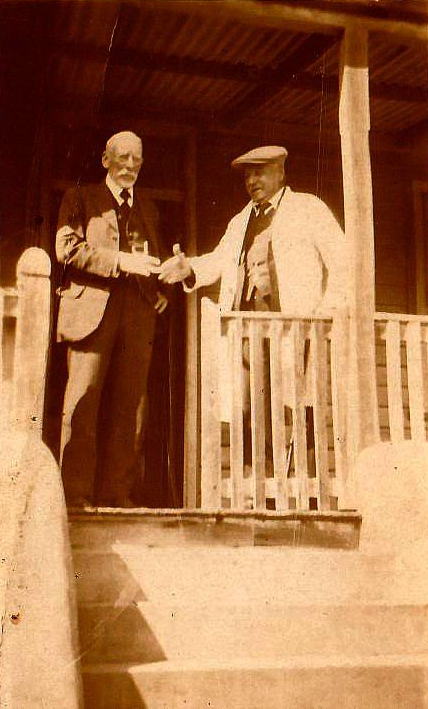
| Alfred Sylvester Richards (R) and Mr. Binnie on the veranda at Dunblane. c.1930-36 | |
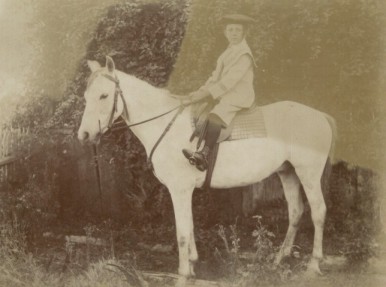 |
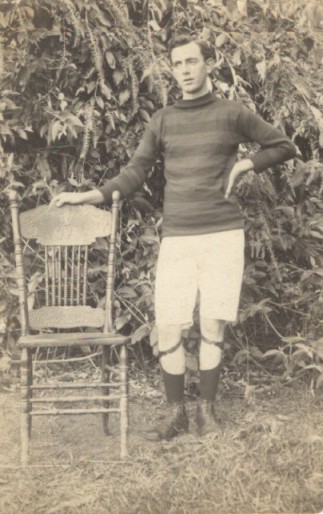 |
| Clarence Binnie Jean McPaul Collection, Eden Killer Whale Museum |
Clarence Binnie in football outfit Jean McPaul Collection, Eden Killer Whale Museum |
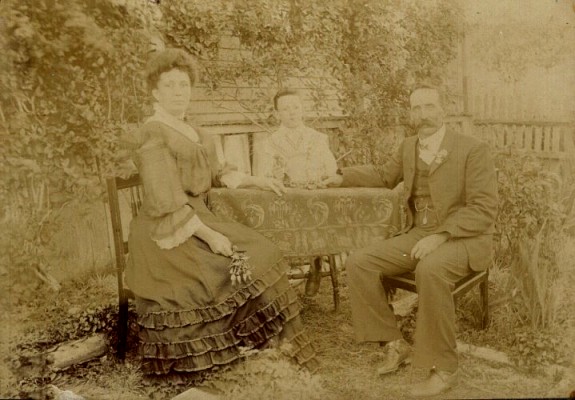 |
|
| L-R: Mollie Binnie, Clarrie Binnie, Albert
Binnie Jean McPaul Collection, Eden Killer Whale Museum |
|
Same date
JANCHO
Mr. Targett and family intend leaving here
shortly, I am informed, and intends residing
at Tantawanglo. For ten years he has been
located here and a vacuum will be caused
by his removal that will be hard to fill.
The weather around here has been behaving
itself fairly well and everything else is
very quiet thus depriving a poor correspondent
of anything to scribble about.
'Pambula Voice' July 7, 1893
BURRAGATE
* I am informed that a receiving office has
been granted here. It is to be in charge
of Mr. Samuel Shipway who has been a resident
for some time. This will supply a long felt
want and be a great convenience to residents.
* Numerous articles have been missing here
lately. One neighbour losing two turkeys,
another a keg of butter from the dairy and
another victim had the line stripped of clothes.
These things are lost but no doubt some thief
discovers them and he will probably be bought
to light ere long.
* Mr. Shipway has now started a general store
and saves the public many a mile for formerly
the nearest stores were Wyndham and Towamba
being upwards of seven miles away.
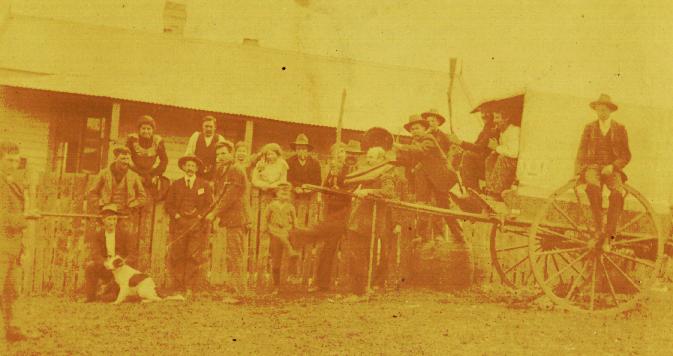 |
| Unknown group. Jean McPaul Collection, Eden Killer Whale Museum No date |
'Pambula Voice' October 13, 1893.
BURRAGATE
At Eden on the 29th of last month 57 allotments
of the Burragate township were offered for
sale and about 22 were sold at upset price,
the rest being passed in. The purchasers
were Mr. John Martin, Mr. David Binnie, Mr.
S. Shipway and Mrs. Starkie.
* Mr. John Robinson Jr., has a ewe in his
possession that has given birth to triplets
and all are doing well.
* Mrs. John Parker gave birth to twins daughters
on October 1st.
* The river, owing to the welcome rains last
week, has been fairly high and almost uncrossable
for a few days.
* We are not behind in floriculture. A primrose
in full bloom at Mrs. Shipway's almost defies
competition either here or in the old land
and the garden of Mrs. John Martin under
the assistance of Mr. John Richard presents
a very pleasing and attractive appearance.
'Pambula Voice' October 20th, 1893.
TOWAMBA
* The butcher shop opened some time ago by
Mr. T. Hite, not proving a success, that
gentleman is turning the building into a
hall which will be a great acquisition to
the township, no public hall of any kind
having existed here hitherto.
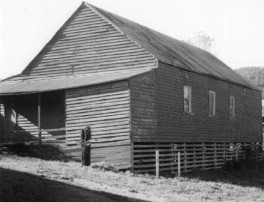 |
| TOWAMBA HALL. Photo K. Clery. |
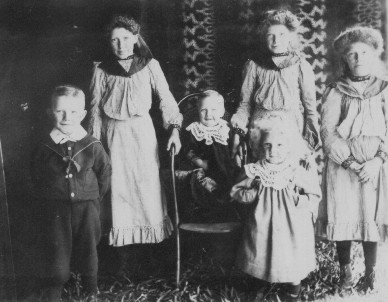
Sawers Family
No date.
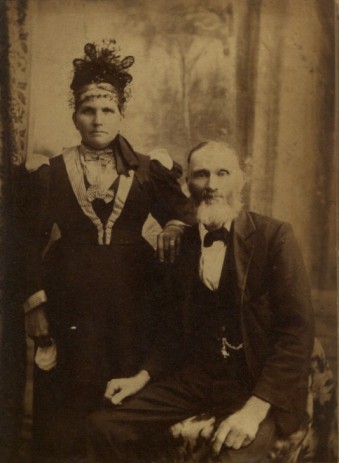 |
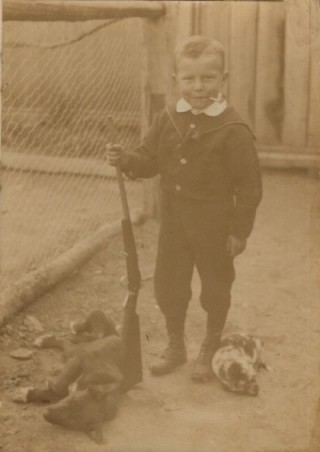 |
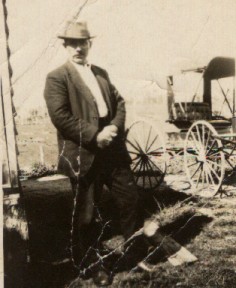
| Mr & Mrs Percy Sawers Jean McPaul Collection, Eden Killer Whale Museum No date |
Peter Sawers Jean McPaul Collection, Eden Killer Whale Museum No date |
 |
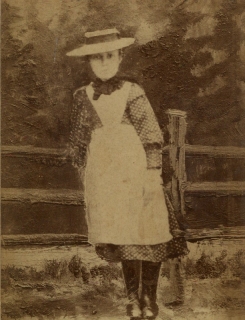 |
|
| Jack Sawers Jean McPaul Collection, Eden Killer Whale Museum No date |
Alice Sawers Jean McPaul Collection, Eden Killer Whale Museum No date |
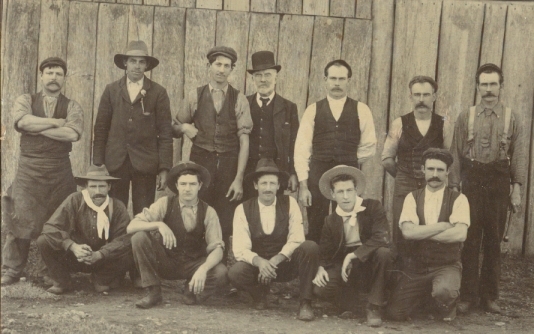 |
| Walter Sawers (second from left, back row).
The rest, unknown. Jean McPaul Collection, Eden Killer Whale Museum No Date |
 |
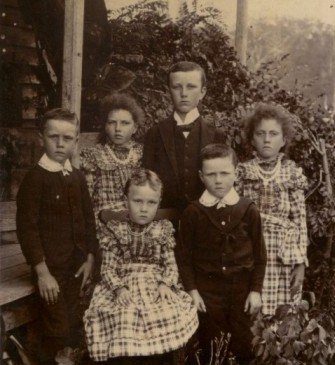 |
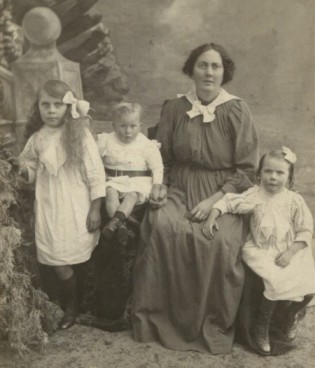
| Unknown family. Jean McPaul Collection, Eden Killer Whale Museum. No date |
Unknown family. Jean McPaul Collection, Eden Killer Whale Museum. No date |
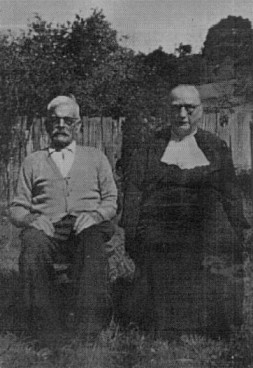 |
WILLIAM CHARLES RYAN AND HELENA RYAN (nee
KERR).
BURRAGATE.
No date. Photo courtesy M. McMahon.
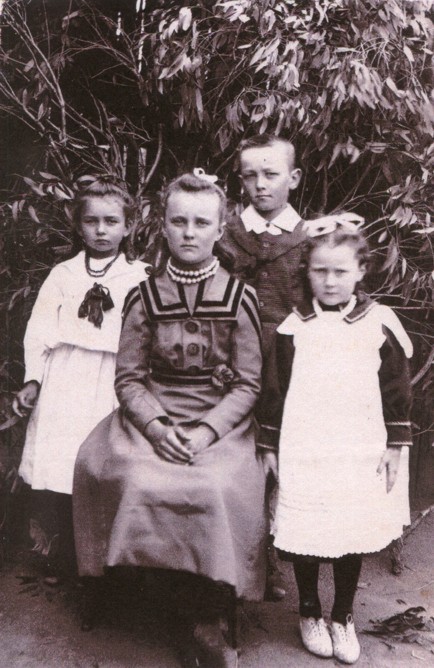 |
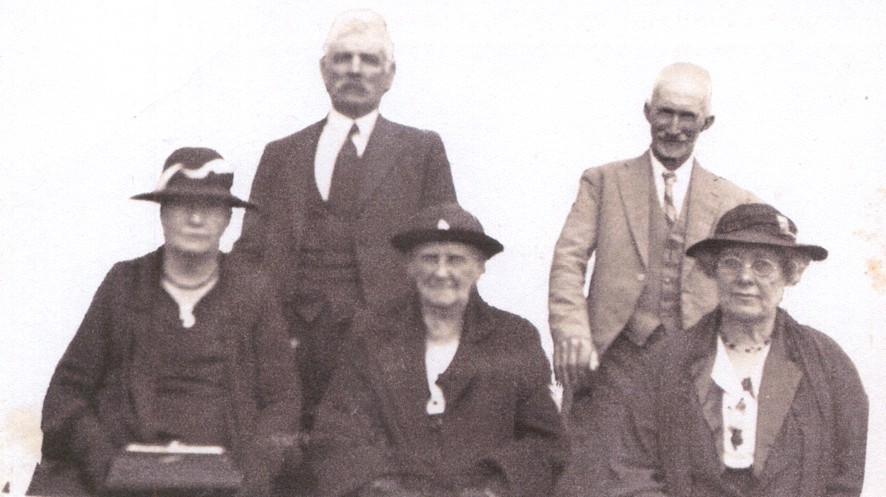 |
|
| Small girl on left is Gladys De Costa, later
Mrs Wallace Grant. Older girl is Maude Elizabeth Robinson, b.1-11-1889, later Mrs Charles Rayner. Girl to right is Annie Ivy Robinson, b.30-4-1894 later Mrs Charles Gilbert Ryan (known as Gilbert) Boy at back is William John Lawrence Robinson (Lawrie) b.1891, killed 19-7-1916 in France. No Date. Photo courtesy Barry Ryan |
Back: William Charles Ryan, James Sherwin Front: Mrs William Charles Ryan nee Helena Kerr, Mrs Henry Kraanstuyver nee Anne Robinson, Mrs Alexander Binnie nee Sarah Robinson Anne Robinson b. 6-5-1861 at Wog Wog Sarah Robinson b. 11-7-1865 James Sherwin b. 29-5-1862 Photo courtesy Barry Ryan |
|
Mrs. Henry Kraanstuyver nee Anne Robinson owned Long Flat Farm, New Buildings near Wyndham, was the first white child born in Burragate. James Sherwin who lived at the western end of New Building Bridge is said to have been the first white boy child born in Burragate. Information courtesy Barry Ryan. |
||
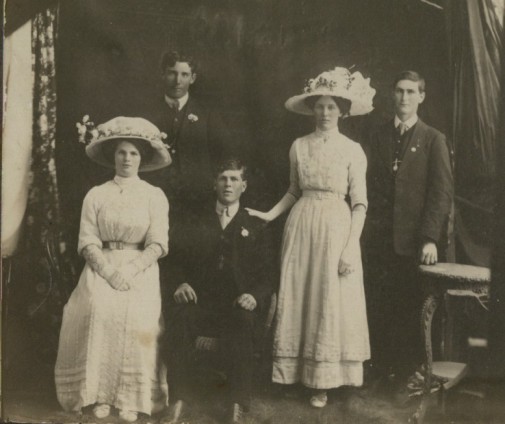 |
| Back: Alby Hunt Front: Ellie Brotherton, Alby Brotherton, Myrtle Hunt or Brotherton, Willie Brotherton. |
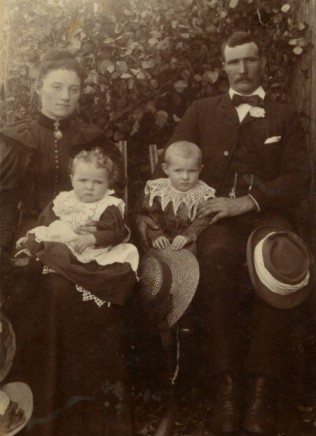 |
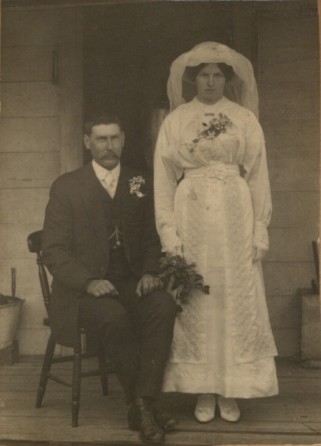 |
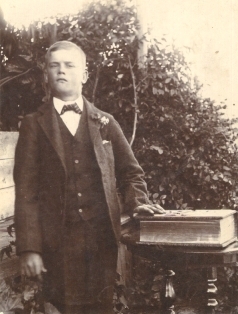
| Mr & Mrs Joe McCaffery and family. Jean McPaul Collection, Eden Killer Whale Museum |
Bill and Lizzie Love Jean McPaul Collection, Eden Killer Whale Museum |
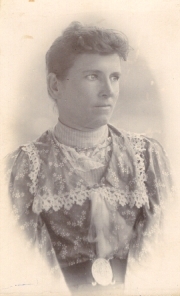 |
 |
| Mrs. Julin Jean McPaul Collection, Eden Killer Whale Museum No date |
Gus Julin Jean McPaul Collection, Eden Killer Whale Museum No date |
'Pambula Voice' November 10, 1893
TOWAMBA
* Our little township is still "alive
and well". Some very hot days were experienced
last week but all the crops in the neighbourhood
are looking well while there are an abundance
of grass and oil - no, I mean butter.
* Mr. Woods of Boyd Town was here last Friday
night and delivered an address on various
subjects from a protective standpoint. It
is understood this gentleman has an ambition
to represent the electorate in parliament.
His meeting held at the Towamba Hotel was
large and influential.
* We are having a change in the Post Office
at Towamba. Mr. George Martin, Postmaster
here for many years past has resigned his
office and is being succeeded by Mr. S. Martin
J. P.. The retiring officer has been here
for nearly a quarter of a century and has
always retained the name of being a courteous
and obliging gentleman. His son and successor,
Mr. S. Martin has been identified with the
Post Office for some fifteen years so that
the management will still be in the hands
of one who is well known in the locality.
It is rumoured that a Money Order Office
and Savings Bank is to be established at
Towamba. Several new buildings are going
up in the township and neighbourhood and
Mr. Hite's Lyceum Hall is nearing completion.
'Pambula Voice' January 19, 1894.
TOWAMBA
That unwelcome epidemic, measles, still
exists in our locality especially in the
neighbourhood of Pericoe. In some instances
the dairy work has been seriously retarded
through several of the milking hands being
all down at one time with the complaint.
Grass is everywhere plentiful, growing crops
would benefit by a short spell of fine weather.
DISTRICT LETTERS
TOWAMBA
Newspaper unknown
March 19, 1913
Wedding bells! silver bells! What a world
of melody their chimes foretells. At any
rate, a nice wedding was celebrated at the
local Church of England on 16th March, Rev.
Hurst officiating. The happy couple were
Edward Umback and Charlotte Keevers. May
their happiness continue.
The country looks well, and a slight improvement
is in evidence as to cream supplied to factory.
The corn crops got knocked about a good deal
during the late storm, which, by the way,
was nothing like so severe as you experienced
over your way.
Our gold mine is at present quiescent, as
timbering and general fitting up are going
on. Certainly some splendid specimens have
been taken out of the solid. I should say,
from what I have seen, the reef is certainly
worth trying. But development work is monstrously
expensive.
An epidemic of whooping cough is with us
and extends from Wangrabelle to here. The
Towamba school has 24 children absent from
this cause, and the confounded thing lasts
so long.
Our roads are beginning to trouble us some,
and complaints are heard from the travelling
public. How absurd it is to expect one man
to maintain possibly 15 miles of road which
has hardly a yard of metal from one end to
the other. Go across to Victoria and you
will see hundreds of miles of the same thing
from same cause.
Dr. Clouston's decision to stay with us
yet awhile appears to have given considerable
satisfaction.
Newspaper unknown
April 7, 1913
TOWAMBA
The weather is very unsettled here; yesterday
a drizzling rain fell, but not enough to
do any good. The growth in the grass is slow,
considering the advantage it has had by the
steady moderate heat that followed the recent
rains.
The mine on the ridge above Ferny Flat is
making decided progress. The shaft is now
timbered, a windlass erected, fall, etc.,
for making work convenient. The further they
go down the better the gold is showing in
the stone and is quite promising enough to
be given a trial.
Constable Glomer has returned to his post
in Towamba after an absence of a few weeks,
during which time he was stationed at Eden
while Constable Chaney was away.
Mr. Walter Roberts, who has been living
in Queensland for some years, has returned
on a visit to Towamba.
Mr. T. Evans, who was blacksmith here for
some time, has left with his wife for Bendoc
where he will take up his residence.
An effort is being made to procure a music
teacher, as a good many are desirous of learning
should the opportunity offer.
The whooping cough that has been prevalent
here for some time is now showing signs of
leaving and many of the ailing children have
returned to school, plainly well on the mend.
It is to be hoped that those who are suffering
from a lingering attack will recover before
the winter sets in, as the contrary would
mean a hard struggle through the cold weather,
and perhaps result in serious lung trouble.
A football match is to be played at an early
date between the school boys of Wyndham and
Towamba, Burragate and Lower Towamba combined.
The corn is ripening fairly quickly, and
anxious farmers are earnestly hoping that
frosts will keep off for a few weeks longer.
Newspaper unknown
October 4, 1913
TOWAMBA
Nearly 6 inches of rain within 21 days! The
country is verdant, stock are looking well,
and the cream cans show a marked increase.
Most of the farmers have their ground ploughed
and are ready for planting. Of course they
are three weeks early, but I hear several
of our more progressive farmers talking of
cross ploughing.
Mr. C. W. Roberts and family are with us
again. Some five years ago they rented their
farm to Mr. Wm. Beasley and went up north
as far as Toowoomba, where, to all accounts,
they have had a fairly good time. One daughter
married while there. We are given to understand
that Mr. And Mrs. Roberts contemplate residing
in Eden, Mr. Roberts' health being anything
but good.
Mr. Wm. Arnold, who has been Mr. Robinson's
managing assistant in the store business
for some years, is leaving for Sydney in
a few days. Mr. Arnold, by his cheerful,
kindly disposition and keen attention to
business has made himself most deservedly
popular, and earnest expressions of regret
are heard on all sides at his decision. Bill
is a keen sport and under more favourable
conditions will be a good cricketer and footballer.
Most certainly he will be a loss to Towamba.
The Church of England people rolled up in
numbers a fortnight ago. Painting the church
was the order of the day. The building now
looks quite a credit to those gentlemen who
gave their time to so good a service. Mr.
B. Beasley supplied the timber to fence the
ground, and then by arrangement erected the
fence. The ladies also gave a hand and prepared
a lunch for the workers, and everything passed
off happily.
Mr. G. Martin is going to build a new hotel.
A good deal of timber is already on the ground.
This is a move in the right direction, and
will certainly be a boon to the travelling
public, the present site not being as convenient
as could be desired.
With the exception of Mr. McWilliam none
of the parliamentarian aspirants have been
here. Politics to date are not exciting.
The rush for the spoils is not close enough,
I suppose.
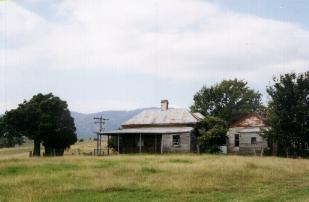
LYNDHURST, BURRAGATE.
Photo K. Clery
Unknown newspaper
1975
MEMORIES OF BURRAGATE
News of the termination of the public telephone
service to Burragate has been of a special
interest to Mrs. Florence Hill of Rockhampton.
Mrs. Hill recalled in a letter to Mr. Ted
Ryan that her father Mr. Sam Shipway was
Postmaster at Burragate at a salary of 48
pound per annum, paid quarterly.
She was educated at Burragate Public School
and received her sixth class certificate
from Inspector Durie when less than 10 years
of age. Until Mrs. Hill was 13 she often
taught the younger classes. There were 60
children at the school and only one teacher.
In 1909 she began to help her father in
the Post Office and was "assistant"
Postmistress. Her father's cheque was paid
quarterly so this meant 12 pound each three
months.
When 'Big Hill' gold mine opened up and
was worked by a syndicate from Melbourne,
business at the Post Office increased considerably.
The mine manager was Mr. Eades who lived
with his wife in Mr. Tom Dawson's house.
Mrs. Hill said that business became so good
that her father was given an increase in
salary to 168 pound per annum.
The office hours were from 8.30 am to 8.30
pm six days a week.
The only other days except Sunday when the
office was closed were Christmas day and
Good Friday but if Christmas day happened
to be on a mail day the office had to be
open for one hour.
Mrs. Hill said her family had a shop at
Burragate and her brothers Alfred and Frank
worked the Robinson farm. Alfred later joined
the NSW Mounted Police and retired to live
at Moss Vale where he died seven years ago
aged 80.
The Hill family sold out at Burragate and
left there on June 21, 1913.
Mrs. Hill would be glad to know if any of
the 'originals' still live at Burragate and
mentions families she knew; Keevers, Hyde,
Tindall, De Costa, and Stewart.
Mrs Hill asked about the School of Arts,
the 'Lyndhurst' homestead and said she hopes
to go back to the place where she was born.