

This work is dedicated to the memory of
my only brother Gordon George Arnold for
his daughter Vanessa Lee and his son Brett
From the book "WHIP CRACKS AND HOOF
BEATS FROM THE PAST" by Wilf Ingram
The George Arnolds
"A great pastry cook, George Arnold
served his apprenticeship under his mother's
tuition at Bombala before marrying and coming
to Towamba, where he managed the hotel for
the Martin Family. From there, after the
hotel was burnt down he went to Pericoe Station
and worked for Alf Alexander for close to
forty years.
He was a prodigious worker in the dairy
and at other times would tackle whatever
task was at hand. His wife and family helped.
George and Sarah Arnold had twelve children.
I went to school at Pericoe with the two
youngest, Frank and Eva. Frank was a fine
tennis player and cricketer. He and I were
both members of the local tennis club.
George loved to help with local dances and
his contribution was the baking of up to
24 dozen jam tarts.... his specialty, for
the suppers at these functions. When fifty
or sixty hungry dancers sat down to big suppers
which formed a break in the proceedings,
the tarts were thoroughly enjoyed by everyone.
The old Arnold couple were noted for their
hospitality and their greeting, if they saw
anyone riding or driving past, was always
"Come in and have dinner with us."
(or whatever meal was on at that particular
time.) There wasn't a chance of getting past
without offending them, and they loved a
yarn. Grand People"
 |
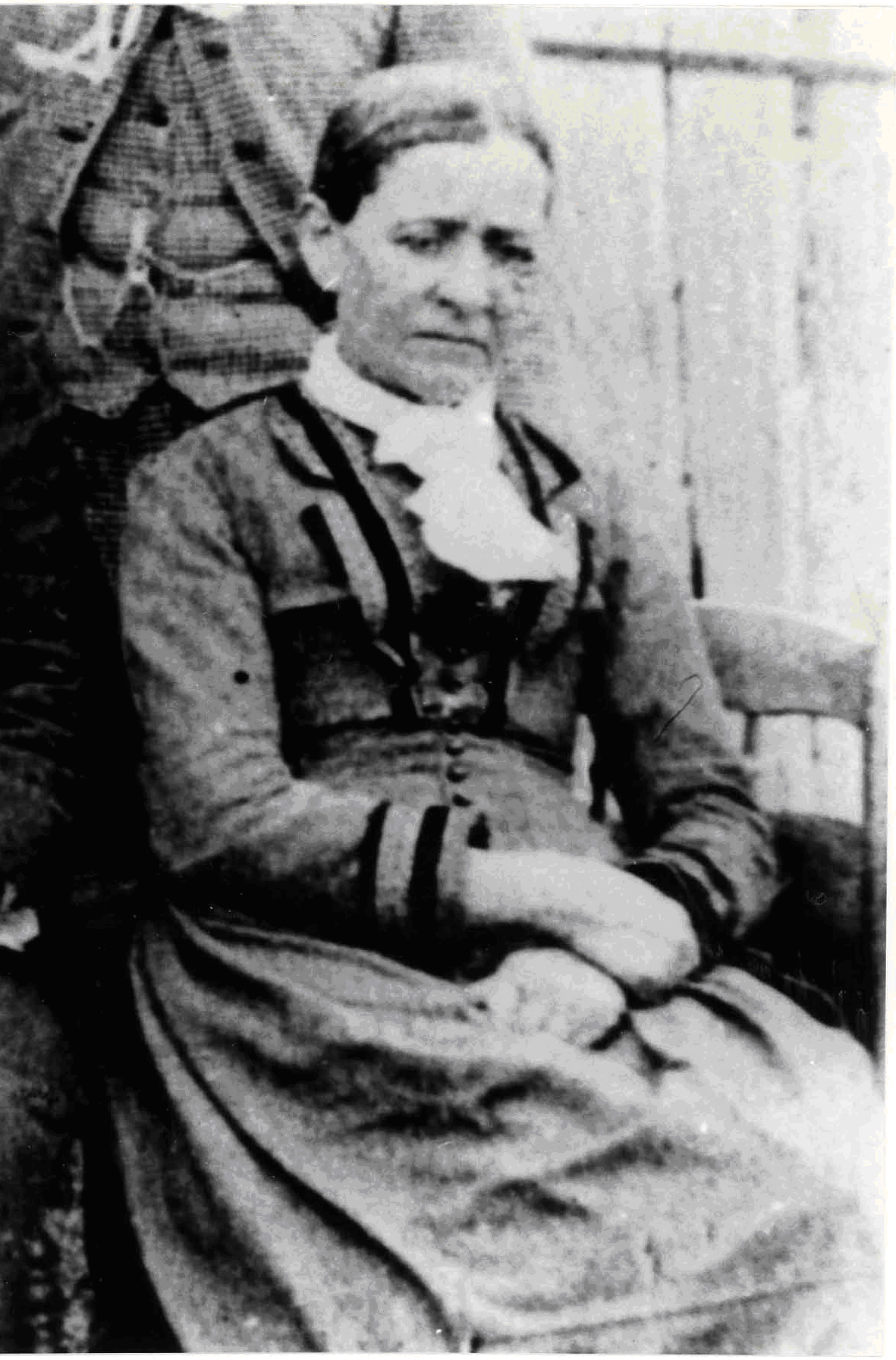 |
| THE ARRIVAL |
From Hamburg the ship "CAESAR"
arrived in Sydney on the twenty-ninth day
of March 1855, carrying government assisted
German immigrants, including one JOHANN JOSEF
ARNOLD and his wife EVA SUSANNAH SCHUPPEL.
JOHANN was a vinedresser or vineyard worker
and the son of Johannes and Juliana Arnold.
EVA SUSANNAH the daughter of Helena and Michael
Schuppel.
Both families were of Evangelistic faith
and came from Baden in the south of Germany,
a town called LEIMEN. The marriage of Eva
and Johann took place in Leimen on January
1st, 1852. Eva gave birth to a son Johannes
in 1853; his death is recorded, aged 11 months,
in Germany before they migrated.
The archives office in Globe Street, Sydney, reel 2469, shows the arrival 'logue of the ship "Caesar" but the film is not too clear.
I learned that the Caesar arrived on 19th March, 1855 at Twofold Bay.
She was the first ship to enter the bay and
here landed 56 of the intended 77 passengers.
The remaining eleven had died on the voyage.
After lying in quarantine in Twofold Bay
for several days she made her way up the
coast to Sydney, where Johann and Eva made
their immigration declaration.
Finding no work in Sydney, they travelled
back down the coast to Eden on Twofold Bay
on a coastal steamer and proceeded to travel
over the mountain by bullock wagon a journey
of thirteen days; this journey was relived
to son George and his wife Sarah and passed
on to their children. Here Johann obtained
his first job in Australia as a labourer
on the sheep station Wambrook, near Cooma.
Society of Australian Genealogists reel 3771... On arrival in Sydney the age of Johann
as twenty-eight and Susannah as twenty-three
years is recorded. Both husband and wife
are able to read and write. Eva Susannah
stated on her immigration entry that she
has an Uncle Leonard Koller living in the
colony.
Johann Umbach and his family including two-year-old
Valentin also arrived on the ship. Fauldine
or Valentin as he was called, later married
Ellen Atkins, eldest sister of my grandmother
Sarah Atkins Arnold, and the Umbach Family
became our cousins. The fourth child, Val
Umbach, had two sons, and Stan, who became
close friends as well as cousins with my
father Frank Arnold
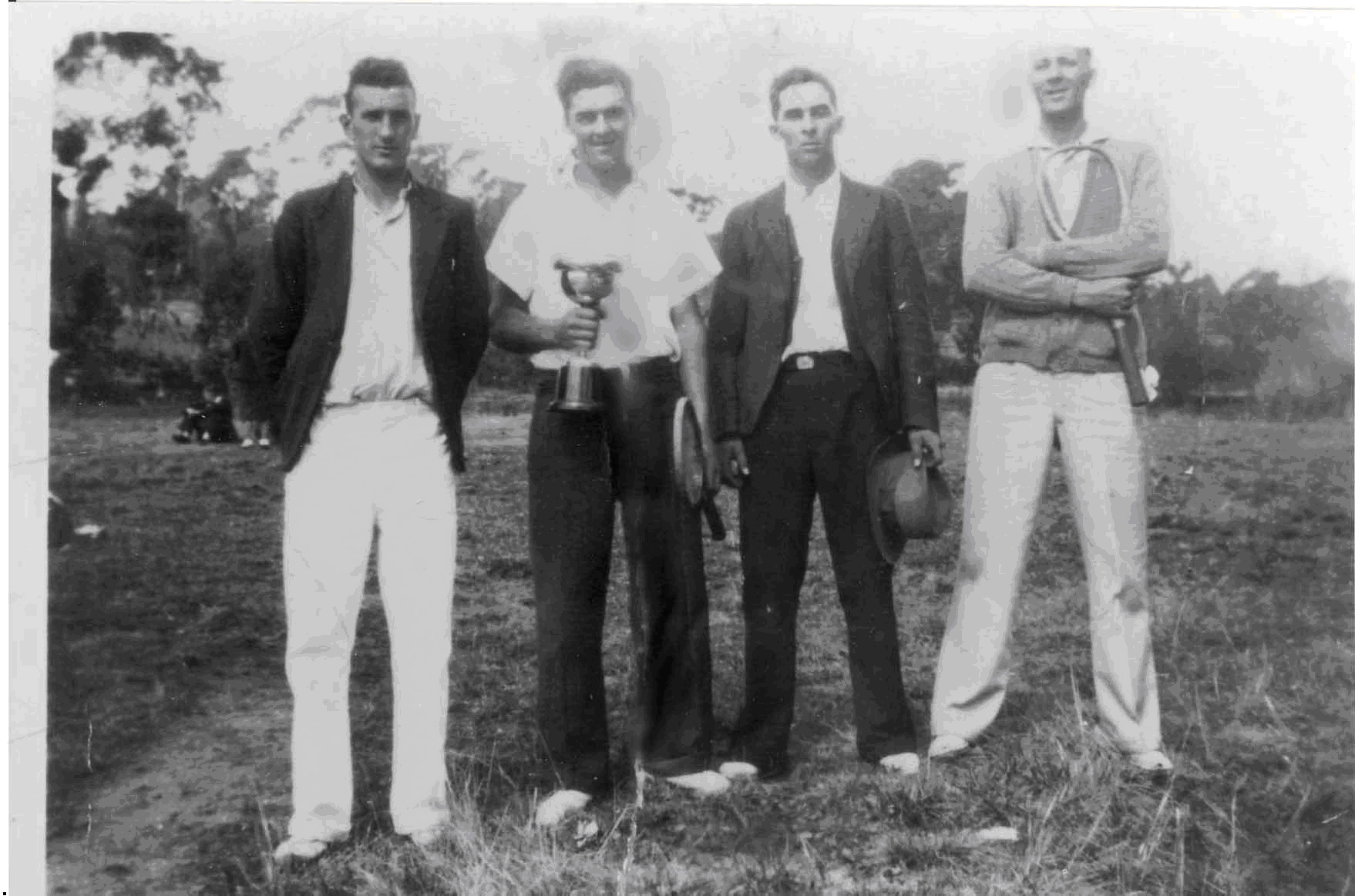 |
| Jim Brownlie, Geoff and Stan Umbach with Frank Arnold c. 1935 |
Burchard Frerichs, a merchant and grazier
from Bremen, Germany, and now landholder
of a property in Monaro (then called Maneroo)
travelled to Germany in 1852 and applied
for three families of vinedressers from the
1855 intake of immigrants. The Arnold's were
not named as one of these families but we
do know that Johann was employed on Wambrook
as a labourer when their first Australian
born child, Selena, was born a year later
in April 1856.
I learned that Eva's brother Georg Jacob
Schuppel migrated to Australia in 1855. He
arrived in Moreton Bay on the ship "Marbs" and in reference to family in the colony,
he stated that his uncle Leonhard Koller
was in Sydney.
Charles Nicholson, a prominent land holder
of the time, was named on the immigration
declaration as sponsor to Johann, and responsible
for providing him with work. It is not clear
why Johann did not go to one of his properties
to work, maybe Nicholson was in Sydney or
Johann and Eva were to meet Eva's uncle Leonhard
here.
| THE VOYAGE |
On the 15th November 1854, aboard the "Caesar", seventy families departed Hamburg and left
their homeland Germany, to start a new life
in Australia. There was a total of 293 passengers,
assisted immigrants and thirteen crew on
a baroque of only 438 tons, from a passenger
"far too many for the size of the ship."
Ahead lay thirteen thousand miles of ocean,
which was to take more than four months to
navigate and to cost many lives from fever
and disease.
Rough seas hit the ship early in the voyage
causing much sea sickness and then about
a month later cholera was blamed for an outbreak
of dysentery and fever. Some passengers died
after only a few hours illness, a total of
74 as far as can be determined from the records
available. The captain, Johann Sturtje and
his crew did their best to help the unfortunate
victims and to keep them busy, several of
the men set about making burial bags for
the burials at sea. Complaints were made
by the passengers against the doctor and
an inquiry was ordered by the Australian
Immigration Department into the conditions
on board the vessel. The report from the
Colonial Secretary's Papers found that the
vessel was not fitted in a manner proper
for the conveyance of passengers and there
was not enough accommodation or exercise
areas on the ship.
It was also reported that there were no water
closets (toilets) on the "tween decks"
where more than 160 people were berthed.
The floors of the 'tween decks were of a
temporary nature allowing access of odours
from the hold and effluent from illness through
onto the water and food. There were no windows
and not enough ventilation.
*AO shipping records and Colonial Secretaries
report give different figures on the number
of passengers and the number of deaths.
Contaminated Water was so bad that the surgeon
reported to the committee that he felt it
necessary to restrict the amount of water
for ration to each person to 1 pint per day.
It was possible that this was the major source
of infection.
Recommendations were made that stricter
regulations on sanitation be enforced and
the number of small children on board immigrant
ships be regulated. ref:Colonial Secretaries report on German
immigration 1855.
It was recommended that German Immigrant
ships to Australia be governed by the same
regulations as British ships. Documentation
from Hamburg showed that all German regulations
were obeyed in the fitting of the ship for
passengers before it left Hamburg. These
regulations were not adequate to prevent
disease or to satisfy British authorities.
The investigative committee found no fault
with the doctor's qualifications or methods
of treatment. It was reported that more than
100 people were suffering the disease after
just a few days at sea.
Blame for the outbreak of disease was thought
to be the lack of sanitation and difficulty
in isolating the disease because of the numerous
children on board. Investigations revealed
that the doctor had done everything possible
under the circumstances and that there was
no negligence on his part.
One of the passengers by the name of Gotts
kept a diary of the fateful journey as he
had lost two children on the voyage. Much
of this diary has now been translated by
Jenny Paterson and a summary appears in a
book of the life of the Umback family written
by Kevin Umback.
I was fortunate enough to meet Kevin in 1996
and he gave me a copy of his book.
| WHY DID THEY COME |
Wages were low and taxes very high and there
was much political and religious unrest in
Germany in 1850. Advertisements were appearing
in the major cities for migrants to the Colony
of New South Wales. Government assistance
was offered and jobs promised for German
families willing to help farm the new colony.
Also at this time, 1853, a man named James
Manning leased a large property at Taylor's
Flat called Cathcart. He and his brother
also had other holdings in the Bombala area
including some interest in Kameruka Estate.
Manning was educated in Europe and during
this time gained much respect for the German
vineyard workers. He admired their tenacity
and their industrious nature.
Arrangements were made by Manning to bring
a number of German families to Twofold Bay
by ship and he would meet them and arrange
guides to take them to jobs on Kameruka Estate.
Eva Schuppel's uncle was one of the men that
Manning had promised work. Maybe this was
the reason that Johann also decided to migrate
to Australia.
NATURALIZATION
Whilst working at the Gunning Grach sheep
station Johann was naturalized, on the thirteenth
of September, 1871. His certificate of naturalization
shows that he was 44 years old and that he
was a shepherd, his name was Anglicized and
he became John Joseph Arnold. At this time
my grandfather George Arnold would only have
been four years old, the eldest living son,
Henry, would have been eleven.
THE TOWAMBA DISTRICT
From the newspaper, 'Pambula Voice'...........
"Many years ago the area from Rocky
Hall to Twofold Bay, Eden, comprised of an
enormous sheep station owned by a man by
the name of Walker. It was known as the Pussy
Cat Station. The general character of the
country consisted of rich grassy flats of
fertile black soil. Towamba Valley was perfect
farming land with a river running through
to supply all the water necessary.
"Pussy Cat" was sold to Sir William
Manning and a Mr.Stiles for a cattle run
about 1830. Early records show that this
was one of the earliest settlement areas
in the Colony of New South Wales. Later the
properties were sold to other settlers and
the township of Towamba grew to include a
school and hotel and many businesses."
It was to this locality that Johann Josef
Arnold and his wife Eva Susannah were to
settle and raise their family. Their wanderings
can be traced through the birth records of
their children, most of the research of this
period was done by Annette (Muffy) Hedges
who is the granddaughter of Wally Arnold,
one of George Arnold's sons. It was her research
also that brought us the records from Germany.
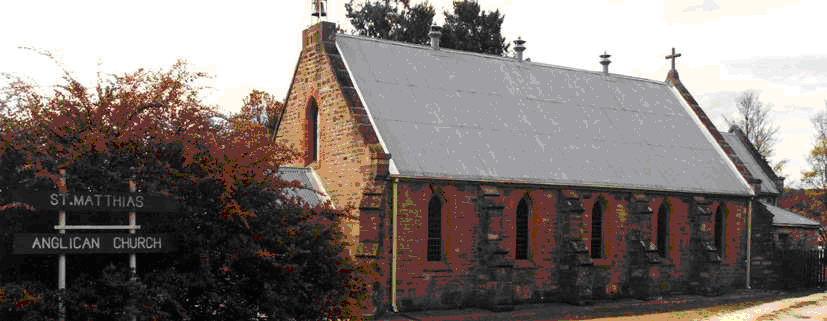 |
| The baptisms of the children of Johann Josef
Arnold and his wife Eva can be found in the records of this Anglican church of St. Matthias in Bombala |
CHILDREN OF JOHANN JOSEF ARNOLD AND EVA SUSANNAH
JOHANNES, was born in Germany in 1853 and
died in the same year aged 11 months.
SELENA, (Colina in the records) first Australian
born child, 1856, at WAMBROOK COOMA married
James Collins. She had twelve children and
died in 1932 aged 76 years.
MARY, 1858, was born at WOOLWAY STATION,
COOMA. She married Joseph Carveth and had
two children. She died in 1941 aged 84 years.
HENRY, 1860, first surviving son, was born
at BURNINA STATION, BOMBALA. He left home
in 1885 to join the army. He married Julia
Merritt 1891 who died soon after their marriage.
His second marriage to Mary Susan Anderson
produced one son, William. He died in 1930
aged 70 years.
JOHN ARNOLD ARNOLD, 1862, in the baptism
record he carried the surname also as a Christian
name, Born in BOMBALA. He married Annie McEwen
and died in 1955. No known children.
WILLIAM,1864, born CAMBALONG STATION, BOMBALA.
He married Esther Collins and they had five
children. He died in 1959 aged 95.
GEORGE, 7th January, 1867, at BACK CREEK,
BOMBALA. Married Sarah Atkins and they had
fourteen children. He died in 1940 aged 74
years.
MARTIN,1869. Born in BOMBALA. He married
Agnes Barnes and they had four sons. He was
accidentally killed at work in Queensland
in 1915, just before the birth of his fourth
son.
JOSEPH, 1871, GUNNING GRACH, BOMBALA. He
married Merab Kent and they had six children.
He died in 1965, aged 93 years.
Children of Johann Joseph and Eva Schuppel
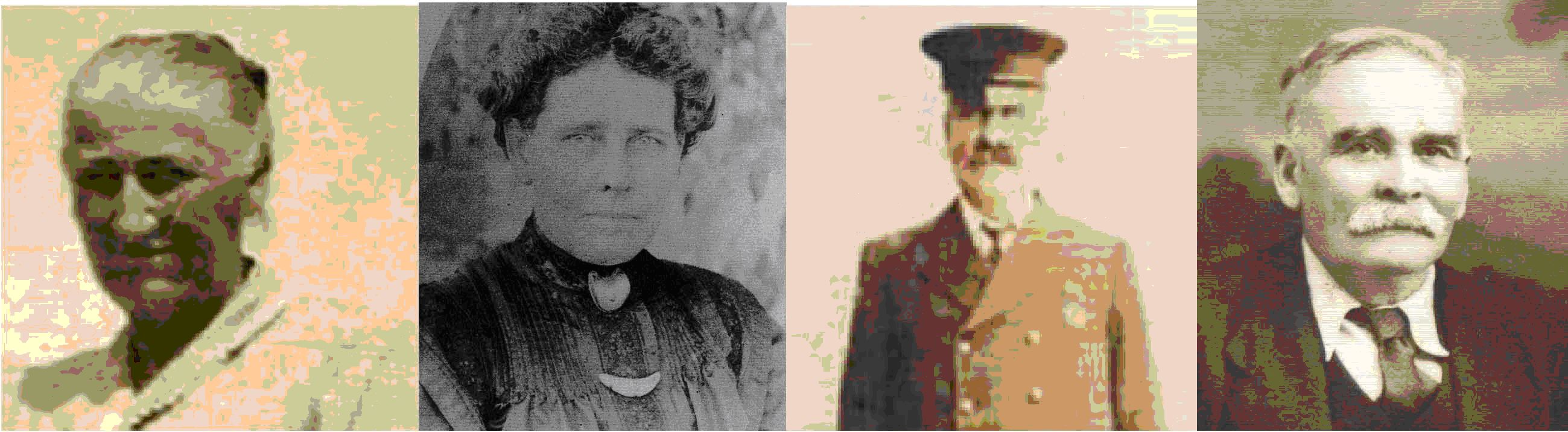 |
| Selena, Mary, Henry (Harry), John (Jack) |
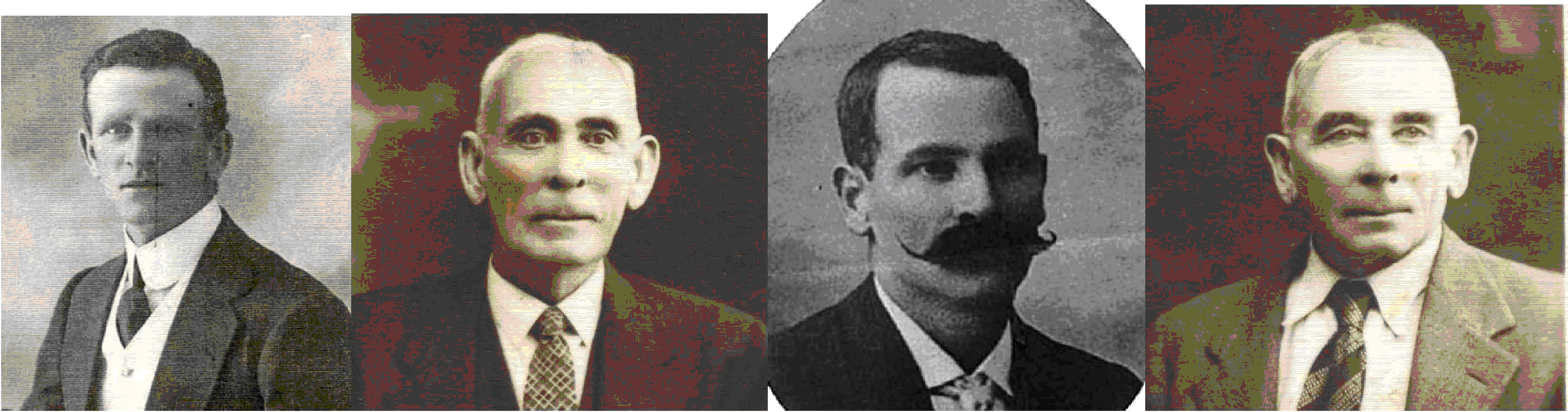 |
| George, William (Bill), Martin, Joseph |
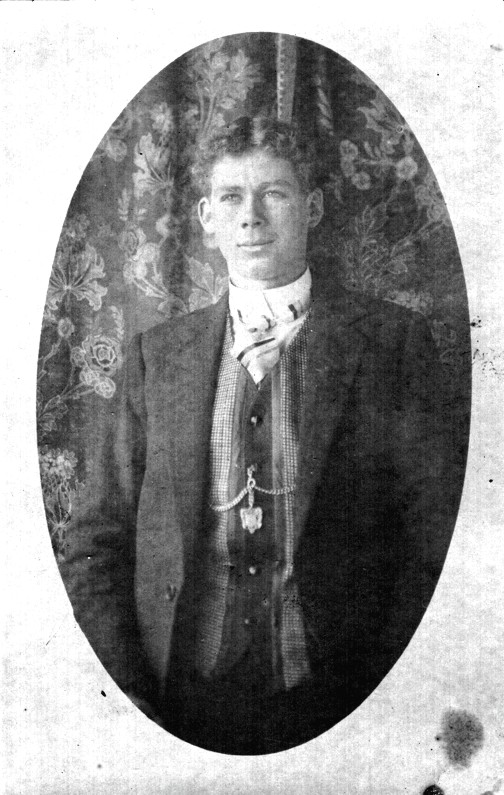 |
| Billy Arnold |
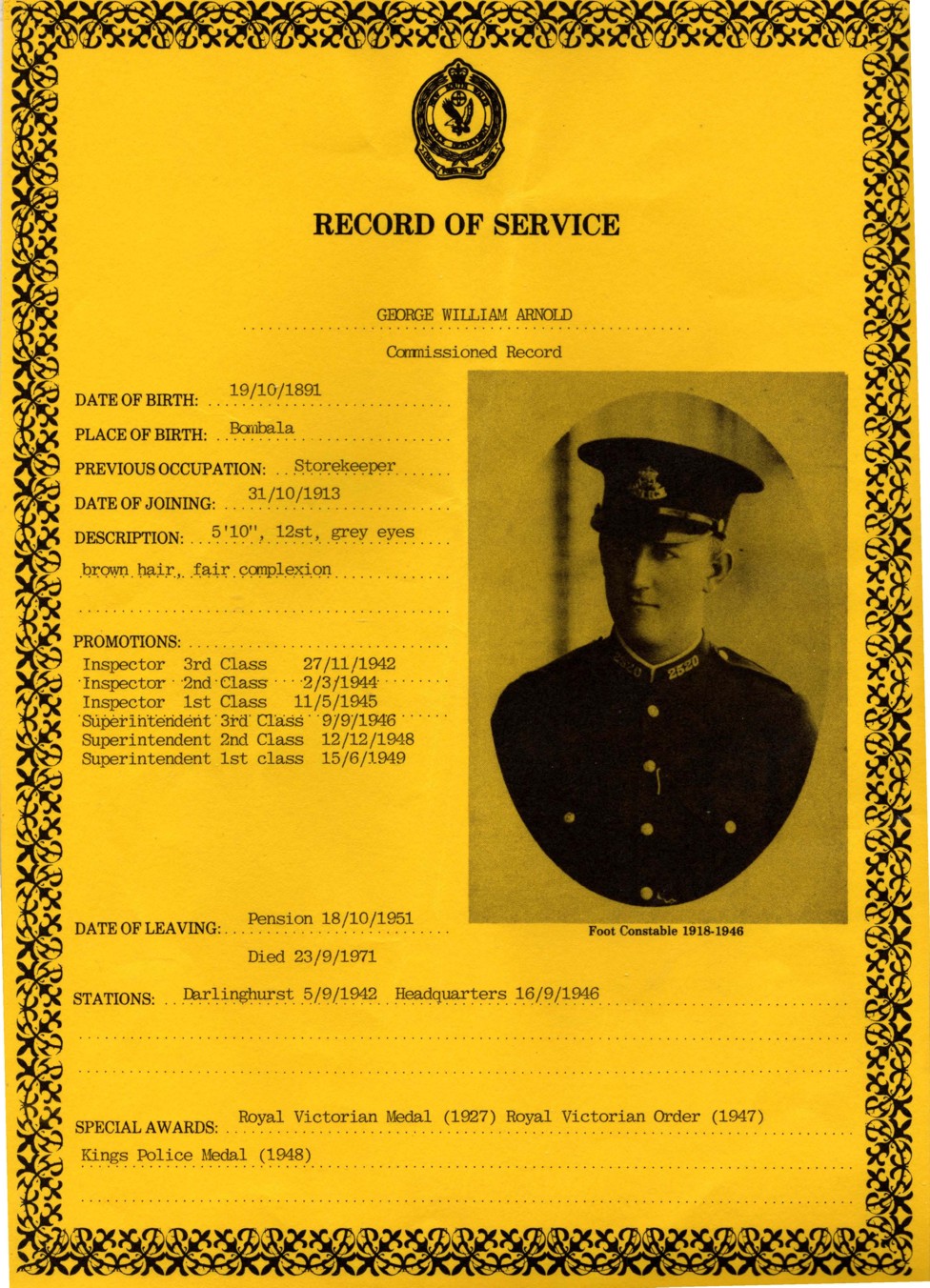 |
 |
| GEORGE ARNOLD |
George was the seventh child born to John
Joseph and Eva Susannah. He was born on the
17th January, 1867, on the property Back
Creek in Bombala, N.S.W. At the time of his
birth his father who was 39 years old was
working as a shepherd on the sheep station,
his mother was 35.
Selina was the eldest living child, she
was ten years old when George was born. Mary,
the second girl was eight. Henry, six years,
John jnr. four years, and William, then the
baby, was two. Education of the children
in the district was left to parents until
the first school in Bombala was built in
1863.
The Bombala school opened in 1864 with a
war between the Anglican Rector of St. Matthias
Church and the new school teacher. Reverend
John Steele was upset by the new school master's
lecture advising parents to send their children
to school instead of to the church to be
educated. He accused the Education Department
of being a den of evil and that the teachers
were "Sons of Satin" sent to further
his kingdom. Letters in the Education Department
archives record the long bitter quarrel until
finally in December, 1864, Mr James Poulton,
the master, asked to be relocated as his
family could take no more of the abuse.
The marriage of George, aged 22 years, with
Sarah Atkins was celebrated at the home of
Sarah's parents, James Atkins and Mary at
Maharatta near Bombala, on the 16th October,
1889.
A wedding photograph shows George's mother
Eva is present and a second woman in the
photograph would have been Sarah's mother,
Mary Neal Atkins. Bridesmaid Annie Atkins,
Sarah's youngest sister is also visible but
the heads of the men in the photograph, except
for the groom are not visible. I have not
been able to find the source of the original
photograph.
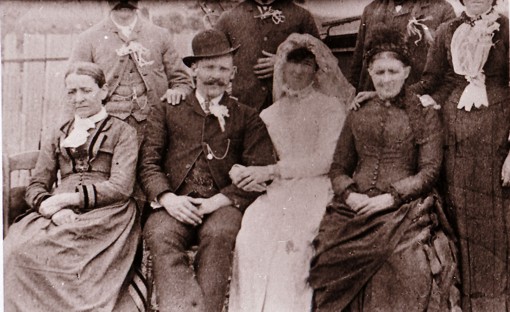 |
| The Wedding photograph of George Arnold and Sarah Atkins 1889 |
| ROCKY HALL |
Here my research continues with the aid of
a local newspaper "THE PAMBULA VOICE".
It records a little of the life of the Arnold
Family after John died from 1893 until 1905.
Apparently George and Sarah lived with his
mother and helped her run the Rocky Hall
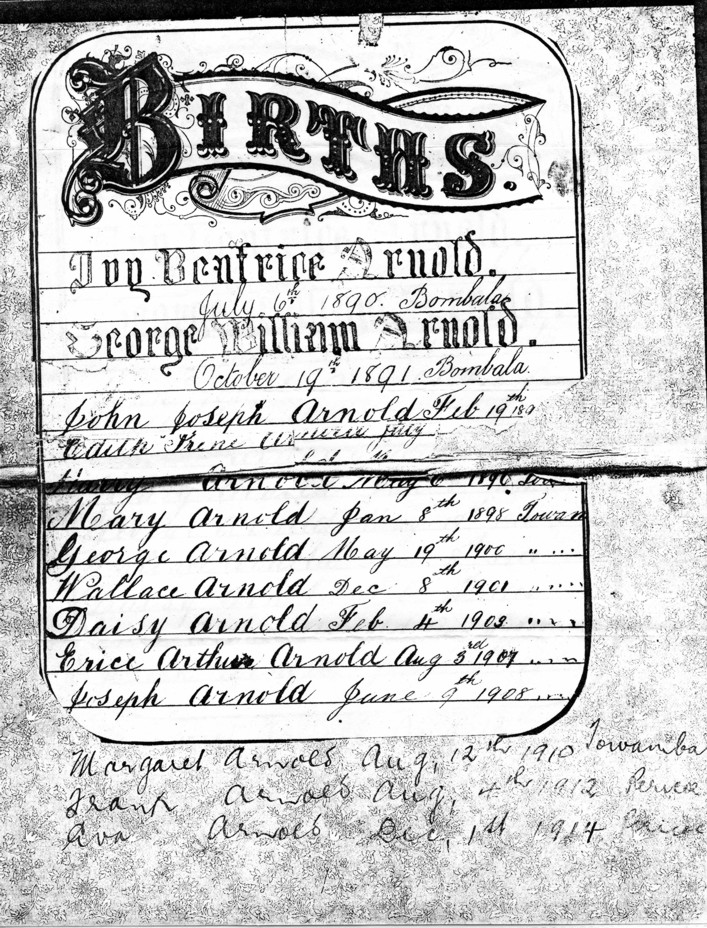
HoteI. Ivy, the first child of Sarah and
George, was born in Bombala in 1890. Second
child George William, known as Bill was born
also in Bombala in 1891. On the 15th February,
1893, a third child of George and Sarah,
John Arnold Arnold, was born. The family
tradition of carrying the surname as a Christian
name was continued from George's brother,
John Arnold Arnold
John Joseph Arnold died in Bombala, New
South Wales (on the same day that Sarah gave
birth to her son John, on February 13th,
1893) at the age of 65 years with the cause
of death given as "senile decay".
He is buried in the Bombala Anglican Cemetery.
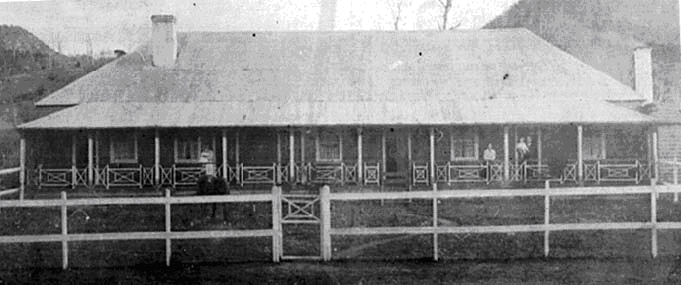 |
| Rocky Hall Pub |
HOTEL FIRE AT THE ROCKY HALL 9TH MARCH 1894
The Big Jack Hotel was totally destroyed
by fire early on Saturday morning. About
half past four in the morning, some of the
inmates were awakened by an unusual noise
and getting out of bed and looking for a
cause were dismayed to find flames bursting
forth from the western end of the building,
which portion was unoccupied at the time.
The remaining occupants were quickly aroused
and several neighbours were soon on the spot,
but it was at once seen that any hope of
saving the building with the crude appliances
at hand was out of the question, as the fire
had too firm a hold on the light structure,
the pine and canvas lining providing excellent
fuel to feed the hungry flames. Not a breath
of wind was stirring, but in a very short
time the hotel was destroyed except for the
kitchen and the brick chimneys. The majority
of the furniture and all the beer and spirits
with the exception of a few casks of spirit
was lost. Mrs Arnold and son Joe, lost several
small articles, watches ornaments and the
account books. No clue as to the origin of
the fire is obtained so far but four police
are seeking evidence for an inquest to be
held during the week. The furniture and stock
was insured.
(a year has passed and I discovered the following
articles under the heading Towamba. A daughter
Edith Irene was born to George & Sarah
on 19th July, 1895, in Bombala
TOWAMBA AUGUST 2nd, 1895
Licensee of the Towamba hotel has vacated
the hostelry before the expiration of his
lease, owing to dull times. He is now renting
the Church of England grounds to start a
butcher's shop. It is hoped that he won't
turn the church into a butcher's shop.
TOWAMBA SEPTEMBER, 1895.
Catering for the Cricketer's Ball on 30th
August was done by Mrs Eva Arnold of the
Towamba Hotel in a manner that showed the
lady is no novice in the field,
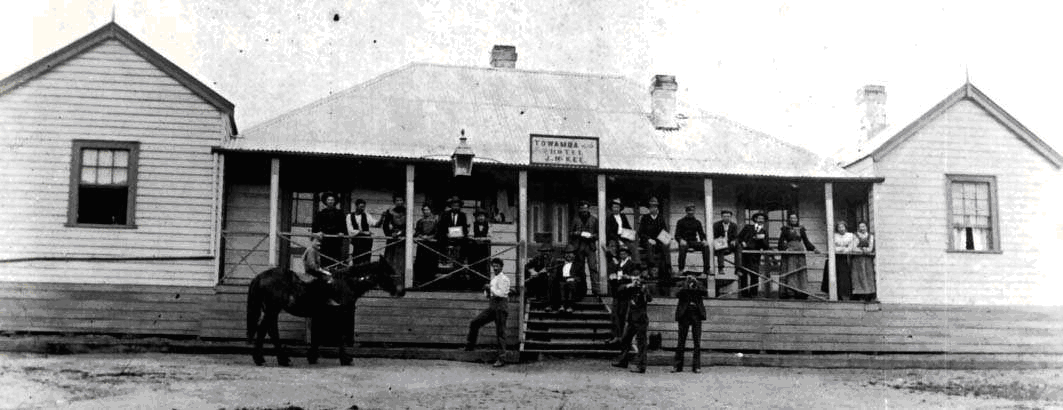 |
| Towamba Hotel |
TOWAMBA DECEMBER 20th, 1985
Mrs Arnold was at the dance wearing a black
dress
TOWAMBA JAN 8th, 1896
Mr Joe Arnold had a publican's booth at
the New Years Day races and he did a good
trade.
TOWAMBA APRIL 8th, 1896
On a list of donors for a sick , widow the
name appears of George Arnold with a donation
of 2/6
TOWAMBA JUNE 26th, 1896
........... the meeting was held at the Arnold's
Hotel.
(This entry is the first referring to the
hotel as that of George Arnold, not his mother,
during the next few years I could not find
any entries for the family. Birth records
show that two more children were born, Henry
or Harry as he was called in 1897 and Mary
Ellen 1899).
TOWAMBA MARCH 1st, 1901
A banquet was held at Mr George Arnold's
hotel
(Wallace James Arnold was born 18th December,
1900 and George Jnr, May, 1902) FEBRUARY
13th, 1903, Brother George Arnold was made
an officer of the Oddfellows
TOWAMBA JANUARY 29th, 1904
Mr & Mrs George Arnold of the Towamba
Hotel suffered the loss of an infant daughter.
(Daisy was born to George & Sarah on
6th September,1903 in Towamba, she died on
15th January, 1904,cause of death given as
convulsions, maybe this too was due to epilepsy)
TOWAMBA NOVEMBER, 1904
Mrs George Arnold had a very narrow escape
from being bitten by a black snake on Monday
14th. On going into the kitchen of the hotel
for some water she found a "Tempter
of Eve" coiled around the bottom of
the bucket. Mrs Arnold had hold of the bucket
before she saw the brute, which on being
disturbed rushed between her feet. Her screams
brought her daughter Ivy, who ran after the
reptile which finally got under the kitchen
floor. Mr Arnold lifted most of the floor
boards and succeeded in killing the serpent
which proved to be five feet eleven inches
long and a perfect specimen of the black
snake order.
TOWAMBA FEBRUARY 3rd, 1905
The goodwill of the Towamba hotel is for
sale due to the ill health of Mrs Sarah Arnold
TOWAMBA FEBRUARY 20th, 1905
Miss Ivy Arnold wore a beautiful white gown
to the ball
TOWAMBA MARCH 3rd, 1905
Mrs George Arnold was taken to Bega hospital.
TOWAMBA MARCH 17th, 1905
The sale of the Towamba hotel has fallen
through.
TOWAMBA APRIL 7th, 1905
Mrs George Arnold is is still in Bega Hospital
but her condition is improved.
TOWAMBA APRIL 21st, 1905
Mr Arnold, who has been unsuccessful in
disposing of his business, has made a deal
finally with Mr Joseph McKee. He is to take
possession of the hotel on the 1st of next
month. Mr. McKee was the former licensee
of the Pambula Royal Hotel where George and
his sister Mary worked and learned the hotel
trade.
TOWAMBA JULY 21st, 1905
I am informed that Mrs. George Arnold's youngest
sister died last week leaving a husband and
young family to mourn her loss.
(Annie Atkins Wiles died in childbirth with
the seventh boy. Her young family 's ages
ranged from eleven years. Annie is in George
& Sarah 's wedding photograph. She was
their bridesmaid. )
SALE OF TOWAMBA HOTEL
TOWAMBA JULY 21st, 1905
On Monday 10th, Mr George Arnold, who for
eight years had been publican of our hotel
and who through a series of misfortunes was
compelled to give up the business. He was
banquetted if I may so put it, and presented
with a purse of sovereigns. Toasts of the
evening were as follows:
The King ...Mr Solomon The Guest of the Evening..
Mr Solomon
The State we live in ... Mr Solomon
The Dairying Industry... Mr P.Alexander
The District ... Mr John Dickie
The Press ... Mr R. Alexander
The Visitors .......... Mr J Ryan
The Ladies ........... Mr P. Alexander
Mr G Martin presented the purse of sovereigns.
The guest of the evening, Mr George Arnold,
touchingly thanked his many friends for their
expressions and goodwill and for the manner
in which it was expressed. He said he always
had tried to do his best in attempting to
advance the place and it gave him great pleasure
to know that his efforts were appreciated.
He earnestly trusted that the kindness expressed
and tended to him in such an open handed
manner, as on the present occasion, would
stimulate to a still better and abler energy
in good citizenship. Many expressions of
appreciation for the evening followed. The
programme was further delivered by song and
recitation. Auld Lang Syne ended a most enjoyable
evening.
Two more children, were born to Sarah &
George before they left Towamba, around 1910,
Eric in 1906 and Joseph in 1908. From the
School records at the Archives office in
Sydney I discovered a letter written by George
Arnold tendering for the cleaning of the
Towamba School cess pits. This letter is
dated October 8th, 1910 and his address given
as Towamba although Margaret Ann Arnold was
born on 12th August, 1910 and her birthplace
given as Pericoe. I can only assume that
George & Sarah moved to Pericoe about
this time. Mrs Elton the Midwife lived at
Pericoe and maybe baby Margaret was born
there.
A photograph handed down from Margaret Arnold
shows a bridge being built over the Towamba
River. Records show that this bridge was
built in 1909 and washed away in a flood
in 1919. The photograph now appears in a
book by Bernard Cornell, called 'Most Obedient
Servants' on education in the Monaro district.
PERICOE 1910-1940
George Arnold was given a job as manager
of the Pericoe Post Office station of Alf
Alexander, where he lived until 1940. Here
his children, Margaret, 1910, Frank 1912
& Eva 1914, were born and later in 1935
and 1938, Lola & Gordon George, the children
of Frank Arnold and Joyce Holdsworth were
also born at Pericoe. Gordon George so named
as he was born on his Grandfather's birthday.
A small one-teacher school of rather colourful
history provided education for the children
in the Pericoe district. It was dedicated
in 1883 after many petitions from farmers.
The records at the Sydney Archives Office
in Globe Street, tell a story of complaints
from teachers, of children who would not
attend classes and of parents who would not
pay fees or send children to school and of
teachers who took regular sick leave for
stress. Parents complained of child abuse
by teachers.
The names of the younger Arnold children
appear on the school records, Joe, Margaret,
Frank and Eva until the school closed in
1918 . There are many letters of petition
for the re opening of the school in the records
but this did not happen until 1921, and closed
again in 1922, a petition dated 1923 shows
the ages of Joseph 13, Frank 11 ,Margaret
12, and Eva 9. These children had to rely
on their parents for most of their education,
however, Eva the youngest, was finally sent
to Dapto to her brother Wally to attend school.
As soon as she was old enough to leave school
Eva went to live at Bondi with Mary her elder
sister where she commenced work for David
Jones. Margaret went to Sydney to work with
Sargents, a large catering firm where sister
Edith was working. Later Eva and Margaret
rented a flat at Bondi Beach where they lived
until their marriages in 1945 and 1946.
Billy Hughes, a politician of the time encouraged
Bill Arnold, the eldest son, to go to Sydney
and make a career in the Police Force. Jack
Arnold also became a policeman. Bill rose
to Inspector and then to Superintendent.
Jack to Sergeant. Both men married and had
families in Sydney. Wally Arnold built a
career for himself in the Fire Brigade at
Dapto on the south coast of New South Wales.
He rose to Fire Chief and was highly decorated
for his work.
Henry or Harry, as he was called, was an
epileptic and as this was an untreatable
condition in those days, he was committed
to an asylum at Orange in 1918, aged seventeen,
and then Callan Park where he died aged 30.
His medical records are in our family history
collection.
Joe Arnold married a local girl Jean Gates
and went to live in Sydney. They had three
children, John Joseph, Patricia Maria, and
Hilary Clare. While the children were still
babies Jean contracted pneumonia and died
in a Sydney Hospital. The children were separated
and raised by relatives until Joe remarried
in 1940. Pat and Clare went to live with
their father and stepmother but John stayed
with his mothers family and grew up in Copmanhurst
near Grafton.
Frank stayed at home with his parents and
helped them run the Pericoe property and
supplemented his income with casual work
of stripping wattle bark for tanning and
catching rabbits for skins. Here he met Joyce
Holdsworth, whom he married, and they raised
their two children at Pericoe until 1940.
George Arnold loved his farm where he had
some dairy cattle and pigs, as well as sheep
and, of course, horses. Again I can remember
a few instances on the farm. Mainly with
Grandfather, whom Gordon and I both adored.
He made me a tiny stool so that I could help
him make the tarts for the dances and other
functions that he loved to cook for. We had
a wonderful vegetable garden and here we
would both work with him. I think this is
where both Gordon and I inherited our love
for the garden and most likely where my catering
genes came from.
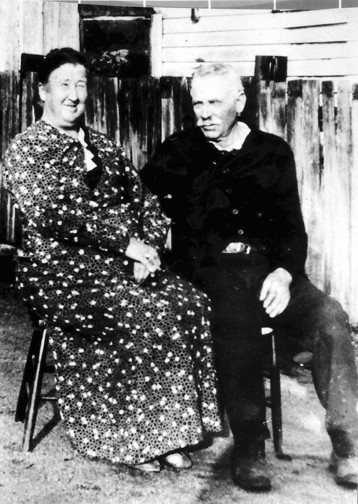 |
| George and Sarah Arnold at Pericoe, 1939 |
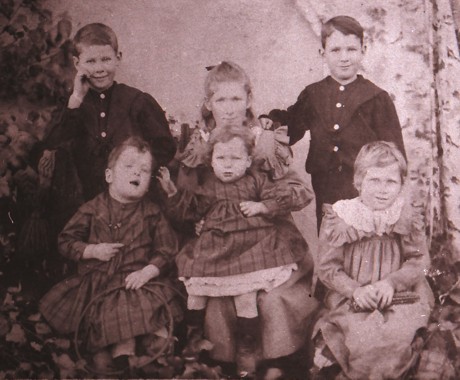 |
| The first six children of George and Sarah |
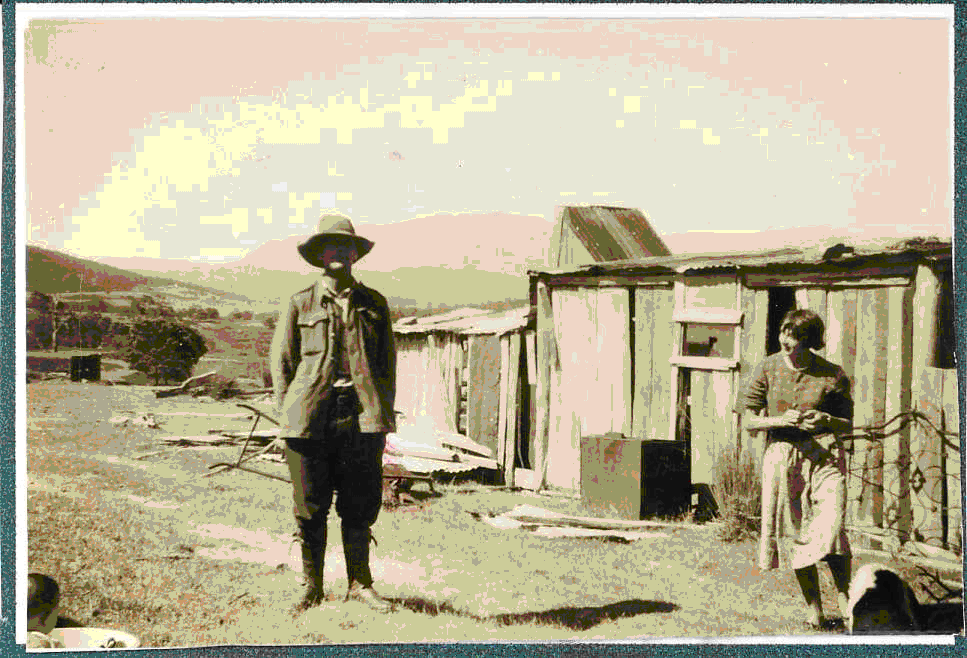 |
| Lola Workman and Wilf Ingram, Pericoe 1956 |
Note: Lola & Ted Workman returned to
Pericoe in 1957 and whilst rummaging around
where the old homestead once stood, Wilf
Ingram came riding over the hill. He spoke
of this meeting some thirty years later when
writing to Tina McCarthy about this page
from his book.
BLACK WEDNESDAY
Again the newspapers of the day tell the
story...
THE SYDNEY MORNING HERALD Wednesday, January
11th, 1939
The Victorian bushfires continue to ravish
the country....Bega on the south coast was
encircled by flame yesterday. A residence
at Pericoe about 40 miles from the town was
destroyed, and others are in grave danger.
THE SYDNEY MORNING HERALD Thursday, January
12th, 1939
The homes of six families were destroyed
yesterday in the Bega district. Those whose
homes were lost include Messrs. L King, South,
Wilfred Ingram and George Arnold. Mr Arnold
lost everything he possessed except the clothes
he and his family were wearing. At Pericoe
and Towamba, 27 men women and children are
homeless. The school building was also destroyed.
LOLA REMEMBERS....
Dad was away fighting the fires and we could
see the dark sky and it was early morning.
I remember it was so hot and all you could
smell was the fire. I don't remember Dad
returning home but Mum tells me that he came
home from fighting the fires early in the
morning and told the family that there was
no hope of stopping the fire. He then took
us, Grandmother Arnold, Mum and Gordon and
me to the river which wasn't very far from
the house. Other neighbours women and children
were there in the river also. Grandmother
Sarah was a big lady, of seventeen stone
and as it was difficult for her to sit in
the river, I remember Dad going back to the
house to get a kitchen chair so that she
would be more comfortable.
After settling us Dad returned to the house
to try and get some clothes and other things
before the fire reached the house. He rescued
quite a few things including what he thought
to be a case of baby clothes, but turned
out to be a case of sewing materials. He
saved my celluloid doll and put it with the
goods out of the fire's reach. We all stayed
in the river and the fire came over and passed
and the house was saved. The fire surrounded
us and we could see the flames leaping to
the sky. The dress of one of the young Laing
girls, about fourteen, caught alight and
mum ripped it off her and then took off her
petticoat to give the girl to wear. We had
wet blankets over our heads so that we could
breath. There were lizards and a snake in
the water near us and a tiny bird perched
in granny Arnold's hair, to us kids it was
an exciting adventure. Then everything changed!
In the afternoon the southerly wind came
and brought the flames back down from Mt.Imlay.
Flames caught the willows behind us, and
swept straight towards the homestead where
a spark caught the open hay loft where Dad
and Grandfather were, they tried to save
the house but the wind was too strong and
Dad was hit by a burning beam and badly burnt.
The celluloid doll exploded with the heat
and set alight all the clothes and goods
that had been saved from the house. Our horse
was near us at the river, when a fireball
hit the horse and it caught alight. ....
It ran around and around in circles until
the poor thing collapsed in a heap on the
ground.
Trauma seems to have obliterated my memory
of the remainder of that day. Mum has been
able to fill the gaps for me... the Galea
family was in the creek with us and when
all the men returned to take us from the
creek, Mr Galea was missing, however he had
been trapped behind the fire and later returned
safely. Alf Alexander's home was spared and
he took Sarah & George Arnold there until
a few days later when Uncle Bill sent a car
for them to go to Bondi to daughter Mary's
home.
Uncle Joe drove Dad's car and took Mum and
Dad and Gordon and me to Wyndham to the Holdsworth
home where we stayed until Friday. There
were twelve children in the Holdsworth family
and so very little room here for more boarders.
Again Uncle Bill had arranged for us to go
to Dapto and stay with Dad's brother Wally
until we could find somewhere else to live.
FRIDAY 13th, JANUARY, 1939
The next thing I remember is being in a
car with a man driving, Mum says it was Jim
Brownlee, my uncle, with Dad, his face bandaged,
and Mum and Gordon and we were being driven
through the bushfires. Trees were alight
on both sides of the road and the car was
a tourer about 1926 with just celluloid curtains
for windows. Mum tells me that many times
Jim Brownlee would stop the car and ask Dad
if he thought we should go on or turn back.
Their decision was to continue on in the
hope that we soon would be through the fires.
Friday 13th, January, 1939, was the day most
homes were lost and several people lost their
lives in the Victorian bushfires. The Sydney
Morning Herald screamed " Black Friday"
and the temperatures were recorded at record
heats of 116 degrees Fahrenheit, however
at Wyndham the crisis had passed and Dad
thought it was now safe to take us to Dapto
to Uncle Wally's house. With Jim Brownlee
driving we set out early on Friday but as
we travelled north we again encountered the
fires.
We drove all through the fires, until we
reached a hotel in Cobargo, which still stands
in this year of 1995. It had stairs! I had
never been in a building with stairs and
I vividly remember being taken up the stairs
where I was washed, put into clean clothes
and put to bed. People of the village came
to our assistance and provided new clothes
from the local shop opposite the hotel. Dads
face badly burned, and baby Gordon's back
also burned, received attention. I had escaped
with just a small burn on my arm.
With clean clothes and a good meal and a
few hours rest we set off again for Dapto.
Travelling through blackened country we thought
we were through the fires when once again
the flames appeared and the men had to decide
whether to continue or return. Night was
now falling and I remember the look of the
whole forest alight in the dark night. Our
trip continued until flashing lights appeared
on the road at MIlton. It was the police
looking for us as the hotel at Cobargo has
notified them that we were travelling through.
We were taken to the police station where
we spent the night .
On Saturday 14th, January we arrived Dapto
where we were to stay just a short time until
three year old Lola locked Gordon, just once,
in the ice chest. This was too much for Uncle
Wally's wife who also had a handicapped child
as well as a young daughter and was not used
to a houseful of country bumkins. From here
we were taken to Mum's uncle Jim (Stormy)
Holdsworth in Wollongong where we lived for
the next few weeks.
Dad was able to get a job at Exeter helping
to rebuild the power lines destroyed in the
fires and through Uncle Wally's contacts
we were given a tiny garden cottage to live
in. I remember this wonderful garden and
how great it was to walk in the garden and
pick flowers. There was no stove but one
day Mum found the top of an old oven on a
rubbish heap and she made us a stove with
some bricks. We slept on the floor on some
hay that the produce store had given to Dad.
Soon after we arrived there Ray Linnane sent
a double innerspring mattress (something
they had never seen before) to Mum and Dad,
on the train. We had some large boxes for
tables and a few small ones for chairs and
here we lived happily after all the trauma.
After a short time here Dad was moved to
Goulburn to work and Mum, Gordon and I went
back to live with Grandmother Holdsworth
at Numbugga until Grandfather Arnold and
Uncle Joe and some of our neighbours built
a temporary residence again at Pericoe, where
we lived until May of 1940 when Uncle Bill
sent Ray Linnane in a Buick to bring the
family to live in Sydney.
NORTH ROCKS ROAD,
CARLINGFORD
My next memory is the arrival at Carlingford.
Grandmother and Grandfather Arnold were with
us and we arrived on a winter's evening in
May. The fire was burning in the large open
fireplace in the lounge room and the neighbours
had prepared a supper for us.
I
had never seen such beautiful cups and plates
and I remember thinking how rich we must
be now that we lived in Sydney and had such
beautiful china. The house was furnished
with a large cane lounge and a sideboard
that the cups and plates were set on; there
were lovely patty cakes and little sandwiches.
It was a modern house on five acres of land
at Carlingford, on North Rocks Road, next
door to the cemetery. A hall ran from a closed
in verandah across the front of the house,
through the centre of the house, past two
bedrooms, one on either side of the hall.
Our grandparents had one bedroom and Mum
and Dad had the other room. Behind the bedrooms
a large lounge room opened from the hall
and on the other side was the kitchen with
a Bega fuel stove with a green enamel door.
I had only seen black stoves before and I
thought this was wonderful. On the other
side of the kitchen was a small dining room
with a dining room suite! and across the
hall from the dining room behind the lounge
room was my bedroom and Gordon's cot. In
the hallway, outside my bedroom, stood a
wonder of the day; an ice chest. Then down
a few steps and there was a large laundry
with a fuel copper and tubs and a large galvanised
iron bath tub. This was the first bathroom
I had ever seen, under the same roof as the
house. Down a long path was the "Dunny"
near the chook yard. Later when Gordon grew
up he had a bed at the end of the closed
in verandah.
Grandfather made a large vegetable garden,
I remember Gordon and I helping to sow the
potatoes, and Mum liked to garden too, she
made a herb garden near the tap where we
had fresh thyme, sage, mint and shallots.
The chook run had a passionfruit vine and
we had lots of fruit trees.
The year was 1940 and in September, Grandfather
got pneumonia and was taken to hospital,
he seemed to recover and was sent home, but
collapsed soon after and died. Mum says that
he never adjusted to leaving Pericoe and
his farm and just didn't want to live. I
was now almost five years old and I thought
I was old enough to go to the funeral, but
the big people wouldn't let me go. Gordon
was born on Grandfather's seventy-second
birthday and he went everywhere with him.
Things never ever seemed the same after Grandfather
died. Each Sunday Uncle Bill would send a
large black car to take Grandmother to the
Field of Mars cemetery where Grandfather
is buried.
Dad got a job at the Lidcombe State Hospital
as a male nurse and as it was war time, Uncle
Bill considered this an occupation where
Dad would not be called up for military service.
When Dad was working at the hospital an old
man gave him a large black opal. He had this
made into a ring and Mum wore it for years
and lost the stone from the ring in Moree
in about 1956.
Gordon was about three years old when he
developed bronchial pneumonia. At this time
there was little hope of recovery from the
infection. I remember the house was kept
dark and we had a blanket at the fireplace
to prevent draughts as this was where Gordon's
cot was so that the nurse could sleep beside
him. After what seemed a lifetime to me one
night the big people stayed up, and in the
morning they said that the crisis had passed
and the baby would live, thanks to the new
sulphur drugs.
SCHOOL AT NORTH ROCKS
I commenced school at Miss Fowler's kindergarten
school at North Rocks and later moved to
the primary school next door. When Gordon
was about five he too attended North Rocks
Primary School. There were only a few pupils
at the school when I started and we had just
one teacher for all the classes, however,
by the time that Gordon had started, there
were enough children to have an infant's
teacher. We travelled to and from school
on the bus and even though it was war time
our life as I remember it was fairly stable.
Uncle Joe Arnold and his second wife Maggie,
and their baby Shirley came to live at North
Rocks. Then nearly every year they had another
baby, so this was always something to look
forward to. Joan, Merlene, Bruce and Gary
were born at North Rocks. Pat and Clare,
Uncle Joe's children from his first marriage,
were brought to live with him to help with
the babies. They rarely got to school as
they had so much to do at home.
There was a great shortage of manpower and
Mum and Dad would work at night in the peach
orchards when we were kids to help grade
and pack the fruit. Gordon and I were taken
sometimes and we would sleep on the floor.
It was great fun as many other children of
the district were there. As we grew older
we too were taught to work the grader and
help with the packing of the peaches. In
the summer time we would all work in the
rose nurseries; Dad pruning, Mum bunching
the roses and Gordon, Pat and I earned one
shilling an hour to pick off the rose hips.
We would earn enough pocket money here to
take us to the pictures in Parramatta on
Saturdays and to have an ice cream as well.
Life was pretty good!
FRANK ARNOLD
Dad changed jobs about this time and went
to work at Parramatta jail as an overseer
in the blacksmith's shop. Uncle Joe also
worked at the jail as a warder and we would
often see him patrolling on top of the wall
at the jail as we went past in the bus. One
of the prisoners made me a wooden pencil
case with my name on it for Dad to give me
for my birthday.
After Grandfather died the vegetable garden
ceased to exist but Mum made a pretty flower
garden in front of the house, and Dad made
paths of bricks around the house. He enjoyed
working around the house, but was never a
gardener. Grandmother Arnold did most of
the cooking and this gave Mum time to sew.
She made all the clothes Gordon and I had,
including coats and trousers for Gordon and
tunics for me for school from Dad's old Police
uniform. I had my first bought dress at thirteen.
Aunty Margaret and Aunty Eva would come to
visit regularly and Aunty Mary and Aunty
Edie also came to visit Grandmother. Weekends
were always busy with large family dinners
and lots of visitors. Uncle Bill and Ray
Linnane were the most frequent and I loved
to lie in bed at night, and listen to Uncle
Bill's story of the latest murders and crimes
of the city. I remember being scared when
Norma Ginn was murdered in the Newtown cemetery.
I always ran down the cemetery lane after
that when it was getting dark.
We became great friends with Stan Coates
the gravedigger. He saved the ribbons from
the wreaths for me for hair ribbons. As it
was wartime ribbon could not be easily bought,
but I always had enough for my cousins and
myself. Lace was another scarce product during
the war, but Grandmother Holdsworth managed
to get some to send to me for a birthday
present for my petticoats, as the eldest
grandchild I was spoiled by her.
Grandmother Arnold died in 1946, I don't
remember much about her death, but it was
about this time that I was savaged by an
Alsatian dog and I spent a long time in hospital.
It was discovered at this time that I had
a heart murmur and doctors thought I had
rheumatic fever, so kept me in hospital just
in case. This proved to be wrong when in
1962, it was discovered that I had a congenital
heart disorder that had to be corrected by
surgery. This long hospitalization prevented
me from sitting for a bursary scholarship
to be a teacher, and instead of repeating
school I was sent to a Home Science school
where my interest in the food industry developed.
About this time Pat, who was now about fifteen,
was unhappy living with her stepmother, she
came to live with us, and went to work at
Mrs Gooden's house as a housemaid, before
getting a job in Parramatta at the Australia
Cafe.
After Grandmother's death, Ray Linnane decided
to terminate our almost free rental of the
property and we moved to Cheltenham in an
overgrown and neglected house in Murray Road,
Cheltenham. Part of the rental agreement
was the care of an old lady who lived there
in the front bedroom. After a year or so
the old lady died and we stayed on in the
house. I was now at school at Hornsby and
Gordon at Beecroft Public School.
Later Gordon went to Eastwood Technical
School where he developed a love for anything
electrical. He was always pulling old appliances
to pieces to fix them. His career spanned
more than thirty years with Sydney Electricity
where he was rewarded with promotion to a
Senior Supervisor. I believe Gordon spent
his life exactly as he wanted to and found
great happiness in his home and his family
after his marriage to Robyn in 1961. This
pleasure increased tremendously when Blake,
his grandson was born and then Peta Lee gave
him a reason to hold on to live for a few
more precious weeks. When Blake was born
I rang him after he had been to the hospital
to enquire of the new babe, his words "He's
a bloody beauty Sis, a bloody beauty".
